Sicilian-Style Pizza
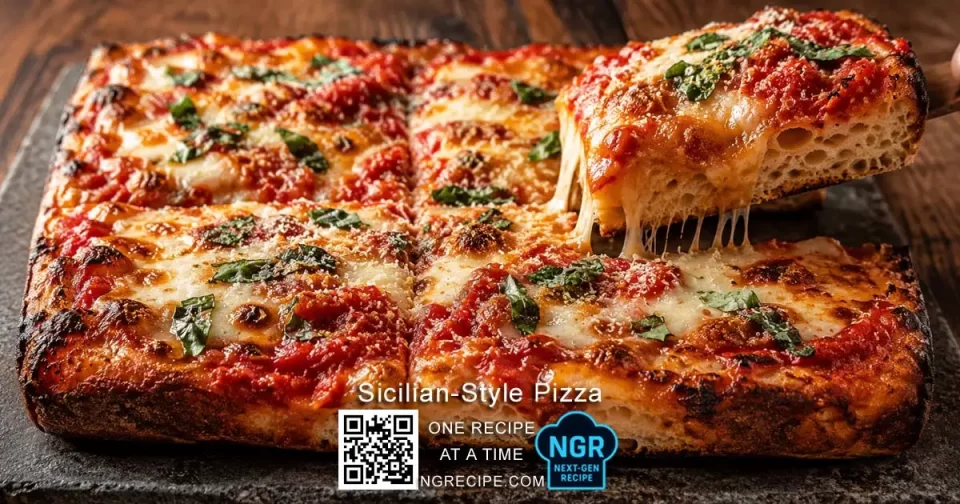
Sicilian-style pizza combines a tall, airy pan-baked crust with robust tomato sauce, melted mozzarella, sharp Pecorino Romano, and a delicate breadcrumb finish. Baked in a rectangular pan and cut into generous squares, it delivers crisp, olive-oil-fried edges, a tender interior, and the satisfying structure associated with classic Italian-American pizzeria slices.
Quick Recipe Card
What This Recipe Is
Sicilian-style pizza is a thick, rectangular pan pizza with a light, bread-like crumb and a crisp, well-browned base. This version reflects the Italian-American pizzeria tradition while retaining clear Sicilian influences through its tomato-forward character, olive oil, oregano, Pecorino Romano, and fine breadcrumb topping.
The dough is intentionally wetter than standard hand-tossed pizza dough. That higher hydration produces an open, tender interior rather than a dense, heavy crust. A generous coating of olive oil in the pan helps the bottom and edges fry gently as the pizza bakes.
Unlike thin round pizza, Sicilian-style pizza is shaped entirely in the baking pan. It is handled gently, allowed to proof until visibly aerated, partially baked, topped, and returned to the oven until the cheese bubbles and the underside becomes deeply golden.
Ingredients
- 400 ml lukewarm water at approximately 30°C (1⅔ cups)
- 4 g instant yeast (1¼ teaspoons)
- 8 g granulated sugar (2 teaspoons)
- 500 g bread flour (about 4 cups plus 2 tablespoons)
- 10 g fine sea salt (1¾ teaspoons)
- 60 ml extra-virgin olive oil, divided (¼ cup)
- 6 g garlic, finely chopped (2 cloves)
- 700 g crushed tomatoes (25 ounces)
- 5 g dried oregano (2 teaspoons)
- 6 g fine sea salt for the sauce (1 teaspoon)
- 1 g freshly ground black pepper (½ teaspoon)
- 4 g granulated sugar for the sauce (1 teaspoon)
- 340 g low-moisture whole-milk mozzarella, freshly shredded (12 ounces)
- 45 g Pecorino Romano, finely grated (1½ ounces or about ½ cup)
- 30 g fine dry breadcrumbs (¼ cup)
- 10 g fresh basil leaves, torn after baking (about ⅓ cup loosely packed)
Equipment
- Digital kitchen scale
- Large mixing bowl
- Flexible dough scraper or sturdy spatula
- 33 × 46 cm (13 × 18-inch) dark metal rimmed baking pan
- Small saucepan
- Wooden spoon or silicone spatula
- Box grater
- Measuring spoons
- Wire cooling rack
- Pizza wheel or large chef’s knife
- Thin metal spatula
Instructions
Step 1:
Pour the lukewarm water into a large mixing bowl. Add the instant yeast and 8 g granulated sugar, then stir until evenly dispersed.
Step 2:
Add the bread flour and 10 g fine sea salt. Mix with a dough scraper or sturdy spatula until no dry flour remains. The dough will be wet, sticky, and rough rather than firm.
Step 3:
Add 15 ml of the olive oil and fold the dough repeatedly until the oil is absorbed. Cover the bowl and let the dough rest for 20 minutes.
Step 4:
With damp hands, lift one side of the dough, stretch it gently, and fold it over the centre. Rotate the bowl and repeat from the remaining sides. Cover and rest for 15 minutes, then complete one more round of stretching and folding.
Step 5:
Cover the bowl and let the dough rise at warm room temperature for 75 to 90 minutes. It should become visibly puffy, aerated, and close to doubled in volume.
Step 6:
While the dough rises, heat 15 ml of the olive oil in a small saucepan over medium-low heat. Add the chopped garlic and cook for about 30 seconds, stirring continuously, until fragrant but not browned.
Step 7:
Add the crushed tomatoes, dried oregano, 6 g fine sea salt, black pepper, and 4 g granulated sugar. Bring the sauce to a gentle simmer and cook for 10 to 12 minutes, stirring occasionally, until slightly thickened. Remove it from the heat and let it cool.
Step 8:
Coat the bottom and sides of the baking pan with the remaining 30 ml olive oil. Transfer the risen dough to the pan and turn it once so both surfaces receive a light coating of oil.
Step 9:
Using oiled fingertips, gently press the dough towards the corners without tearing or forcing it. When the dough resists, stop, cover the pan, and let it relax for 15 minutes.
Step 10:
Press the relaxed dough again until it reaches the edges and corners of the pan. Cover loosely and let it proof for 45 to 60 minutes, until thick, soft, and visibly bubbly.
Step 11:
Position an oven rack in the lower third of the oven. Preheat the oven to 245°C (475°F) for at least 35 minutes so the oven and rack are thoroughly heated.
Step 12:
Gently dimple the proofed dough with oiled fingertips, taking care not to deflate it. Place the pan on the lower oven rack and bake the untopped crust for 7 to 8 minutes, until the surface is set but still pale.
Step 13:
Remove the pan from the oven. Spread the cooled tomato sauce evenly over the partially baked crust, leaving only a narrow border around the edges.
Step 14:
Distribute the shredded mozzarella evenly over the sauce. Sprinkle the Pecorino Romano over the mozzarella, followed by an even layer of fine breadcrumbs.
Step 15:
Return the pizza to the lower oven rack and bake for 15 to 18 minutes. The cheese should be bubbling, the edges should be deeply golden, and the underside should be crisp and well browned.
Step 16:
Transfer the pan to a wire rack and let the pizza rest for 10 minutes. Scatter the torn fresh basil over the surface.
Step 17:
Run a thin metal spatula around the edges to loosen the crust. Lift the pizza from the pan, cut it into 12 squares, and serve while the crust is warm and crisp.
Visual Cooking Cues
- Properly mixed dough looks sticky, glossy, and much softer than conventional pizza dough.
- After the first rise, the dough should contain visible bubbles beneath the surface.
- Fully proofed pan dough should look pillowy and slowly spring back when touched lightly.
- The par-baked crust should appear set and dry on top without developing significant colour.
- Properly reduced tomato sauce should spread easily without releasing watery liquid.
- Finished cheese should be fully melted with scattered golden patches.
- The outer crust should be deeply browned and slightly crisp where it meets the oiled pan.
- The underside should be uniformly golden rather than pale or floury.
- A properly baked interior should have an airy, irregular crumb without a gummy line beneath the sauce.
Chef Tips
- Weigh the flour and water whenever possible. Small measuring differences have a noticeable effect on high-hydration dough.
- Use bread flour for enough gluten strength to support the tall, airy crumb.
- Handle the dough with damp or oiled hands instead of adding extra flour.
- Give the dough time to relax before pressing it fully into the pan.
- Use a sturdy metal baking pan rather than glass or ceramic for better bottom browning.
- Preheat the oven completely before baking. A hot oven is essential for rapid expansion and a crisp base.
- Cool the sauce before placing it on the dough so it does not weaken the partially baked crust.
- Shred the mozzarella from a block. Pre-shredded cheese often melts less smoothly.
- Spread the toppings to the edges for the characteristic corner pieces with caramelised cheese and crisp crust.
- Rest the pizza briefly before cutting so the crumb and cheese can settle.
Common Mistakes
- Adding extra flour until the dough feels dry creates a dense, bready crust.
- Pressing aggressively into the pan can tear the dough and remove the gas developed during proofing.
- Skipping the relaxation period causes the dough to shrink away from the corners.
- Using watery tomato sauce can produce a soft or gummy layer beneath the toppings.
- Placing hot sauce on the dough can weaken the crust structure.
- Underproofing produces a tight crumb with limited height.
- Overproofing can make the dough fragile and prone to collapsing.
- Using fresh mozzarella without draining it thoroughly releases excess moisture.
- Baking on a high oven rack may brown the cheese before the bottom becomes crisp.
- Cutting immediately after baking can compress the crumb and pull the cheese from the surface.
Troubleshooting
- Dough feels unusually stiff: Check the flour measurement and work in a small amount of water with wet hands.
- Dough spreads like batter: Complete an additional round of stretching and folding, then allow more resting time.
- Dough keeps shrinking in the pan: Cover it and wait another 10 to 15 minutes before pressing again.
- Crust remains dense: Extend the proofing period until the dough is visibly puffy and aerated.
- Surface deflates during dimpling: Use lighter pressure and avoid pressing all the way through the dough.
- Sauce makes the pizza soggy: Simmer it longer and ensure the crust is properly set during the initial bake.
- Cheese releases excessive oil: Use low-moisture whole-milk mozzarella and avoid overbaking.
- Bottom remains pale: Bake on a lower rack in a fully preheated dark metal pan.
- Bottom browns too quickly: Move the pan one rack higher during the final minutes of baking.
- Pizza sticks to the pan: Loosen the edges while warm and use a thin metal spatula beneath the crust.
Ingredient Pairings
- Roasted bell peppers complement the sweet acidity of the tomato sauce.
- Fennel-seasoned sausage pairs naturally with oregano, garlic, and Pecorino Romano.
- Sautéed mushrooms contribute savoury depth without overpowering the crust.
- Black olives provide briny contrast to the rich cheese.
- A crisp green salad balances the pizza’s bread and dairy richness.
- Marinated vegetables add acidity and texture alongside the tender crumb.
- Sparkling water with citrus helps refresh the palate between bites.
- Light-bodied red wine or a dry Italian-style lager suits the tomato-forward flavour profile.
Substitutions
- Bread flour may be replaced with strong all-purpose flour, although the crust may be slightly less chewy and structured.
- Instant yeast may be replaced with active dry yeast. Dissolve it in the lukewarm water before mixing the dough.
- Low-moisture whole-milk mozzarella may be replaced with part-skim low-moisture mozzarella for a lighter finish.
- Pecorino Romano may be replaced with finely grated Parmesan for a milder, less salty flavour.
- Crushed tomatoes may be replaced with whole peeled tomatoes crushed by hand.
- Extra-virgin olive oil may be replaced with regular olive oil when a more neutral flavour is preferred.
- Fine dry breadcrumbs may be replaced with finely crushed plain bread crumbs dried in a low oven.
- Fresh basil may be omitted when unavailable, as dried oregano already provides the principal herb flavour.
Recipe Family Variations
- New York Sicilian Pizza
- Upside-Down Sicilian Pizza
- Palermo-Style Sfincione
Serving Suggestions
- Serve Sicilian-style pizza warm rather than piping hot so the cheese, sauce, and airy crumb remain distinct. Cut it into 12 squares for a main meal or into smaller pieces for parties and shared appetisers.
- Pair it with a simple green salad dressed with a sharp vinaigrette, roasted vegetables, marinated artichokes, or a light vegetable soup. For a pizzeria-style meal, offer crushed red pepper and additional grated Pecorino Romano at the table.
- Corner slices provide the crispest edges, while centre slices have the softest, most bread-like crumb. Serving a mixture of both allows guests to choose their preferred texture.
Dietary Classification
This recipe is vegetarian when the cheeses are produced with vegetarian-compatible enzymes.
It contains gluten and dairy. It does not contain eggs, meat, fish, shellfish, peanuts, or tree nuts as written.
The recipe is not vegan, dairy-free, gluten-free, low-carbohydrate, or suitable for a strict low-sodium diet without significant modification.
Nutrition Information
Approximate nutrition per serving:
- Calories: 500
- Protein: 20 g
- Carbohydrates: 56 g
- Fat: 21 g
- Saturated Fat: 8 g
- Fiber: 4 g
- Sugar: 6 g
- Sodium: 1,250 mg
Storage / Reheating
Let leftover pizza cool completely before storing it. Place the slices in an airtight container with parchment between stacked layers and refrigerate for up to 4 days.
For longer storage, freeze individual slices on a tray until firm, then transfer them to a freezer-safe container. Freeze for up to 2 months.
Reheat refrigerated slices in a 200°C (400°F) oven for 8 to 10 minutes. Place them directly on a heated baking tray or oven rack for the crispest base.
An air fryer may be used at 180°C (355°F) for approximately 4 to 6 minutes. Check early because the cheese and edges can brown quickly.
For stovetop reheating, place a slice in a covered skillet over medium-low heat. Heat until the base becomes crisp and the cheese is hot.
Avoid relying solely on a microwave, which softens the crust. When necessary, microwave briefly to warm the centre, then finish the slice in a dry skillet.
FAQ
Is Sicilian-style pizza the same as traditional Sicilian sfincione?
Not exactly. Traditional sfincione from Sicily commonly features a thick bread-like base with tomato, onion, aged cheese, breadcrumbs, and sometimes anchovies. Italian-American Sicilian-style pizza developed into a distinct pizzeria form that commonly uses mozzarella and a more familiar pizza-sauce profile.
Why is the dough so sticky?
The dough has a relatively high water content. This hydration allows steam to expand during baking, producing a lighter, more open crumb. Adding excessive flour would make the finished crust heavier.
Do I need to knead the dough by hand?
Traditional kneading is unnecessary. Resting and repeated stretching and folding build sufficient gluten while preserving the soft texture of the dough.
Why is the crust partially baked before topping?
The initial bake sets the dough’s upper surface and helps protect the airy crumb from the moisture in the tomato sauce. It is especially useful in a domestic oven.
Can I prepare the dough in advance?
Yes. After mixing and folding, cover the dough and refrigerate it for up to 24 hours. Let it stand at room temperature until flexible and visibly active before transferring it to the oiled pan.
Can I use fresh mozzarella?
Fresh mozzarella contains considerably more water. It may be used only after being sliced, thoroughly drained, and dried. Low-moisture mozzarella provides more predictable melting and browning.
Why did my pizza turn out dense?
The dough may have contained too much flour, received insufficient proofing time, or been pressed too aggressively in the pan. It should be visibly puffy before baking.
How do I know when the underside is done?
Lift one corner carefully with a thin metal spatula. The base should be evenly golden brown and firm enough to support the slice.
Can I bake this in a smaller pan?
Yes, but the crust will be thicker and may require additional baking time. Avoid placing all the dough in a pan so small that it cannot bake through before the toppings overbrown.
Why are breadcrumbs added to the top?
Breadcrumbs contribute a subtle dry crunch, absorb a small amount of surface moisture, and reflect the breadcrumb tradition associated with Sicilian sfincione.
Why This Recipe Works
The high-hydration dough creates enough internal steam to produce an open, tender crumb. Bread flour supplies the gluten strength needed to hold that gas without making the pizza excessively firm.
Stretching and folding develops the gluten gradually while keeping the dough manageable. Two proofing stages provide both flavour and sufficient aeration.
Olive oil serves several functions. It tenderises the dough, prevents sticking, adds flavour, and encourages the bottom and edges to fry gently against the hot metal pan.
Reducing the tomato sauce before assembly concentrates its flavour and removes excess water. Par-baking the crust adds a second layer of moisture protection.
Low-moisture mozzarella melts evenly without flooding the surface. Pecorino Romano adds saltiness and savoury depth, while the breadcrumbs create a light textural contrast.
Baking in the lower third of a thoroughly preheated oven directs strong heat towards the pan, helping the base become crisp before the cheese overcooks.
Recipe Identity
Sicilian-style pizza is a thick rectangular pan pizza recognised by its tall, aerated crust, crisp oil-browned base, tomato sauce, and cheese topping.
The Italian-American form is related to Sicily’s sfincione tradition but has its own established identity. Mozzarella is more prominent, the sauce is often smoother, and the finished pizza resembles the square slices associated with American pizzerias.
Its defining characteristics are the pan-shaped rectangular form, high-hydration dough, bread-like crumb, olive-oil-crisped exterior, and square-cut serving style.
Dish Classification
- Primary dish category: Pizza
- Structural category: Thick-crust pan pizza
- Culinary family: Italian-American pizza
- Regional influence: Sicily
- Primary grain component: Yeasted wheat dough
- Primary sauce component: Seasoned tomato sauce
- Primary dairy component: Mozzarella
- Secondary dairy component: Pecorino Romano
- Typical shape: Rectangular
- Typical cut: Square slices
- Meal role: Main course or substantial snack
- Serving temperature: Warm
- Preparation complexity: Intermediate
Recipe History
Sicilian-style pizza belongs to a culinary lineage connected to the thick, bread-like baked dishes of Sicily. Palermo’s sfincione is a particularly important relative, traditionally built on a soft rectangular base and finished with tomato, aged cheese, breadcrumbs, and other savoury ingredients.
As Sicilian immigrants established communities in the United States, thick pan-baked pizza evolved within Italian-American bakeries and pizzerias. The American form increasingly incorporated mozzarella and developed the recognisable square-slice presentation now commonly called Sicilian pizza.
The dish continued to adapt to commercial deck ovens, sheet pans, local cheese preferences, and the expectations of American pizza customers. It became especially associated with pizzerias in the northeastern United States.
Modern versions vary in dough thickness, cheese placement, sauce texture, and whether the crust is baked once or partially baked before topping. The central identity remains a generously risen rectangular pizza with a crisp base and tender interior.
Cultural Notes
In the United States, the word Sicilian often describes the pizza’s thick rectangular format rather than an exact reproduction of a single recipe from Sicily.
Traditional sfincione and Italian-American Sicilian pizza should be understood as closely related but distinct preparations. The former is commonly more bread-like and may feature onion, anchovy, aged cheese, and breadcrumbs without a heavy layer of mozzarella.
Sicilian-style pizza is often sold by the square and is valued for its contrast between crisp edges and a soft centre. Corner pieces are especially prized because they offer two deeply browned sides.
The dish is frequently prepared for family meals, community gatherings, parties, and pizzeria service because a single pan produces multiple substantial portions.
Culinary Context
Sicilian-style pizza sits between focaccia-like bread and fully topped pizza. Its dough receives more hydration and proofing than many thin-crust styles, giving it a soft internal structure capable of supporting generous toppings.
Within Italian-American pizza culture, it is distinct from thin New York-style pizza, shallow Grandma pizza, and cheese-edged Detroit-style pizza. Although these styles share rectangular pans or related baking techniques, each has its own dough structure, assembly method, and regional identity.
The recipe also demonstrates how immigrant food traditions evolve. Sicilian baking principles were adapted to American ingredients, ovens, businesses, and customer preferences without losing the defining relationship between bread, tomato, cheese, and olive oil.
Advanced Cooking Knowledge Open detailed cooking science and reference notes
Flavor, Texture, and Aroma Profile
The finished pizza has a savoury, tomato-forward flavour supported by garlic, oregano, olive oil, mozzarella, and sharp Pecorino Romano.
Its base is crisp and lightly fried, while the interior remains tender, springy, and aerated. The outer edges develop deeper caramelisation than the centre.
Mozzarella contributes creamy richness and gentle dairy sweetness. Pecorino Romano adds a sharper salty finish, and the breadcrumbs provide a faint toasted crunch.
The principal aromas are warm bread, roasted tomato, toasted cheese, garlic, oregano, olive oil, and fresh basil.
Flavor Balance
Tomato acidity balances the richness of the cheese and olive oil. A small amount of sugar rounds the sharper edges of the tomatoes without making the sauce noticeably sweet.
Mozzarella provides mild richness, while Pecorino Romano supplies concentrated saltiness and umami. Garlic and oregano add aromatic depth.
Breadcrumbs soften the perception of surface oil and contribute a dry toasted note. Fresh basil introduces a clean herbal finish after baking.
Flavor Components
- Savoury foundation: Bread flour, mozzarella, Pecorino Romano, and tomato
- Acidity: Crushed tomatoes
- Saltiness: Fine sea salt, mozzarella, and Pecorino Romano
- Mild sweetness: Tomatoes and small amounts of granulated sugar
- Herbal character: Oregano and basil
- Aromatic depth: Garlic and extra-virgin olive oil
- Toasted character: Baked crust, browned cheese, and breadcrumbs
- Richness: Olive oil and whole-milk mozzarella
Ingredient Notes
Bread flour gives the dough enough strength to hold a high proportion of water and rise without collapsing.
Lukewarm water activates the yeast efficiently without exposing it to damaging heat.
Instant yeast disperses directly into the water and flour mixture without requiring a separate activation stage.
Low-moisture whole-milk mozzarella offers reliable melting, moderate browning, and controlled moisture.
Pecorino Romano is sharper and saltier than mozzarella, so a relatively small quantity provides significant flavour.
Crushed tomatoes produce a consistent sauce texture while retaining enough body to remain distinct after baking.
Fine dry breadcrumbs create a more even finish than coarse crumbs and are less likely to form hard patches.
Ingredient Science
Hydrated wheat proteins form gluten as the dough rests and folds. This gluten network traps carbon dioxide produced by the yeast.
High hydration allows the dough to expand freely and promotes a more irregular crumb. It also creates steam during baking, contributing to internal lift.
Salt strengthens the gluten structure, regulates yeast activity, and improves flavour. Sugar supports browning and provides readily available food for early fermentation.
Olive oil coats some flour particles and softens the crumb. In the pan, it transfers heat efficiently and promotes crisp browning.
Reducing the tomato sauce evaporates water and concentrates soluble flavour compounds. Lower sauce moisture reduces the risk of a gummy crust.
Low-moisture mozzarella contains less free water than fresh mozzarella, allowing it to melt without saturating the pizza.
Ingredient Roles
- Water: Hydrates the flour and supports an open crumb
- Instant yeast: Produces fermentation gases and flavour
- Granulated sugar: Supports browning and balances tomato acidity
- Bread flour: Forms the structural gluten network
- Fine sea salt: Seasons and regulates fermentation
- Extra-virgin olive oil: Tenderises, flavours, lubricates, and crisps
- Garlic: Adds aromatic savouriness
- Crushed tomatoes: Form the acidic, umami-rich sauce
- Dried oregano: Provides concentrated herbal character
- Black pepper: Adds mild warmth and aromatic complexity
- Mozzarella: Supplies melt, stretch, richness, and protein
- Pecorino Romano: Contributes saltiness, umami, and sharpness
- Breadcrumbs: Add light crunch and absorb surface moisture
- Basil: Provides a fresh aromatic finish
Ingredient Classification
- Grain: Bread flour and breadcrumbs
- Leavening agent: Instant yeast
- Hydration component: Water
- Culinary fat: Extra-virgin olive oil
- Primary vegetable ingredient: Tomatoes
- Aromatic vegetable: Garlic
- Dried herb: Oregano
- Fresh herb: Basil
- Seasonings: Fine sea salt, black pepper, and granulated sugar
- Melting cheese: Low-moisture whole-milk mozzarella
- Hard grating cheese: Pecorino Romano
Preparation Techniques
The dough is mixed until fully hydrated rather than kneaded until firm. Resting allows the flour to absorb water and begins gluten development.
Stretching and folding strengthens the dough without adding flour or forcing the delicate structure.
The dough is shaped directly in an oiled pan. Intermittent resting allows the gluten to relax so the dough can reach the corners without tearing.
The tomato sauce is cooked separately and cooled before assembly.
The mozzarella is shredded for even distribution and predictable melting.
Cooking Techniques
The sauce is gently simmered to reduce moisture and concentrate flavour.
The dough undergoes an initial untopped bake to set its structure.
The pizza is assembled after the crust has partially baked.
The final bake melts the cheese, browns the crust, and crisps the oiled base.
Resting after baking allows the crumb and toppings to stabilise before cutting.
Heat Management
A fully preheated oven provides the immediate heat needed for strong oven spring and bottom browning.
The lower oven rack directs more heat towards the metal pan and crust.
The sauce is simmered over moderate heat to prevent scorching and excessive splattering.
Garlic is cooked briefly over medium-low heat because browned garlic can become bitter.
The pizza should be moved higher only when the base is browning faster than the cheese.
Texture Development
Gluten development creates elasticity and allows the dough to retain fermentation gas.
The first rise builds internal aeration, while the final pan proof establishes the pizza’s height.
Olive oil in the pan produces a crisp exterior through direct contact with the hot metal.
Par-baking firms the upper crust before moisture-rich toppings are added.
The final rest protects the crumb from compression and helps the cheese remain attached when sliced.
Cooking Time Control
Fermentation should be judged by dough volume and aeration rather than time alone. Cooler kitchens require longer proofing, while warm kitchens accelerate yeast activity.
The sauce is ready when it has thickened slightly and no longer looks watery around the edges.
The par-bake should stop when the top is set but still pale.
The final bake is complete when the edges are deeply golden, the cheese bubbles actively, and the underside is crisp.
Dark pans may brown the base faster than light-coloured pans, so visual checks are more reliable than a fixed baking time.
Flavor Pairing Logic
Tomato, garlic, and oregano create the familiar savoury foundation associated with Italian-American pizza.
Mozzarella moderates tomato acidity with mild dairy richness. Pecorino Romano adds concentrated saltiness and fermented complexity.
Olive oil connects the bread and sauce components while strengthening the dish’s aroma.
Basil is added after baking because its fresh, delicate aroma contrasts with the deeper roasted flavours.
Breadcrumbs pair naturally with tomato and aged cheese while contributing a texture associated with Sicilian baking traditions.
Leftover Ideas
- Reheat individual squares for a quick lunch.
- Cut reheated slices into smaller pieces for a shared snack platter.
- Serve warm leftover pizza with a fresh salad for a balanced meal.
- Reheat crisp squares and top them with a lightly dressed herb salad.
- Use smaller reheated pieces as part of an appetiser spread.
- Pack chilled slices for travel when refrigeration can be maintained safely.
Cooking Safety Notes
Keep dairy ingredients refrigerated until needed.
Wash hands, utensils, and work surfaces before preparing the dough and toppings.
Do not taste raw flour or uncooked dough.
Use oven gloves when moving the hot, oil-coated metal pan.
Keep the pan level when transferring it because hot oil may collect around the crust.
Let the pizza rest before removing it from the pan to reduce the risk of burns from hot cheese and sauce.
Refrigerate leftovers within 2 hours of baking.
Reheat stored pizza until it is steaming hot throughout.
Sustainability Notes
Measure ingredients carefully to reduce excess dough, sauce, and cheese waste.
Buy mozzarella in block form when possible, as it often uses less processing and packaging than individually portioned products.
Use leftover bread to prepare homemade dry breadcrumbs.
Freeze excess grated cheese and unused tomato products in labelled portions.
Reheat only the number of slices needed rather than warming the entire remaining pizza repeatedly.
Use reusable containers for refrigerated and frozen leftovers.
Recipe Classification
Primary dish type: Pizza
Parent family: Pan Pizza
Subfamily: Sicilian-Style Pizza
Specific recipe identity: Sicilian-Style Pizza
Cuisine: Italian-American
Country: United States
Meal role: Main Course
Primary protein: Mozzarella
Primary dairy: Mozzarella
Bread component: High-Hydration Bread-Flour Pan Crust
Fresh components: Basil
Condiment profile: Tomato, Garlic, Oregano, And Olive Oil
Cooking methods: Mixing, Stretch-and-Folding, Proofing, Baking, Assembling
Serving style: Rectangular Pizza Cut Into Squares
Difficulty level: Intermediate
Occasions: Family Dinner, Game Day, Casual Gathering, Weekend Cooking
