Grandma Pizza
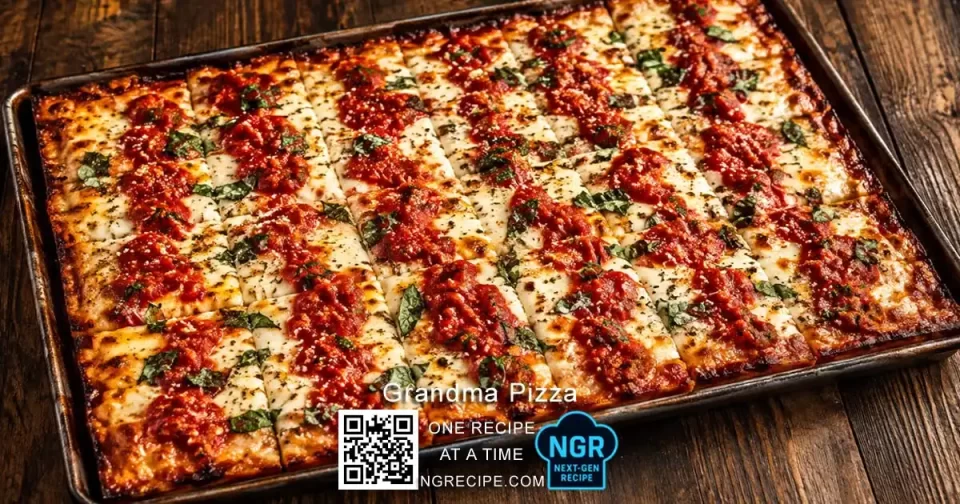
Grandma Pizza is a thin, crisp-edged Italian-American pan pizza topped with whole-milk mozzarella, garlicky crushed tomatoes, Pecorino Romano, oregano, and fresh basil. Baked in a generously oiled rectangular pan, it combines a crunchy, almost fried underside with a light, tender interior and distinctive patches of cheese and tomato.
Quick Recipe Card
What This Recipe Is
Grandma Pizza is a rectangular Italian-American pizza strongly associated with Long Island and the wider New York metropolitan area. It is baked in a rimmed, olive-oil-coated pan and is generally thinner and less bread-like than traditional Sicilian pizza.
The dough is stretched directly in the pan rather than shaped into a round. Whole-milk low-moisture mozzarella is scattered over the dough before the tomato mixture is added in spoonfuls or irregular stripes. This cheese-first arrangement helps protect the crust from excess moisture while creating the characteristic red-and-white surface.
A well-made Grandma Pizza should have a crisp, deeply browned bottom, lacy caramelised cheese around parts of the edge, a tender but not overly thick crumb, and a bright tomato flavour supported by garlic, oregano, Pecorino Romano, and olive oil.
Ingredients
- 350 g lukewarm water (1 1/2 cups)
- 4 g instant yeast (1 1/4 teaspoons)
- 500 g bread flour (about 4 cups plus 2 tablespoons)
- 14 g fine sea salt (about 2 1/2 teaspoons), divided
- 75 g extra-virgin olive oil (5 1/2 tablespoons), divided
- 400 g crushed tomatoes (14 ounces)
- 8 g garlic (2 medium cloves), finely grated or minced
- 2 g dried oregano (2 teaspoons)
- 1 g freshly ground black pepper (1/2 teaspoon)
- 340 g whole-milk low-moisture mozzarella (12 ounces), shredded or thinly sliced
- 40 g Pecorino Romano (about 1/2 cup), finely grated
- 10 g fresh basil leaves (about 1/2 loosely packed cup), torn
Equipment
- Digital kitchen scale
- Large mixing bowl
- Flexible dough scraper or sturdy spoon
- Airtight container or covered bowl
- 33 × 46 cm (13 × 18-inch) rimmed metal baking pan
- Small mixing bowl
- Fine grater or microplane
- Measuring spoons
- Offset spatula or thin metal spatula
- Oven gloves
- Pizza wheel or large chef’s knife
- Wire cooling rack
Instructions
Step 1:
Pour the lukewarm water into a large mixing bowl and stir in the instant yeast. Add the bread flour and mix until no dry flour remains. Cover the bowl and leave the rough dough to rest for 15 minutes.
Step 2:
Add 10 g of the fine sea salt and 25 g of the extra-virgin olive oil. Knead the dough in the bowl or on a clean work surface for 5–7 minutes, until it becomes smoother, elastic, and slightly tacky. Avoid adding extra flour unless the dough is genuinely wet rather than simply sticky.
Step 3:
Shape the dough into a ball and place it in a lightly covered container. Refrigerate for 18–24 hours. During this cold fermentation, the dough should expand, develop small bubbles, and gain a fuller wheat flavour.
Step 4:
Remove the dough from the refrigerator about 2 hours before baking. Leave it covered at room temperature for 45–60 minutes so it can relax and lose its chill.
Step 5:
Press the dough gently towards the edges without tearing it. When it begins to spring back, stop and leave it uncovered for 15–20 minutes. Stretch it again until it reaches the corners. Cover loosely and leave it to proof for 60–90 minutes, until relaxed, slightly puffy, and visibly aerated.
Step 6:
Combine the crushed tomatoes, garlic, dried oregano, black pepper, the remaining 4 g fine sea salt, and 10 g of the extra-virgin olive oil in a small bowl. Stir gently without blending so the tomatoes retain some texture.
Step 7:
Place an oven rack in the lower third of the oven. Preheat the oven to 260°C (500°F), or the highest temperature available up to that point, for at least 45 minutes. A thoroughly heated oven is essential for a crisp bottom crust.
Step 8:
Distribute the whole-milk low-moisture mozzarella evenly across the dough, extending close to the edges. Spoon the tomato mixture over the cheese in irregular stripes and patches, leaving some mozzarella visible.
Sprinkle the Pecorino Romano over the surface and drizzle with the remaining 5 g extra-virgin olive oil.
Step 9:
Bake on the lower oven rack for 15 minutes. Rotate the pan, then continue baking for 3–7 minutes, until the underside is deeply golden, the edges are crisp, the mozzarella is bubbling, and the tomato patches have thickened slightly.
Step 10:
Slide the pizza onto a wire rack so the bottom remains crisp. Scatter the torn fresh basil over the surface, cut into squares, and serve while hot.
Visual Cooking Cues
- Properly mixed dough looks rough at first but contains no pockets of dry flour.
- Properly kneaded dough feels elastic, smooth in places, and slightly tacky rather than liquid or paste-like.
- Cold-fermented dough shows visible bubbles along the sides and expands noticeably without necessarily doubling.
- Relaxed dough stretches towards the pan corners without repeatedly shrinking back.
- Fully proofed dough appears softly inflated with scattered bubbles beneath the surface.
- Properly assembled pizza has an uneven red-and-white appearance rather than a completely covered layer of sauce.
- The outer crust becomes deep golden brown and may develop small caramelised cheese patches.
- The finished underside should be crisp, evenly browned, and firm enough to support a slice.
- Properly baked tomato patches appear darker, thicker, and less watery than before baking.
- The interior crumb should be light and tender with small to medium air pockets, not dense or cake-like.
Chef Tips
- Weigh the flour and water whenever possible. Small measurement differences can noticeably change the dough texture.
- Use a light-coloured aluminium pan for predictable browning. Very dark pans can burn the bottom before the top finishes.
- Give the dough time to relax instead of forcing it into the corners. Resting prevents tearing and preserves internal air.
- Use whole-milk low-moisture mozzarella rather than fresh mozzarella. Its lower moisture content supports a crisper crust.
- Place the cheese beneath the tomato mixture to limit moisture penetration and create the classic Grandma Pizza appearance.
- Preheat the oven fully. A hot oven sets the underside quickly and reduces the chance of a pale, soft crust.
- Check the underside with a thin spatula before removing the pizza. Surface colour alone does not confirm that the base is crisp.
- Transfer the finished pizza to a wire rack instead of leaving it in the hot pan, where trapped steam can soften the bottom.
- Tear the basil immediately before serving to preserve its aroma and prevent darkened edges.
- For cleaner squares, allow the pizza to settle for several minutes before cutting.
Common Mistakes
- Adding excessive flour because the dough feels tacky during the first few minutes of mixing.
- Using cold dough before it has had enough time to relax.
- Forcing resistant dough into the corners and tearing its gluten structure.
- Applying an overly thick tomato layer that makes the centre wet.
- Using watery fresh mozzarella without draining it thoroughly.
- Skipping the long oven preheat.
- Baking on a high oven rack, which can brown the cheese before the underside becomes crisp.
- Removing the pizza as soon as the cheese melts, before the crust has fully browned.
- Leaving the baked pizza in the pan for too long.
- Cutting immediately and compressing the hot, delicate crumb.
Troubleshooting
- Dough will not stretch: Leave it covered for another 15–20 minutes so the gluten can relax, then stretch again gently.
- Dough tears during stretching: Pinch the torn area together, rest the dough briefly, and continue with lighter pressure.
- Dough seems excessively wet: Continue kneading and folding before adding flour. Bread flour absorbs water gradually.
- Dough is dense after fermentation: The yeast may have been inactive, the room may have been cold, or the fermentation may have been too short.
- Pizza sticks to the pan: Use the full amount of oil, coat the corners thoroughly, and loosen the crust while it is still warm.
- Bottom remains pale: Bake lower in the oven, extend the oven preheat, or use a conductive metal pan.
- Bottom burns before the top is ready: Move the pan one rack higher or reduce the temperature slightly during the final minutes.
- Centre is soft or soggy: Use less tomato mixture, avoid high-moisture cheese, and bake until the underside is well browned.
- Cheese releases excessive oil: Use good-quality whole-milk low-moisture mozzarella and avoid overbaking after full browning.
- Crust becomes soft after baking: Transfer the pizza to a wire rack promptly instead of cooling it in the pan.
- Tomato flavour tastes flat: Confirm that the measured salt, garlic, oregano, Pecorino Romano, and finishing olive oil were distributed evenly.
- Crust is tough: Avoid adding unnecessary flour, over-kneading, or baking long after the underside has browned.
Ingredient Pairings
- Bread flour pairs with long fermentation to produce a crust that is both extensible and strong.
- Extra-virgin olive oil complements the wheat flavour while creating a crisp, savoury underside.
- Whole-milk mozzarella provides creamy richness that softens the acidity of the tomatoes.
- Crushed tomatoes pair naturally with garlic and oregano for a direct Italian-American flavour profile.
- Pecorino Romano adds saltiness and sharpness that contrast with the mild mozzarella.
- Black pepper reinforces the savoury character of the cheese and tomato.
- Fresh basil contributes a fresh herbal aroma that lifts the rich baked toppings.
- A lightly dressed bitter-leaf salad balances the pizza’s cheese and olive oil.
- Roasted vegetables complement the crisp crust without competing with the tomato flavour.
- Sparkling water with citrus provides a refreshing contrast to the salty cheese.
Substitutions
- Bread flour may be replaced with strong all-purpose flour, although the crust may be slightly softer and less chewy.
- Instant yeast may be replaced with an equal weight of active dry yeast. Dissolve active dry yeast in the water for 5–10 minutes before mixing.
- Whole-milk low-moisture mozzarella may be replaced with part-skim low-moisture mozzarella for a lighter but less richly browned topping.
- Crushed tomatoes may be replaced with well-crushed whole peeled tomatoes after excess liquid has been drained.
- Pecorino Romano may be replaced with finely grated Parmesan for a milder, less salty finish.
- Fresh basil may be omitted when unavailable, although the finished aroma will be less fresh.
- Fine sea salt may be replaced by another non-iodised salt by weight rather than by volume.
- Up to 150 g of the bread flour may be replaced with whole-wheat flour, but the dough may require an additional 10–20 g of water.
- A neutral high-heat oil may replace part of the pan oil, although extra-virgin olive oil provides more characteristic flavour.
Recipe Family Variations
- Sourdough Grandma Pizza
- No-Knead Grandma Pizza
- Whole-Wheat Grandma Pizza
Serving Suggestions
- Serve Grandma Pizza hot or warm, cut into square or rectangular portions. Two medium squares generally make a satisfying main-course serving, while smaller squares work well as an appetiser or party snack.
- Pair it with a crisp green salad, a fennel salad, roasted peppers, marinated vegetables, or a light vegetable soup. The pizza also suits casual family meals, game-day gatherings, picnics, and buffet-style entertaining.
- For a pizzeria-style presentation, place the cut squares on a warm metal tray or wooden serving board while keeping them in a single layer. Avoid stacking hot pieces because trapped steam will soften the crust.
Dietary Classification
This Grandma Pizza is vegetarian because it contains no meat, poultry, fish, or seafood.
It is naturally egg-free and nut-free as written. It contains gluten from bread flour and dairy from mozzarella and Pecorino Romano.
The recipe is not suitable for a vegan diet without replacing both cheeses. It is not suitable for a gluten-free diet unless the dough is reformulated with a tested gluten-free pizza flour system.
People with severe allergies should verify the manufacturing and handling information for the flour, yeast, cheese, tomatoes, and seasonings because cross-contact can occur during processing.
Nutrition Information
Approximate nutrition per serving:
- Calories: 470
- Protein: 18 g
- Carbohydrates: 51 g
- Fat: 21 g
- Saturated Fat: 7 g
- Fiber: 3 g
- Sugar: 4 g
- Sodium: 930 mg
Storage / Reheating
Allow leftover pizza to cool to room temperature, but do not leave it unrefrigerated for more than 2 hours. Place the squares in a shallow airtight container with baking paper between layers.
Refrigerate for up to 4 days. For longer storage, freeze individual squares on a tray until firm, then transfer them to a freezer-safe container or bag. Freeze for up to 2 months.
For the best reheated texture, place refrigerated slices in a dry covered frying pan over medium-low heat for 3–5 minutes. Uncover for the final minute so the underside becomes crisp while the cheese heats through.
To reheat in the oven, place the pizza directly on a rack or preheated tray at 200°C (400°F) for 6–10 minutes. Frozen pieces may be reheated without thawing at 190°C (375°F) for approximately 12–16 minutes.
An air fryer may be used at 180°C (350°F) for 3–5 minutes for refrigerated pieces. Avoid overheating, which can toughen the crust and separate the cheese.
Microwaving is convenient but produces a softer crust. When necessary, microwave briefly and then crisp the slice in a dry frying pan.
Do not repeatedly cool and reheat the same portion.
FAQ
What makes Grandma Pizza different from Sicilian pizza?
Grandma Pizza is generally thinner, crisper, and less bread-like than Sicilian pizza. Its dough is pressed into an oiled rectangular pan with a relatively modest final rise, while Sicilian pizza commonly has a thicker, more focaccia-like crumb. Grandma Pizza also often places mozzarella beneath irregular spoonfuls or stripes of tomato.
Why is the cheese placed under the tomato mixture?
The cheese creates a partial moisture barrier between the tomato and the dough. This helps the crust remain crisp and produces the characteristic patchwork surface of red tomato and pale melted mozzarella.
Does Grandma Pizza need an overnight fermentation?
An overnight cold fermentation is not the only possible method, but it improves flavour, dough strength, browning, and extensibility. It also makes the finished crumb more aromatic and less one-dimensional.
Can I make the dough and bake it on the same day?
Yes. Increase the instant yeast to about 7 g and let the mixed dough rise at room temperature until doubled, usually 1–2 hours. Stretch it in the oiled pan, proof it again, and bake as directed. The crust will be good but usually less complex in flavour.
Why does my dough keep shrinking in the pan?
Shrinking means the gluten is still tense. Stop stretching, cover the dough, and let it rest for 15–20 minutes. It should then extend more easily without tearing or springing back.
Can I use fresh mozzarella?
Fresh mozzarella contains substantially more moisture than low-moisture mozzarella. It can be used only after thorough draining and drying, but even then the centre may be softer. Low-moisture whole-milk mozzarella is more dependable for the classic texture.
How do I know when the bottom is properly baked?
Lift one corner with a thin metal spatula. The underside should be evenly deep golden brown with crisp, fried-looking areas and no pale, doughy centre.
Why did my pizza stick to the pan?
Sticking usually results from insufficient oil, an unevenly coated pan, damaged pan surfaces, or trying to remove the pizza before the crust has set. Use a generous, even oil layer and loosen the pizza while it is still warm.
Can I bake Grandma Pizza in a smaller pan?
Yes, but the crust will be thicker. Divide the dough between two smaller pans for a similar thickness, or use the full batch in a smaller pan for a more substantial, bread-like result.
Can the dough ferment longer than 24 hours?
The dough may ferment for up to about 48 hours when kept consistently cold. Reduce the yeast slightly for a longer fermentation and watch for excessive expansion, collapse, or a strong fermented aroma.
Why is my finished crust dense?
A dense crust can result from inactive yeast, insufficient fermentation, forcing out too much gas during stretching, using excessive flour, or baking before the dough has completed its pan proof.
Should Grandma Pizza be served immediately?
It is best after a brief 3–5-minute rest. This allows the cheese and tomato to settle while preserving the crisp crust. It remains enjoyable warm or at room temperature but gradually loses crispness as it sits.
Why This Recipe Works
A moderately hydrated bread-flour dough creates enough gluten strength to trap fermentation gases while remaining soft enough to stretch across a rectangular pan. The overnight cold fermentation allows enzymes to develop flavour, improve browning, and make the dough easier to digest and handle.
Olive oil in the dough tenderises the crumb, while the larger quantity beneath the dough promotes direct contact frying. This produces the defining crisp, richly browned underside without making the interior dry.
The pan proof gives the dough enough time to recover from stretching and develop a light structure, but it does not create the very thick crumb associated with some Sicilian pizzas.
Placing low-moisture mozzarella directly over the dough reduces the amount of tomato liquid reaching the crust. The tomato mixture remains concentrated in separate patches, preserving both visual contrast and textural variation.
Garlic, oregano, black pepper, Pecorino Romano, and olive oil season the tomatoes without turning them into a heavily cooked sauce. Baking the mixture directly on the pizza preserves a brighter, fresher tomato character.
The lower oven position delivers strong heat to the pan and promotes bottom browning. Moving the pizza to a wire rack after baking prevents steam from becoming trapped underneath, maintaining the crust’s crispness.
Recipe Identity
Grandma Pizza is a rectangular, pan-baked Italian-American pizza with a relatively thin, crisp crust, a tender interior, low-moisture mozzarella, irregular tomato coverage, grated hard cheese, herbs, and olive oil.
Its defining identity comes from the combination of an olive-oiled sheet pan, modest crust thickness, cheese-first assembly, patchy tomato application, and square-cut serving format.
It is neither a standard round New York slice nor simply another name for thick Sicilian pizza. The distinctions lie in the dough depth, pan treatment, topping order, crumb structure, and final texture.
Dish Classification
Grandma Pizza belongs to the broad pizza family and the more specific category of rectangular Italian-American pan pizzas.
It functions primarily as a main course but may also be served in smaller portions as an appetiser, snack, party food, or buffet item.
Its core structural components are a fermented wheat dough, olive oil, tomato, melting cheese, aged grating cheese, and aromatic herbs. Its principal cooking process is high-temperature baking in a rimmed metal pan.
The dish is classified as vegetarian, yeast-leavened, oven-baked, savoury, cheese-based, tomato-based, and suitable for square-cut service.
Recipe History
Grandma Pizza developed within Italian-American food culture in the New York metropolitan region and became especially associated with Long Island pizzerias during the later twentieth century.
Its name reflects the idea of a simple home-style pizza made by Italian-American grandmothers using ordinary kitchen pans rather than specialised commercial pizza equipment. These home pizzas often relied on stretched yeast dough, canned tomatoes, cheese, olive oil, garlic, and dried herbs.
As pizzerias adopted and formalised the style, Grandma Pizza developed a recognisable commercial identity. The crust remained thinner than a typical Sicilian slice, while the rectangular shape, crisp pan-fried base, and irregular tomato-over-cheese pattern became defining features.
The dish continues to represent the exchange between domestic Italian-American cooking and New York pizzeria culture.
Cultural Notes
Grandma Pizza is valued for its home-style appearance. Its irregular tomato patches, browned edges, and square cuts are part of its identity rather than signs that it should resemble a perfectly uniform round pizza.
The term “grandma” expresses familiarity and domestic tradition, but it does not describe one single inherited recipe. Families and pizzerias may differ in hydration, fermentation time, cheese placement, tomato texture, crust thickness, and seasoning.
Long Island remains central to the style’s cultural identity, although Grandma Pizza is now prepared in pizzerias and home kitchens far beyond New York.
Confusion with Sicilian pizza is common because both are rectangular and pan-baked. In everyday pizzeria use, however, Grandma Pizza is generally understood as the thinner, crisper, less heavily proofed style.
Culinary Context
Grandma Pizza occupies a middle ground between a crisp New York slice and a thicker Sicilian pan pizza. It uses the convenience of a sheet pan while retaining a relatively light profile and firm underside.
The method is well suited to home ovens because the metal pan conducts heat directly into the dough. This compensates for the lower thermal intensity of a domestic oven compared with a professional deck oven.
Its topping order differs from many familiar pizzas. Cheese is distributed first, followed by irregular tomato coverage. The result includes bites that are more cheese-forward, bites that are more tomato-forward, and crisp edge pieces with concentrated caramelisation.
The dish demonstrates how pan material, oil quantity, fermentation, topping moisture, oven position, and cooling method work together to determine pizza texture.
Advanced Cooking Knowledge Open detailed cooking science and reference notes
Flavor, Texture, and Aroma Profile
Grandma Pizza has a savoury, tangy, dairy-rich flavour with pronounced olive oil, toasted wheat, garlic, oregano, aged cheese, and fresh basil notes.
The underside is crisp and richly browned, with a lightly fried quality produced by the oiled pan. The interior is tender and moderately airy rather than thick or bready. The outer edges may be crunchy, chewy, and caramelised where cheese meets the pan.
The mozzarella is milky and mellow, while Pecorino Romano contributes sharper saltiness. The tomatoes provide acidity and gentle sweetness, and the garlic gives the topping a warm aromatic intensity.
Fresh basil adds a clean, peppery herbal aroma after baking. The overall flavour remains direct and balanced rather than heavily sauced or overloaded.
Flavor Balance
The tomatoes provide acidity that cuts through the richness of the mozzarella and olive oil.
Mozzarella softens the tomato’s sharper edges and contributes creamy body without overwhelming the crust.
Pecorino Romano supplies concentrated saltiness and savoury depth, so the tomato mixture requires only controlled additional salt.
Olive oil carries the aromas of garlic, oregano, pepper, basil, and toasted wheat while also adding gentle fruitiness.
The long-fermented dough contributes mild sweetness and nutty baked flavours that balance the assertive toppings.
Flavor Components
- Savoury foundation: Bread flour, fermented dough, mozzarella, and Pecorino Romano
- Acidity: Crushed tomatoes
- Richness: Whole-milk mozzarella and extra-virgin olive oil
- Saltiness: Fine sea salt, mozzarella, and Pecorino Romano
- Aromatic heat: Garlic and black pepper
- Herbal character: Dried oregano and fresh basil
- Toasted notes: Deeply browned crust and caramelised cheese
- Mild sweetness: Ripe tomatoes and fermented wheat
- Freshness: Basil added after baking
Ingredient Notes
Bread flour provides the protein needed for a dough that can stretch across a large pan while retaining fermentation gases. Flour absorption varies, so the dough may feel slightly different between brands.
Lukewarm water supports initial yeast activity without overheating the dough. Water that feels hot can weaken or kill yeast.
Instant yeast may be mixed directly with the flour or water. The small quantity is appropriate for a long cold fermentation.
Fine sea salt strengthens gluten, regulates fermentation, and seasons the crust. Measuring it by weight improves consistency.
Extra-virgin olive oil is used in the dough, under the dough, in the tomato mixture, and as a finishing drizzle. Each use contributes differently to tenderness, crispness, aroma, and flavour.
Crushed tomatoes should taste bright and clean. Extremely watery tomatoes may be drained briefly before seasoning.
Whole-milk low-moisture mozzarella offers dependable melting, browning, and moisture control. Pre-shredded cheese may melt less smoothly because of anti-caking starches.
Pecorino Romano is sharper and saltier than mozzarella. A fine grate distributes it evenly without creating heavy patches.
Dried oregano withstands baking and provides the familiar pizzeria-style herbal note. Fresh basil is added after baking because its aroma is more delicate.
Ingredient Science
Bread flour contains gluten-forming proteins that link together when hydrated and mixed. This network traps carbon dioxide produced by the yeast and gives the dough extensibility.
The initial flour-and-water rest begins hydration before the salt and oil are fully incorporated. This makes kneading easier and reduces the amount of mechanical mixing required.
Salt strengthens the gluten network and moderates yeast activity. Without enough salt, the dough may ferment too quickly and taste flat.
Olive oil coats portions of the flour proteins and limits excessive toughness. In the pan, oil improves heat transfer and encourages frying at the dough’s surface.
Cold fermentation slows yeast activity while allowing enzymes to continue breaking down starches and proteins. The resulting sugars support browning, while the breakdown products contribute aroma and flavour.
Low-moisture mozzarella contains less free water than fresh mozzarella. This limits steam and surface liquid during baking.
Tomato acidity balances dairy fat, while the pectin and solids in crushed tomatoes thicken as water evaporates in the oven.
Moving the pizza to a wire rack allows moisture to escape from the underside. Leaving it in the pan traps steam and reverses some of the crisping achieved during baking.
Ingredient Roles
- Water: Hydrates flour and allows gluten development
- Instant yeast: Produces carbon dioxide and fermentation aromas
- Bread flour: Forms the structural base of the crust
- Fine sea salt: Seasons the dough, strengthens gluten, and controls fermentation
- Extra-virgin olive oil: Tenderises the crumb, fries the underside, and carries aroma
- Crushed tomatoes: Provide acidity, moisture, colour, and tomato flavour
- Garlic: Adds pungent savoury aroma
- Dried oregano: Contributes a stable pizzeria-style herbal note
- Black pepper: Adds mild aromatic heat
- Whole-milk low-moisture mozzarella: Provides melting, richness, browning, and moisture protection
- Pecorino Romano: Adds concentrated saltiness and aged-cheese depth
- Fresh basil: Adds fresh herbal aroma and colour after baking
Ingredient Classification
- Grain ingredient: Bread flour
- Hydration ingredient: Water
- Leavening ingredient: Instant yeast
- Seasoning ingredient: Fine sea salt
- Culinary fat: Extra-virgin olive oil
- Fruit-based topping: Crushed tomatoes
- Allium: Garlic
- Dried herb: Dried oregano
- Spice: Black pepper
- Melting dairy: Whole-milk low-moisture mozzarella
- Aged grating dairy: Pecorino Romano
- Fresh herb: Fresh basil
Preparation Techniques
The dough is mixed until fully hydrated, rested briefly, and then kneaded until elastic. This staged process allows flour hydration to begin before intensive gluten development.
Cold fermentation develops flavour while slowing the rise. The dough is then warmed gradually so it can stretch without tearing.
Pan stretching is completed in stages. Resting between stretches prevents the gluten from pulling the dough back towards the centre.
The tomato mixture is stirred rather than blended. Preserving some tomato texture prevents the topping from becoming an overly smooth sauce.
The cheese-first assembly creates a moisture barrier and the characteristic Grandma Pizza surface.
The finished pizza is loosened while warm and transferred to a rack to preserve crispness.
Cooking Techniques
High-temperature pan baking is the primary cooking technique. The metal pan transfers oven heat directly to the olive oil and dough, producing strong bottom browning.
The lower oven position increases the intensity of heat reaching the pan. Rotation compensates for uneven domestic oven hot spots.
The crust undergoes simultaneous baking and shallow frying where the dough contacts the oil-coated pan.
The cheese melts and browns while the exposed tomato mixture reduces and concentrates.
Carryover heat continues to firm the crust and topping during the brief post-baking rest.
Heat Management
Preheat the oven for at least 45 minutes so the walls, racks, and surrounding air store sufficient thermal energy.
Bake in the lower third to prioritise the bottom crust. A higher position may melt and brown the cheese too quickly.
Use a metal pan rather than glass. Metal responds quickly and conducts heat more efficiently into the dough.
Rotate the pan after approximately 15 minutes because many home ovens heat unevenly from front to back.
If the bottom is browning too quickly, move the pan higher for the final minutes. If it remains pale, continue baking lower in the oven.
Avoid opening the oven repeatedly. Each opening releases stored heat and can prolong baking.
Texture Development
Gluten development gives the dough enough strength to hold gas while remaining extensible.
Cold fermentation introduces small and medium air pockets throughout the dough.
The pan proof expands those pockets and creates a tender interior.
Olive oil within the dough limits toughness, while oil beneath the dough creates surface crispness.
The cheese layer reduces direct tomato moisture absorption.
High heat rapidly sets the outer dough structure before excessive moisture can migrate into the base.
Cooling on a rack prevents steam from softening the finished crust.
Cooking Time Control
The stated baking time is a guide rather than the only indicator of doneness. Pan colour, oven calibration, rack position, dough temperature, and topping moisture can alter the required time.
Begin checking the pizza after 15 minutes. Rotate the pan and inspect the edge colour.
Check the underside after approximately 18 minutes. Continue baking when the centre remains pale or flexible.
Remove the pizza when the bottom is deeply golden, the outer edge is crisp, the cheese is actively bubbling, and the tomato patches are visibly concentrated.
Do not extend baking solely to achieve very dark cheese if the crust is already finished.
Flavor Pairing Logic
Tomato and aged cheese create a balance of acidity, saltiness, and savoury depth.
Mild mozzarella supplies richness without competing with the tomato.
Garlic strengthens the savoury tomato profile, while oregano gives it a recognisable Italian-American aromatic character.
Black pepper provides warmth without turning the pizza distinctly spicy.
Fresh basil is added after baking to contrast with the deeper cooked flavours.
Olive oil links the crust, tomato, cheese, herbs, and garlic through a shared aromatic fat.
Leftover Ideas
Reheat leftover squares and serve them with a crisp salad for a quick lunch.
Cut cold pizza into smaller pieces and reheat them as appetiser-sized bites.
Warm individual squares in a covered frying pan and serve with roasted vegetables.
Cut reheated crust edges into strips for dipping into a warm tomato-based soup.
Pack fully chilled pieces for a picnic in an insulated container with appropriate cold storage.
Avoid repurposing leftovers that have remained at room temperature for more than 2 hours.
Cooking Safety Notes
Wash hands and clean surfaces before preparing the dough and toppings.
Do not taste raw dough because uncooked flour may contain harmful microorganisms.
Keep cheese refrigerated until needed and return unused portions promptly.
Use oven gloves when handling the hot metal pan. The pan, oil, and exposed handles remain hot after removal from the oven.
Turn the pan carefully to prevent hot oil or melted cheese from spilling.
Use a stable heatproof surface when loosening and transferring the pizza.
Refrigerate leftovers within 2 hours of baking.
Reheat stored pizza until it is steaming hot throughout.
Discard leftovers with an unusual smell, visible mould, or uncertain storage history.
Sustainability Notes
Measure ingredients accurately to reduce waste and improve repeatability.
Use leftover crushed tomatoes in soups, sauces, stews, or braised dishes within a safe refrigerated storage period.
Choose recyclable or reusable packaging when selecting flour, tomatoes, and cheese.
Buy cheese in a block and grate it at home to reduce packaging and improve melting quality.
Store herbs correctly and use remaining basil in salads, sauces, or vegetable dishes.
Freeze extra pizza portions before they begin to deteriorate.
Use the oven efficiently by baking other compatible dishes during the preheating or cooling cycle when practical and safe.
Avoid using more disposable baking paper or foil than necessary because a properly oiled metal pan does not require a liner.
Recipe Classification
Primary dish type: Savoury Baked Flatbread
Parent family: Pizza
Subfamily: Pan Pizza
Specific recipe identity: Grandma Pizza
Cuisine: Italian-American
Country: United States
Meal role: Main Course
Primary dairy: Whole-Milk Low-Moisture Mozzarella
Bread component: Olive-Oil-Enriched Yeast Dough
Fresh components: Fresh Basil
Condiment profile: Tomato, Garlic, Oregano, Black Pepper, And Pecorino Romano
Cooking methods: Dough Mixing, Kneading, Cold Fermentation, Pan-Proofing, Assembling, And Baking
Serving style: Rectangular Pan Pizza Cut Into Squares
Difficulty level: Intermediate
Occasions: Weeknight Dinner, Family Dinner, Game Day, And Casual Entertaining
