Philadelphia Tomato Pie
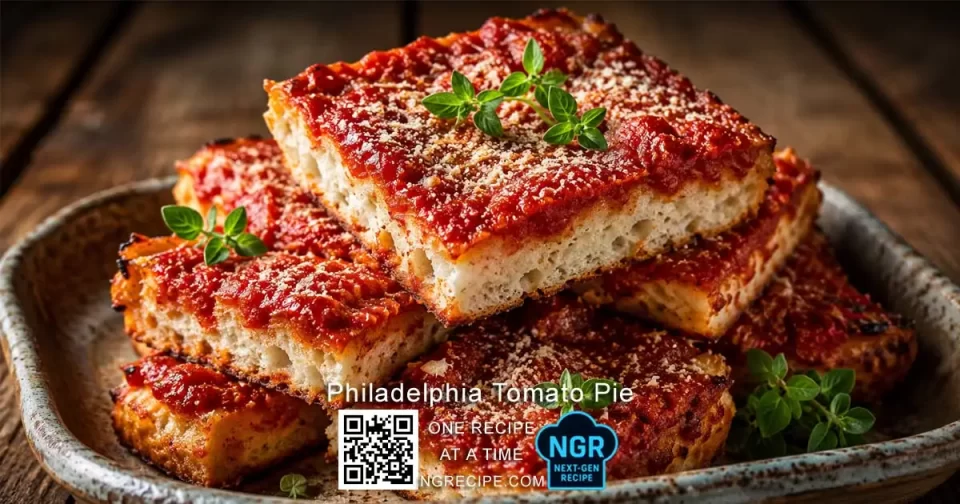
Philadelphia Tomato Pie is a classic Italian-American bakery dish made with a thick, airy rectangular crust, a generous layer of concentrated tomato sauce, and only a light dusting of sharp grated cheese. Unlike cheese-heavy pizza, the tomato topping remains the defining feature, and the finished pie is traditionally cut into squares and enjoyed warm or at room temperature.
Quick Recipe Card
What This Recipe Is
Philadelphia Tomato Pie is a rectangular, bakery-style tomato bread associated with the Italian-American food traditions of Philadelphia. Its defining structure consists of a soft yet sturdy yeast-raised crust topped with a thick, deeply flavoured tomato sauce and a restrained amount of finely grated hard cheese.
The crust is thicker and more bread-like than a typical round pizza crust. It should have an airy interior, a lightly crisp underside, and enough strength to support the sauce without becoming soggy. The sauce is cooked before it reaches the dough so that its flavour becomes concentrated and its moisture is reduced.
Traditional Philadelphia tomato pie is usually served in square or rectangular portions. It may be eaten slightly warm, but its flavour and texture become especially characteristic after it has cooled to room temperature. The tomato topping should remain more prominent than the cheese, distinguishing the dish from conventional pizza.
Ingredients
- 500 g bread flour (4 cups)
- 7 g instant yeast (2¼ teaspoons)
- 18 g granulated sugar (1½ tablespoons), divided
- 16 g fine sea salt (2¾ teaspoons), divided
- 360 ml lukewarm water (1½ cups), approximately 38–43°C (100–110°F)
- 30 ml extra-virgin olive oil (2 tablespoons), for the dough
- 15 ml extra-virgin olive oil (1 tablespoon), for the baking pan
- 30 ml extra-virgin olive oil (2 tablespoons), for the tomato sauce
- 9 g garlic (3 medium cloves), finely minced
- 30 g tomato paste (2 tablespoons)
- 800 g canned crushed tomatoes (28 ounces)
- 2 g dried oregano (2 teaspoons)
- 20 g finely grated Pecorino Romano cheese (¼ cup)
Equipment
- Digital kitchen scale
- Measuring cups and spoons
- Large mixing bowl
- Stand mixer with dough hook or sturdy wooden spoon
- Clean work surface
- Medium saucepan
- Heatproof spoon or silicone spatula
- 33 × 46 cm (13 × 18-inch) rimmed baking pan
- Pastry brush or clean fingertips
- Kitchen towel or reusable bowl cover
- Wire cooling rack
- Pizza wheel, bench scraper, or sharp knife
Instructions
Step 1:
Prepare the tomato sauce. Heat 30 ml extra-virgin olive oil in a medium saucepan over medium-low heat. Add the minced garlic and cook for approximately 30 seconds, stirring continuously, until fragrant but not browned.
Step 2:
Add the tomato paste and cook for 1 minute, stirring it through the oil and garlic. Add the crushed tomatoes, dried oregano, 6 g of the granulated sugar, and 6 g of the fine sea salt.
Step 3:
Bring the sauce to a gentle simmer. Reduce the heat to low and cook uncovered for 20–25 minutes, stirring occasionally, until the sauce is thick, spreadable, and no longer watery. Remove it from the heat and allow it to cool while the dough rises.
Step 4:
Place the bread flour, instant yeast, remaining 12 g granulated sugar, and remaining 10 g fine sea salt in a large mixing bowl. Stir until evenly combined.
Step 5:
Add the lukewarm water and 30 ml extra-virgin olive oil. Mix until no dry flour remains and a sticky, shaggy dough forms.
Step 6:
Knead the dough with a stand mixer on medium-low speed for 7–8 minutes. Alternatively, knead by hand on a lightly oiled surface for 10–12 minutes. The finished dough should be smooth, elastic, slightly tacky, and able to stretch without tearing immediately.
Step 7:
Shape the dough into a ball and return it to the mixing bowl. Cover the bowl and leave the dough in a warm, draught-free place for approximately 75 minutes, or until it has nearly doubled in volume.
Step 8:
Coat the bottom and sides of a 33 × 46 cm rimmed baking pan with the remaining 15 ml extra-virgin olive oil. Transfer the risen dough to the pan and gently press it outward with oiled fingertips.
Step 9:
If the dough contracts, allow it to rest for 10 minutes before continuing to stretch it towards the corners. Once the pan is evenly covered, leave the dough uncovered or loosely covered for another 20 minutes.
Step 10:
During the final dough rest, position a rack in the lower-middle part of the oven and preheat the oven to 230°C (450°F).
Step 11:
Gently dimple the dough with your fingertips without pressing all the way through to the pan. Spread the cooled tomato sauce evenly over the surface, leaving a narrow border of approximately 1 cm (⅜ inch) around the edges.
Step 12:
Bake for 22–26 minutes, rotating the pan once after approximately 15 minutes. The crust should be golden around the edges, firm underneath, and fully baked through the centre.
Step 13:
Remove the pan from the oven and immediately sprinkle the finely grated Pecorino Romano cheese evenly over the hot tomato topping.
Step 14:
Leave the tomato pie in the pan for 10 minutes. Carefully transfer it to a wire rack and allow it to cool for at least another 20 minutes so the crumb and sauce can set.
Step 15:
Cut the tomato pie into 12 rectangular or square portions. Serve slightly warm or at room temperature.
Visual Cooking Cues
- The kneaded dough should appear smooth and elastic rather than rough or dry. When gently stretched between the fingers, a small piece should become thin before tearing.
- After the first rise, the dough should look inflated and should retain a shallow indentation when pressed lightly with a fingertip. If it springs back immediately, it may need additional proofing time.
- The cooked tomato sauce should be thick enough to leave a brief trail when a spoon is drawn across the bottom of the saucepan. It should spread easily but should not release watery liquid around its edges.
- Before baking, the dough should fill the pan without excessive tension. Small fingertip dimples may remain visible beneath the sauce.
- The finished crust should have golden-brown edges and a lightly crisp underside. The centre should feel set and resilient rather than wet or doughy.
- The tomato layer should look concentrated, glossy, and deep red. It should remain clearly visible beneath the restrained dusting of grated cheese.
Chef Tips
- Use bread flour for the most dependable combination of chew, lift, and structural strength. Its higher protein content helps the dough support the generous tomato topping.
- Measure the flour by weight whenever possible. Scooped flour can become compacted, creating a dry dough and an overly dense crust.
- Keep the dough slightly tacky during kneading. Adding excessive flour may make it easier to handle, but it can produce a heavy, bread-like base without the desired open crumb.
- Cook the tomato sauce until it is noticeably thicker than an ordinary pasta sauce. Reducing excess water is essential for preventing a soggy centre.
- Allow the sauce to cool before spreading it over the dough. Very hot sauce can soften the proofed dough and interfere with its final oven rise.
- Stretch the dough gradually. When it resists or shrinks, pause and let it relax rather than forcing it into the corners.
- Bake the pie on a lower-middle oven rack so the bottom receives enough heat to brown while the tomato topping remains protected from excessive scorching.
- Use the cheese sparingly. Philadelphia tomato pie should taste primarily of seasoned tomato, olive oil, and well-fermented bread.
- Do not skip the cooling period. Resting allows steam to escape, strengthens the crumb, and gives the tomato layer time to settle.
Common Mistakes
- Adding too much flour while kneading, which produces a dense and dry crust
- Using cold water that slows yeast activity
- Using excessively hot water that damages the yeast
- Failing to reduce the tomato sauce sufficiently
- Spreading hot sauce over the proofed dough
- Forcing the dough into the pan without allowing it to relax
- Applying such a heavy sauce layer that the centre cannot bake properly
- Covering the tomato topping with a thick layer of cheese
- Cutting the pie immediately after baking
- Baking on a rack that is too high in the oven
- Removing the pie before the centre of the crust is fully set
Troubleshooting
If the dough is very dry and refuses to come together, add lukewarm water 5 ml (1 teaspoon) at a time until no dry flour remains.
If the dough is extremely wet after several minutes of kneading, continue kneading before adding more flour. High-hydration dough often becomes smoother and less sticky as its gluten develops.
If the dough does not rise, move it to a warmer location and allow additional time. Yeast activity slows considerably in a cool kitchen.
If the dough repeatedly shrinks away from the corners of the pan, leave it undisturbed for 10–15 minutes. The relaxed gluten will stretch more easily.
If the sauce remains watery after 25 minutes, continue simmering it uncovered over low heat until it becomes thick and spreadable.
If the crust is pale underneath, return individual portions directly to a hot baking tray for several minutes, or place them on a preheated oven rack.
If the edges brown before the centre is ready, reduce the oven temperature to 220°C (425°F) and continue baking until the middle is fully set.
If the finished pie becomes soggy during cooling, transfer it from the baking pan to a wire rack so trapped steam can escape.
Ingredient Pairings
- Bread flour and olive oil create a crust that is both resilient and tender. The flour supplies gluten-forming proteins, while olive oil softens the crumb and adds savoury richness.
- Crushed tomatoes and tomato paste work together to create a topping with fresh tomato character and concentrated body. The paste reinforces colour, sweetness, and savoury depth without requiring an excessively long cooking time.
- Garlic and dried oregano provide the familiar aromatic profile associated with Italian-American tomato breads. Briefly cooking the garlic in olive oil softens its sharpness and distributes its flavour throughout the sauce.
- A small amount of sugar balances the natural acidity of the tomatoes. It should not make the sauce taste sweet; its purpose is to round out harsh acidic notes.
- Pecorino Romano contributes saltiness and a sharp, savoury finish. Its assertive flavour allows a small quantity to season the entire pie without obscuring the tomato topping.
Substitutions
- All-purpose flour may replace bread flour, although the crust will generally be softer and less chewy. Begin with slightly less water because all-purpose flour may absorb less liquid.
- Active dry yeast may replace instant yeast in the same quantity. Dissolve it in the lukewarm water with a small portion of the sugar and leave it for 5–10 minutes before mixing the dough.
- Fine table salt may replace fine sea salt by weight. When measuring by volume, use slightly less because fine table salt can pack more densely.
- Canned whole peeled tomatoes may replace crushed tomatoes. Crush or blend them before cooking and simmer the sauce until sufficiently thick.
- Parmesan cheese may replace Pecorino Romano for a milder and slightly nuttier finish.
- A vegetarian hard cheese made with microbial or plant-based rennet may be used when strict vegetarian suitability is required.
- A dairy-free grated hard-cheese alternative may be used, or the finishing cheese may be omitted for a dairy-free version.
Recipe Family Variations
- South Philadelphia Tomato Pie
- Utica Tomato Pie
- Trenton Tomato Pie
Serving Suggestions
- Serve Philadelphia Tomato Pie at room temperature as a bakery-style lunch, afternoon snack, or party food.
- Pair it with a crisp green salad dressed with a bright vinaigrette to balance the richness of the olive oil and bread.
- Include it in an Italian-American antipasto spread with roasted vegetables, marinated vegetables, olives, and cured meats.
- Cut the pie into smaller squares for a buffet, picnic, game-day gathering, or casual celebration.
- Serve larger rectangular portions as a light main course with soup or salad.
- For the most characteristic texture, allow refrigerated portions to lose their chill before serving rather than eating them directly from the refrigerator.
Dietary Classification
This recipe is meat-free and can be suitable for a vegetarian diet when the Pecorino Romano cheese is produced with vegetarian rennet.
It is naturally egg-free and nut-free as written. Anyone with severe allergies should still verify the processing and cross-contact information for packaged ingredients.
The recipe contains gluten because it is made with bread flour.
The recipe contains dairy because of the Pecorino Romano cheese. Omitting the cheese or using a suitable dairy-free alternative creates a dairy-free version.
The recipe is not vegan as written, but it can be adapted by omitting the cheese or replacing it with a plant-based alternative.
Nutrition Information
Approximate nutrition per serving:
- Calories: 240
- Protein: 7 g
- Carbohydrates: 39 g
- Fat: 7 g
- Saturated Fat: 1.5 g
- Fiber: 3 g
- Sugar: 5 g
- Sodium: 690 mg
Storage / Reheating
Allow leftover tomato pie to cool completely before storage. Do not leave it at room temperature for longer than 2 hours.
Refrigerate portions in a shallow airtight container or wrap them securely. Store for up to 4 days.
To prevent the squares from sticking together, place parchment paper between stacked portions.
For longer storage, freeze individual squares on a tray until firm, then transfer them to a freezer-safe container. Freeze for up to 2 months.
Thaw frozen portions overnight in the refrigerator before reheating.
To reheat in an oven, place the tomato pie on a baking tray and heat at 180°C (350°F) for 8–10 minutes.
To reheat in an air fryer, heat at 170°C (340°F) for approximately 4–6 minutes.
A microwave may be used for convenience, but it softens the crust. Heat one portion in short intervals until just warm.
Philadelphia Tomato Pie may also be served at room temperature. Remove a refrigerated portion approximately 20–30 minutes before serving, while keeping the total unrefrigerated time within safe limits.
FAQ
Is Philadelphia Tomato Pie the same as pizza?
It belongs to the broader pizza and tomato-bread family, but it has a distinct identity. It usually has a thicker rectangular crust, a generous cooked tomato topping, very little grated cheese, and no heavy layer of melted mozzarella.
Why is the cheese placed over the sauce?
A restrained dusting of finely grated hard cheese seasons the tomato topping without covering it. The visible tomato layer is a defining characteristic of Philadelphia Tomato Pie.
Is Philadelphia Tomato Pie traditionally served cold?
It is commonly served at room temperature rather than refrigerator-cold. It may also be enjoyed slightly warm, but it is normally allowed to cool enough for the crust and sauce to set.
Can I make the dough in advance?
Yes. After mixing and kneading, cover the dough and refrigerate it for up to 24 hours. Allow it to stand at room temperature for 60–90 minutes before stretching it into the pan.
Can I prepare the tomato sauce ahead of time?
Yes. The sauce may be prepared up to 3 days in advance and refrigerated in an airtight container. Bring it closer to room temperature before spreading it over the dough.
Why did my crust become soggy?
The sauce may have been too watery, too much sauce may have been applied, or the pie may have remained in the hot pan during cooling. Reduce the sauce until thick and transfer the baked pie to a wire rack after its initial rest.
How thick should the tomato sauce be?
It should be thicker than a typical pasta sauce and should spread without running. A spoon drawn across the bottom of the saucepan should leave a visible trail briefly before the sauce closes over it.
Can I use fresh tomatoes?
Fresh tomatoes contain more variable amounts of water and require longer cooking. They may be used, but they should be peeled or finely crushed and simmered until the sauce reaches a dense, spreadable consistency.
Why does the dough need such a high amount of water?
The relatively moist dough creates steam during baking, helping produce an airy interior. Bread flour provides enough gluten strength to hold that moisture while supporting the sauce.
Can I bake this in a smaller pan?
Yes, but the crust will be thicker and may require additional baking time. Avoid using a pan so small that the centre remains doughy before the edges become overbrowned.
Why This Recipe Works
The high-hydration dough creates an open, tender crumb while bread flour provides enough gluten strength to maintain structure beneath the tomato topping.
Two proofing stages allow the dough to expand gradually. The first develops overall volume and fermentation flavour, while the second relaxes the dough in the pan and creates a lighter final texture.
Cooking the sauce separately concentrates the tomatoes before they reach the crust. This reduces excess moisture and creates a bold tomato flavour without soaking the dough.
Tomato paste strengthens the sauce by adding concentrated tomato solids. It improves body, colour, and savoury depth while shortening the reduction time.
Olive oil performs several roles. It tenderises the dough, prevents sticking, encourages browning around the crust, and carries the garlic and oregano flavours through the tomato sauce.
The narrow uncovered border allows the crust edges to brown and provides a firm structure for holding each portion.
Adding the grated cheese after baking preserves its sharp flavour and keeps the tomato layer visually and structurally dominant.
Cooling the finished pie on a wire rack prevents trapped steam from softening the underside. The resting period also stabilises the crumb, making the pie easier to cut cleanly.
Recipe Identity
Philadelphia Tomato Pie is a regional Italian-American bakery speciality identified by its rectangular shape, thick yeast-raised crust, concentrated tomato topping, minimal grated cheese, and customary room-temperature serving style.
Its identity depends on proportion. The tomato layer must be prominent, while the cheese functions as seasoning rather than as the main topping.
The dish should not be confused with a conventional thick-crust cheese pizza, which normally contains a substantial layer of melted mozzarella. It is also distinct from thin, round tomato pies in which cheese may be placed beneath the sauce.
Dish Classification
Philadelphia Tomato Pie may be classified as a savoury yeast bread, a regional tomato pie, an Italian-American bakery food, and a member of the broader pizza family.
Its base is a high-hydration, pan-baked dough rather than pastry. The word pie in this context refers to a regional pizza-related dish rather than a pastry shell with a filling.
The dish commonly functions as a snack, light main course, bakery lunch, picnic food, or party item.
Recipe History
Philadelphia Tomato Pie developed within the city’s Italian-American bakery culture during the early twentieth century. Its form reflects older traditions of baking yeast-raised bread with seasoned tomatoes, olive oil, herbs, and small amounts of hard cheese.
The dish became especially practical for bakeries because it could be baked in large rectangular pans, divided into portions, displayed at room temperature, and served without reheating each piece.
Over time, the thick crust, cooked tomato topping, restrained cheese, and square-cut presentation became closely associated with Philadelphia’s regional interpretation.
The precise dough thickness, sweetness of the sauce, amount of grated cheese, and preferred serving temperature vary among neighbourhoods, bakeries, and families. These differences represent local practice rather than a single universally fixed formula.
Cultural Notes
Philadelphia Tomato Pie is strongly connected with neighbourhood bakeries, family gatherings, celebrations, and casual communal eating. It is often purchased as a whole rectangular tray and shared rather than ordered as individual slices.
Serving it at room temperature is not merely a matter of convenience. Cooling allows the tomato flavour to become more pronounced and gives the soft crumb enough structure to support the topping cleanly.
The restrained use of cheese is culturally important to the dish’s identity. Adding a heavy layer of melted mozzarella changes both the appearance and the eating experience, moving the result closer to conventional pizza.
Regional preferences may favour a sweeter sauce, a stronger oregano presence, a denser crust, or a particularly airy crumb. These variations can coexist within the Philadelphia tomato pie tradition.
Culinary Context
Philadelphia Tomato Pie belongs to a wider group of Italian and Italian-American breads topped with tomatoes, olive oil, herbs, and cheese. Related foods developed differently according to local baking practices, available ingredients, and community preferences.
Its rectangular pan shape and thick crumb share structural similarities with Sicilian-style pan pizza. However, the dominant cooked tomato layer, minimal cheese, and room-temperature service give Philadelphia Tomato Pie a distinct regional character.
Utica Tomato Pie also uses a thick base and prominent tomato topping, but its sauce, cheese treatment, crust characteristics, and local serving traditions may differ.
Trenton Tomato Pie usually refers to a thinner round pizza in which cheese is placed on the dough before tomato sauce is applied. Despite sharing the tomato pie name, its construction and final texture are substantially different.
Within Philadelphia, tomato pie occupies a space between bread, pizza, bakery snack, and communal party food. Its appeal comes from the balance of airy dough, concentrated tomato flavour, olive oil richness, and sharp grated cheese.
Advanced Cooking Knowledge Open detailed cooking science and reference notes
Flavor, Texture, and Aroma Profile
The dominant flavour is rich, gently acidic tomato supported by olive oil, garlic, oregano, and a restrained salty finish from Pecorino Romano.
The crust has a lightly crisp underside and browned perimeter, while the interior remains soft, airy, and pleasantly chewy.
The reduced sauce provides a dense, smooth, and slightly rustic texture. It should remain moist without becoming watery.
The aroma combines baked bread, cooked tomato, warm olive oil, garlic, dried herbs, and sharp aged cheese.
At room temperature, the tomato flavour becomes more prominent and the olive oil aromas remain rounded rather than intensely hot.
Flavor Balance
Tomato acidity supplies brightness and prevents the bread and olive oil from tasting heavy.
A small amount of sugar softens harsh acidity without creating a dessert-like sweetness.
Salt seasons both the dough and the sauce, ensuring that neither component tastes flat.
Pecorino Romano provides concentrated savoury flavour and salinity in a small quantity.
Olive oil contributes richness and helps carry the garlic and oregano aromas.
The mild flavour of the bread base balances the concentrated tomato topping and gives each portion enough substance to function as a snack or meal.
Flavor Components
- Primary flavour: Concentrated tomato
- Supporting flavours: Olive oil, garlic, oregano, and fermented wheat
- Salty element: Fine sea salt and Pecorino Romano cheese
- Sweet element: Natural tomato sweetness and a small amount of granulated sugar
- Acidic element: Canned tomatoes
- Umami element: Tomato paste, reduced tomatoes, and aged cheese
- Aromatic element: Garlic and dried oregano
- Richness: Extra-virgin olive oil
- Fermented character: Yeast-raised dough
Ingredient Notes
Bread flour provides the strength needed for a moist, airy dough. Its protein content helps the dough retain gas during proofing and maintain structure beneath the sauce.
Instant yeast may be mixed directly into the flour. Its performance still depends on suitable water temperature and adequate proofing time.
Lukewarm water hydrates the flour and activates the yeast. Water above the recommended range may weaken or kill the yeast.
Extra-virgin olive oil contributes flavour, tenderness, browning, and moisture retention. It also helps release the baked crust from the pan.
Crushed tomatoes provide a consistent texture that requires less processing than whole canned tomatoes.
Tomato paste thickens the topping and reinforces tomato flavour.
Dried oregano performs well during simmering and baking because its concentrated aroma withstands prolonged heat.
Pecorino Romano is sharp, salty, and assertive. A small amount is sufficient for finishing the entire pie.
Ingredient Science
Water hydrates the proteins and starches in bread flour. During kneading, the hydrated proteins form a gluten network capable of trapping carbon dioxide produced by the yeast.
Yeast consumes available sugars and releases carbon dioxide and flavour compounds. The trapped gas expands the dough and creates its airy structure.
Sugar supports browning and yeast activity while also balancing tomato acidity. Excessive sugar would make the crust overly sweet and could cause premature browning.
Salt strengthens the gluten network and regulates fermentation. Without enough salt, the dough may rise too quickly and taste bland.
Olive oil coats portions of the flour and gluten network, contributing tenderness while preserving enough elasticity for a chewy crumb.
Simmering the sauce evaporates water and concentrates dissolved sugars, acids, aromatic compounds, and tomato solids.
Tomato paste contains concentrated solids that increase viscosity and reinforce savoury flavour.
During baking, yeast activity accelerates briefly before stopping as the dough heats. Expanding gases and steam create oven spring, while starch gelatinisation and protein setting stabilise the crumb.
The underside browns through reactions between sugars and proteins, aided by the hot metal pan and olive oil.
Ingredient Roles
Bread flour: Forms the structural base and supplies gluten-forming proteins.
Instant yeast: Leavens the dough and contributes fermentation flavour.
Granulated sugar: Supports fermentation, encourages browning, and balances tomato acidity.
Fine sea salt: Seasons the dough and sauce while strengthening gluten and regulating yeast.
Water: Hydrates the flour and creates steam during baking.
Extra-virgin olive oil: Adds richness, tenderises the crumb, prevents sticking, and carries aromatic flavours.
Garlic: Adds savoury aroma and depth to the tomato sauce.
Tomato paste: Concentrates tomato flavour and thickens the topping.
Crushed tomatoes: Form the primary topping and flavour identity.
Dried oregano: Provides the characteristic herbal aroma.
Pecorino Romano cheese: Adds a sharp, salty, umami-rich finishing note.
Ingredient Classification
- Grain ingredient: Bread flour
- Leavening ingredient: Instant yeast
- Sweetening ingredient: Granulated sugar
- Seasoning ingredient: Fine sea salt
- Hydrating ingredient: Water
- Culinary fat: Extra-virgin olive oil
- Aromatic ingredient: Garlic
- Concentrated tomato ingredient: Tomato paste
- Primary produce ingredient: Crushed tomatoes
- Dried herb: Dried oregano
- Aged dairy ingredient: Pecorino Romano cheese
Preparation Techniques
Accurate weighing improves dough consistency and prevents excessive flour from creating a dense crust.
Combining the dry ingredients before adding water distributes the yeast, sugar, and salt evenly throughout the flour.
Gradual mixing hydrates the flour and begins gluten formation before intensive kneading.
Kneading aligns and strengthens the gluten network, allowing the dough to hold fermentation gases.
Bulk proofing develops volume, flavour, and dough extensibility.
Resting the dough after it is transferred to the pan relaxes the gluten and makes stretching easier.
Dimpling distributes small pockets of gas and helps keep the dough evenly positioned in the pan.
Cooling the sauce before application protects the proofed dough from excessive heat and moisture.
Cooling the baked pie on a rack allows steam to escape and preserves the texture of the underside.
Cooking Techniques
Gentle sautéing releases garlic aroma without creating bitterness.
Cooking tomato paste briefly in olive oil develops its savoury character and removes a raw metallic taste.
Uncovered simmering concentrates the sauce by allowing water to evaporate.
Pan baking creates a defined rectangular shape and exposes the dough to direct conductive heat from the metal.
High-temperature baking produces oven spring, crust browning, and a fully set crumb before the tomato topping becomes excessively dry.
Rotating the pan compensates for uneven oven heat.
Residual heat helps the finishing cheese adhere to the tomato topping without creating a heavy melted layer.
Heat Management
Keep the garlic over medium-low heat and stir continuously. Browned garlic may make the entire sauce taste bitter.
Once the tomato sauce begins simmering, reduce the heat so it cooks gently without scorching or splattering excessively.
Preheat the oven fully before baking. A partially heated oven can produce a dense crust and pale underside.
Use the lower-middle rack to expose the bottom of the pan to strong heat while preventing the tomato surface from burning.
Rotate the pan only after the crust has begun to set. Opening the oven too early can reduce heat during the initial oven spring.
If using a dark metal pan, inspect the underside slightly earlier because dark surfaces absorb heat efficiently.
If using a light aluminium pan, the pie may require the full baking time or several additional minutes to brown underneath.
Texture Development
The high water content helps create a moist and open crumb rather than a dry, tight bread structure.
Bread flour supplies enough gluten strength to support that moisture and retain fermentation gases.
Kneading creates elasticity, while proofing gives the gluten time to expand around developing gas bubbles.
The oiled pan encourages a lightly crisp, fried quality along the base and edges.
The thickened tomato sauce remains on the surface instead of soaking deeply into the crumb.
Cooling stabilises the gelatinised starches and allows moisture to redistribute through the crust.
Transferring the pie to a wire rack prevents condensation from softening the underside.
Cooking Time Control
Judge dough fermentation by volume and texture rather than by time alone. A cool room may extend the first rise, while a warm room may shorten it.
Simmer the sauce until it reaches the required consistency. The moisture content of canned tomatoes varies, so reduction time may differ.
Begin checking the pie after 22 minutes. The edges should be browned, the centre should feel set, and the underside should have visible colour.
A smaller pan creates a thicker crust and requires additional baking time. A larger pan creates a thinner crust that may bake more quickly.
Allow the pie to cool for at least 30 minutes before cutting. Cutting too early releases steam and compresses the crumb.
Flavor Pairing Logic
Tomato and oregano form the central aromatic pairing. The herb reinforces the savoury character of the cooked tomatoes without competing with them.
Garlic adds depth and warmth, while olive oil disperses its aromatic compounds throughout the sauce.
Sugar moderates tomato acidity, but the quantity remains low enough to preserve a savoury profile.
The mild wheat flavour of the crust provides a neutral foundation for the concentrated sauce.
Pecorino Romano adds salt, umami, and a sharp aged flavour. Because it is highly concentrated, only a light dusting is needed.
Bright salads, pickled vegetables, and vinaigrette-dressed dishes pair well with the pie because their acidity contrasts with its bread and olive oil richness.
Leftover Ideas
Cut leftover tomato pie into small squares and serve it as part of an appetiser platter.
Warm portions briefly and serve them alongside soup for a simple lunch.
Cut the crust into strips and serve them with additional warm tomato sauce for dipping.
Use room-temperature squares as picnic food when they can be transported and consumed within safe temperature limits.
Reheat individual portions until crisp and serve them with a fresh salad.
Freeze portions individually for convenient future snacks or light meals.
Cooking Safety Notes
Use care when handling the hot baking pan, especially when rotating it or transferring the pie to a cooling rack.
Direct steam away from the hands and face when opening the oven.
Keep saucepan handles turned away from the edge of the hob.
Avoid touching the sauce immediately after baking because concentrated tomato topping can retain substantial heat.
Do not leave the finished tomato pie at room temperature for more than 2 hours. When the surrounding temperature is above 32°C (90°F), limit unrefrigerated time to 1 hour.
Refrigerate leftovers promptly in a shallow container so they cool efficiently.
Use clean utensils and surfaces when handling cooked portions intended for storage.
Sustainability Notes
Measure ingredients accurately to reduce failed batches and unnecessary food waste.
Use any remaining crushed tomatoes or tomato paste in soups, sauces, stews, or braised dishes.
Freeze unused tomato paste in small measured portions for later cooking.
Bake the full tray at one time and freeze surplus portions rather than running the oven repeatedly for smaller batches.
Allow the oven to preheat only as long as necessary.
Use reusable bowl covers and storage containers where practical.
Store the pie correctly so leftovers remain safe and appealing rather than being discarded.
Recipe Classification
Primary dish type: Savoury Baked Bread
Parent family: Tomato Pie
Subfamily: Philadelphia Tomato Pie
Specific recipe identity: Philadelphia Tomato Pie
Cuisine: Italian-American
Country: United States
Meal role: Main Course, Snack
Primary dairy: Pecorino Romano Cheese
Bread component: Thick Rectangular Yeast-Raised Crust
Fresh components: Garlic
Condiment profile: Concentrated Tomato Topping with Garlic and Oregano
Cooking methods: Mixing, Kneading, Proofing, Simmering, Baking, Assembling
Serving style: Rectangular Portions Served Slightly Warm or At Room Temperature
Difficulty level: Intermediate
Occasions: Family Gathering, Game Day, Picnic, Party, Casual Entertaining
