Chicago Stuffed Pizza
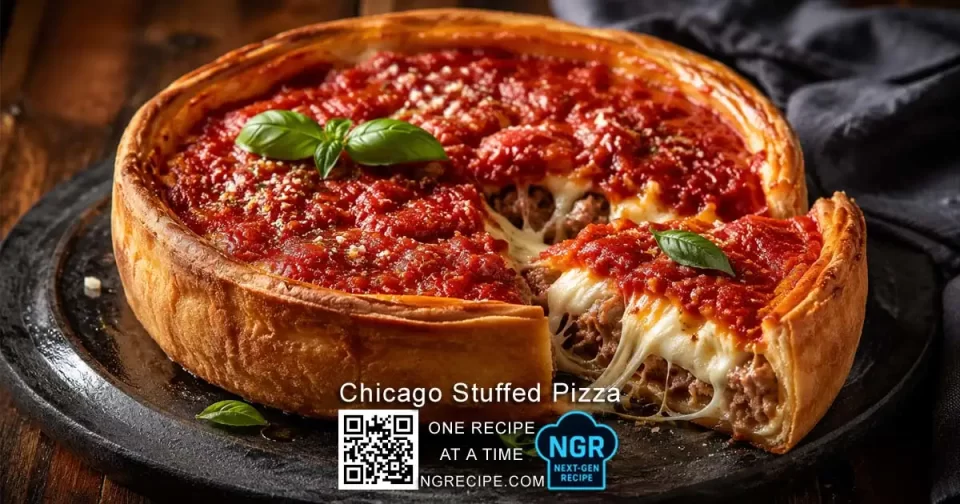
Chicago stuffed pizza is a towering, deeply filled pan pizza built with two layers of yeasted crust, generous mozzarella and sausage, and a thick tomato sauce spread over the sealed upper crust. This home-kitchen version preserves the dish’s defining structure while providing dependable dough handling, moisture control, baking, and slicing guidance.
Quick Recipe Card
What This Recipe Is
Chicago stuffed pizza is a deep-pan pizza distinguished by its enclosed filling and dramatic height. A sturdy lower crust lines the base and sides of a deep pizza pan, mozzarella and other fillings are packed inside, and a thinner upper crust seals everything together. Tomato sauce and Parmesan are then spread over the top crust before baking.
The upper crust is the key feature separating stuffed pizza from standard Chicago deep-dish pizza. In a deep-dish pizza, the cheese and fillings remain open beneath the tomato sauce. In a stuffed pizza, the cheese and filling are enclosed between two crusts before the sauce is added.
This recipe uses low-moisture mozzarella and cooked Italian sausage to create a rich but sliceable interior. A briefly simmered tomato sauce adds concentrated flavour without making the upper crust excessively wet.
Ingredients
- 500 g (4 cups) bread flour
- 35 g (¼ cup) fine cornmeal
- 7 g (2¼ teaspoons) instant yeast
- 8 g (2 teaspoons) granulated sugar
- 10 g (1¾ teaspoons) fine salt
- 290 ml (1 cup plus 3 tablespoons) warm water
- 60 ml (¼ cup) olive oil, divided
- 450 g (1 pound) mild or hot Italian sausage, casings removed
- 500 g (17½ ounces) low-moisture whole-milk mozzarella cheese, coarsely grated
- 800 g (28 ounces) crushed tomatoes
- 30 g (2 tablespoons) tomato paste
- 3 garlic cloves, finely minced
- 2 teaspoons dried oregano
- 1 teaspoon dried basil
- ½ teaspoon ground black pepper
- 4 g (¾ teaspoon) fine salt
- 50 g (½ cup) finely grated Parmesan cheese
Equipment
- Digital kitchen scale
- Large mixing bowl
- Wooden spoon or dough whisk
- Clean work surface
- Deep 30 cm (12-inch) round pizza pan or cake pan
- Large frying pan or skillet
- Medium saucepan
- Rolling pin
- Bench scraper
- Fine grater
- Pastry brush
- Sharp knife or kitchen scissors
- Wide pizza server
- Instant-read thermometer
Instructions
Step 1:
Combine the bread flour, cornmeal, instant yeast, sugar, and 10 g salt in a large mixing bowl. Add the warm water and 45 ml of the olive oil. Stir until no dry flour remains and a rough dough forms.
Step 2:
Transfer the dough to a lightly floured work surface. Knead for 7 to 9 minutes, until the dough is smooth, elastic, and slightly tacky but no longer sticky. Avoid adding excessive flour, which can make the baked crust dense.
Step 3:
Shape the dough into a ball. Lightly coat the mixing bowl with 5 ml of the olive oil, place the dough inside, and turn it once to coat. Cover and leave to rise in a warm place for 1½ to 2 hours, or until approximately doubled in volume.
Step 4:
While the dough rises, place the Italian sausage in a large frying pan over medium heat. Break it into small, irregular pieces and cook for 8 to 10 minutes, stirring occasionally, until browned and fully cooked. The thickest pieces should reach at least 71°C (160°F). Drain away excess fat and leave the sausage to cool.
Step 5:
Heat 5 ml of the olive oil in a medium saucepan over medium-low heat. Add the garlic and cook for about 30 seconds, stirring continuously, until fragrant but not browned.
Step 6:
Add the crushed tomatoes, tomato paste, oregano, basil, black pepper, and 4 g salt. Bring the sauce to a gentle simmer and cook uncovered for 18 to 22 minutes, stirring occasionally, until thick enough to hold its shape briefly when stirred. Remove from the heat and allow it to cool.
Step 7:
Place an oven rack in the lower third of the oven. Preheat the oven to 220°C (425°F) for at least 30 minutes. Brush the base and sides of the deep pizza pan with the remaining 5 ml olive oil.
Step 8:
Gently deflate the risen dough and divide it into two portions, with approximately two-thirds of the dough for the lower crust and one-third for the upper crust. Shape each portion into a ball and leave them covered for 10 minutes to relax.
Step 9:
Roll the larger dough portion into a circle approximately 40 cm (16 inches) wide. Carefully transfer it to the prepared pan. Press it evenly across the base and up the sides, leaving a small overhang around the rim. Repair any thin areas before adding the filling.
Step 10:
Spread the grated mozzarella evenly over the lower crust. Distribute the cooled sausage over the cheese, keeping the filling level rather than mounded in the centre. Reserve the Parmesan for the top of the pizza.
Step 11:
Roll the smaller dough portion into a circle approximately 31 cm (12¼ inches) wide. Lay it over the filling. Pinch the upper crust firmly to the lower-crust overhang, then trim or fold the excess inward to create a secure sealed rim.
Step 12:
Cut four to six small steam vents in the upper crust. Spread the cooled tomato sauce evenly over the crust, stopping just before the sealed edge. Sprinkle the Parmesan over the sauce.
Step 13:
Bake on the lower oven rack for 40 to 50 minutes, rotating the pan once after 25 minutes. The exposed rim should be deep golden brown, the sauce should be bubbling gently, and the centre should feel hot and structurally set. Loosely shield the rim if it browns too quickly.
Step 14:
Place the pan on a heat-resistant surface and rest the pizza for 15 minutes. Run a thin knife around the edge, release the pizza carefully from the pan, and transfer it to a cutting board. Cut into 8 slices and serve while hot.
Visual Cooking Cues
- The kneaded dough should look smooth and elastic, with enough moisture to feel supple rather than dry. When pressed gently, it should spring back slowly.
- After proofing, the dough should be visibly expanded and aerated. It does not need to triple in size, but it should feel lighter and contain small gas bubbles.
- The cooked sausage should be browned in places, fully cooked inside, and free from large pools of rendered fat.
- The tomato sauce should be thicker than an uncooked pizza sauce. A spoon drawn across the bottom of the saucepan should leave a visible trail for a moment before the sauce flows back.
- The lower crust should extend evenly across the bottom and sides of the pan without transparent patches. Thin spots may tear under the weight of the filling.
- The upper crust should be firmly sealed to the lower crust. Escaping cheese around the rim usually indicates an incomplete seal.
- The finished pizza should have a deeply browned outer crust, a bubbling red surface, and a hot, melted interior that remains layered after resting.
Chef Tips
- Use low-moisture mozzarella rather than fresh mozzarella. Fresh mozzarella releases considerably more liquid and can make the enclosed crust soggy.
- Cool the sausage and sauce before assembling the pizza. Hot components soften the dough, encourage tearing, and may begin melting the cheese before the pizza reaches the oven.
- Keep the filling relatively level. A large mound in the centre makes the top crust difficult to seal and produces uneven slices.
- Roll the lower crust large enough to line the entire pan without aggressive stretching. Dough that is stretched too tightly may shrink or tear during assembly.
- Vent the upper crust before adding the sauce. The vents release steam from the enclosed filling and reduce ballooning.
- Rest the pizza before slicing. The cheese will still be molten after baking, and immediate cutting can cause the filling to flow out of the crust.
- For cleaner slices, use a sharp chef’s knife or kitchen scissors rather than repeatedly pressing with a dull pizza wheel.
Common Mistakes
- Using fresh, high-moisture mozzarella can release enough liquid to soften both crust layers.
- Adding hot sausage or sauce to the dough can weaken the crust and make sealing difficult.
- Rolling both dough portions to the same thickness leaves too little dough for the deep lower shell. The lower crust needs the larger share.
- Overfilling the centre creates a domed pizza with under-supported slices and an unevenly baked crust.
- Failing to drain the sausage can create a greasy layer inside the pizza.
- Using a thin, watery sauce can make the upper crust damp and prevent the surface from baking properly.
- Skipping the steam vents may cause the upper crust to inflate, separate, or tear.
- Cutting immediately after baking prevents the melted cheese and rendered fats from settling.
Troubleshooting
If the dough keeps shrinking while being rolled, cover it and let it rest for another 10 minutes. The gluten will relax, making the dough easier to shape.
If the dough feels dry and cracks while kneading, work in a few drops of water at a time until it becomes flexible. Do not pour in a large quantity at once.
If the dough is very sticky, continue kneading before adding more flour. If it remains unmanageable, dust the work surface with a small amount of bread flour.
If the upper crust tears during assembly, pinch the opening closed with a small piece of dough before adding the sauce.
If liquid collects inside the baked pizza, the sauce may have been too thin, the sausage may not have been drained, or the mozzarella may have contained too much moisture.
If the crust is pale after the filling is hot, move the pizza slightly lower in the oven and continue baking for several minutes.
If the rim browns before the centre is ready, shield only the rim loosely and continue baking until the centre is fully heated.
If the pizza collapses while slicing, allow it to rest longer so the filling can stabilise.
Ingredient Pairings
- Italian sausage pairs with mozzarella because its savoury seasoning balances the cheese’s mild richness.
- Crushed tomatoes provide acidity that cuts through the high proportion of cheese and crust.
- Parmesan adds concentrated saltiness and aged dairy flavour to the tomato-covered surface.
- Garlic, oregano, and basil reinforce the familiar herb profile of the sauce without overpowering the filling.
- Cornmeal contributes a faint toasted flavour and subtle texture to the bread-based crust.
- Black pepper complements both the sausage seasoning and the natural sweetness of cooked tomatoes.
Substitutions
- All-purpose flour may replace bread flour, although the dough may be softer and slightly less chewy. Hold back a small amount of water initially because different flours absorb moisture differently.
- Polenta-style cornmeal may replace fine cornmeal when ground finely enough to blend into the dough. Coarse grains can make the crust difficult to roll and seal.
- Part-skim low-moisture mozzarella may replace whole-milk mozzarella for a somewhat lighter filling, though the result will be less rich.
- Turkey Italian sausage may replace pork sausage. Cook it fully and add a small amount of olive oil to the frying pan if it is very lean.
- A vegetarian Italian-style sausage may be used for a meat-free adaptation, provided it is cooked and cooled before assembly.
- Whole peeled tomatoes may replace crushed tomatoes after being thoroughly crushed and simmered until thick.
- Grated Pecorino Romano may replace Parmesan, but its sharper and saltier flavour may require reducing the added sauce salt.
Recipe Family Variations
- Chicago Stuffed Cheese Pizza
- Chicago Stuffed Sausage Pizza
- Chicago Stuffed Spinach Pizza
Serving Suggestions
- Serve the pizza as a complete main course with a crisp green salad dressed lightly with an acidic vinaigrette.
- Offer roasted or steamed vegetables alongside the pizza to balance its rich cheese, sausage, and crust.
- Cut the pizza into smaller wedges when serving it as part of a game-day or party spread.
- Serve each slice on a warmed plate so the thick filling remains hot throughout the meal.
- A lightly dressed tomato and cucumber salad provides freshness without competing with the pizza’s concentrated tomato flavour.
- Because the pizza is highly substantial, begin with one slice per person and offer additional portions as needed.
Dietary Classification
This recipe contains wheat gluten and milk.
The standard recipe contains pork and is not vegetarian, vegan, gluten-free, dairy-free, or suitable for people avoiding pork.
It contains no eggs as written, although commercially prepared sausage, cheese, or tomato products should be checked individually when managing allergies.
A vegetarian version can be prepared with a suitable meat-free Italian-style sausage.
A fully vegan version requires replacements for the mozzarella, Parmesan, and sausage and will produce a noticeably different melting and flavour profile.
A gluten-free version requires a separately formulated structural crust rather than a direct one-for-one flour replacement.
Nutrition Information
Approximate nutrition per serving:
- Calories: 710
- Protein: 35 g
- Carbohydrates: 67 g
- Fat: 34 g
- Saturated Fat: 14 g
- Fiber: 4 g
- Sugar: 7 g
- Sodium: 1,430 mg
Storage / Reheating
Allow leftover pizza to cool, but refrigerate it within 2 hours of baking. Store slices in a shallow airtight container or wrap them individually.
Refrigerated Chicago stuffed pizza is best eaten within 3 to 4 days.
For oven reheating, place a slice on a baking tray and cover it loosely. Heat at 180°C (350°F) for 15 to 20 minutes, uncovering for the final few minutes to restore the crust.
For skillet reheating, place a slice in a covered skillet over low heat. Add a few drops of water beside, not on, the pizza and heat for 8 to 12 minutes. The trapped steam warms the filling while the pan refreshes the lower crust.
Microwave reheating is fast but softens the crust. Heat one slice at medium power in short intervals until the centre is steaming hot.
To freeze, wrap fully cooled individual slices tightly and place them in a freezer-safe container. Freeze for up to 2 months.
Thaw frozen slices overnight in the refrigerator before reheating, or reheat them from frozen in a moderate oven with additional heating time.
Reheated leftovers should reach 74°C (165°F) at the centre.
FAQ
Is Chicago stuffed pizza the same as Chicago deep-dish pizza?
No. Both are baked in deep pans, but stuffed pizza has a second crust placed over the cheese and filling. Tomato sauce is spread over that upper crust. Standard deep-dish pizza does not enclose the filling beneath a second crust.
Why is the tomato sauce placed on top?
Placing the sauce above the upper crust protects the large quantity of cheese during the long bake. It also preserves the defining layered structure of the stuffed-pizza style.
Can I use fresh mozzarella?
Fresh mozzarella is not recommended unless it is drained very thoroughly because its high moisture content can make the enclosed filling watery. Low-moisture mozzarella produces a more reliable structure.
Does the sausage need to be cooked before assembly?
Pre-cooking is recommended for this home-kitchen method. It confirms that the sausage reaches a safe temperature, removes excess rendered fat, and makes the final filling easier to slice.
Why does the dough contain cornmeal?
Cornmeal contributes mild toasted flavour and a subtle granular texture. It is a supporting ingredient rather than the main flour and should not make the crust crumbly.
Can I prepare the dough in advance?
Yes. After kneading, cover the dough and refrigerate it for up to 24 hours. Allow it to stand at room temperature until relaxed and workable before dividing and rolling.
Can I assemble the pizza ahead of time?
It is better to assemble the pizza shortly before baking. Long storage after assembly allows moisture from the cheese, sausage, and sauce to soften the dough.
Why did my top crust inflate?
The steam vents may have been too small, blocked by sauce, or omitted. Cut several clear openings through the upper crust before spreading on the sauce.
How do I know when the centre is hot?
Insert an instant-read thermometer through a steam vent without touching the pan. The centre should reach at least 74°C (165°F), and the cheese should be completely melted.
Can I bake this in a springform pan?
A sturdy springform pan can work, but melted fat or sauce may leak through the base seam. Set it on a rimmed baking tray and confirm that its coating is suitable for the required oven temperature.
Why must the pizza rest before slicing?
Resting allows the melted cheese, hot fat, and tomato moisture to settle. It also helps the crust retain the filling when the first slice is removed.
Can I reduce the amount of cheese?
The cheese may be reduced moderately, but it forms a major part of the dish’s identity and structure. A large reduction will produce a flatter pizza with a different filling-to-crust balance.
Why This Recipe Works
The dough contains enough bread flour to create a strong gluten network capable of supporting a deep shell and heavy filling. Olive oil tenderises that structure, while cornmeal contributes gentle texture without replacing the flour needed for elasticity.
Dividing the dough unevenly provides a larger piece for the base and sides and a smaller piece for the upper seal. This reflects the different structural demands of the two crusts.
Cooking and draining the sausage before assembly controls both food safety and excess fat. Cooling it prevents premature softening of the dough.
Low-moisture mozzarella supplies dependable melting with less free water than fresh cheese. Placing it directly over the lower crust creates a cohesive cheese layer beneath the sausage.
Simmering the tomato sauce concentrates its flavour and reduces moisture. The thickened sauce can remain on top of the upper crust without soaking it as aggressively.
Steam vents allow pressure to escape from the sealed filling. The long bake then cooks the thick crust, reheats the sausage, melts the cheese, and develops a browned outer rim.
The final rest is part of the cooking process. It allows residual heat to equalise and gives the cheese enough time to thicken slightly before slicing.
Recipe Identity
Chicago stuffed pizza is a double-crust, deep-pan pizza with an enclosed cheese filling and tomato sauce applied above the upper crust.
Its identity depends on four structural features: a high-sided lower crust, a substantial filling, a sealed upper crust, and a tomato-covered surface.
The recipe belongs to the Chicago pan-pizza tradition but remains distinct from open-topped deep-dish pizza and thin, square-cut Chicago tavern-style pizza.
This version uses Italian sausage as the principal filling protein, low-moisture mozzarella as the principal cheese, and a cooked tomato-herb sauce as the upper layer.
Dish Classification
Chicago stuffed pizza is classified as a savoury baked main course, a regional American pan pizza, a yeast-leavened bread dish, and an assembled cheese-and-meat preparation.
Its structure combines elements of bread making, filled dough preparation, sauce making, and deep-pan baking.
The finished dish is served in wedges and eaten hot. Its substantial portion size and layered construction make it more closely aligned with a full meal than a light snack.
Recipe History
Chicago stuffed pizza developed in Chicago during the 1970s as a highly filled variation within the city’s established deep-pan pizza culture.
Its defining innovation was the placement of a second dough layer over the cheese and filling. Tomato sauce was spread above this sealed crust, creating a pizza that was taller and more enclosed than conventional deep-dish pizza.
The style became associated with specialist pizzerias capable of managing its long baking time, dense filling, and distinctive cutting and serving requirements.
As the style spread beyond Chicago, home and restaurant versions adopted many different fillings. The double-crust construction and top layer of tomato sauce remained its most stable identifying features.
Cultural Notes
Chicago stuffed pizza reflects the city’s tradition of substantial, shareable restaurant foods designed for group dining.
It is commonly treated as a sit-down meal rather than a quick hand-held slice. Its height, hot filling, and generous cheese layer often make a knife and fork practical, especially when freshly served.
The pizza is closely connected with gatherings, family meals, sports viewing, celebrations, and destination dining.
Although frequently discussed alongside Chicago deep-dish pizza, local pizza culture contains several separate styles. Stuffed pizza represents one branch and should not be used as a label for every thick Chicago pizza.
Culinary Context
The recipe occupies a point between pizza, filled bread, and savoury pie. It uses pizza dough and familiar pizza flavours, but its enclosed filling requires techniques similar to those used for other sealed dough preparations.
Its construction reverses the visual order expected in many pizzas. The cheese and meat are hidden, the upper crust becomes an internal structural layer, and the tomato sauce remains visible on the surface.
The long baking time is necessary because the oven must cook two crust layers while heating a dense filling. Moisture management is therefore central to success.
Within a meal, Chicago stuffed pizza functions as a rich centrepiece. Fresh, acidic, or lightly cooked accompaniments help balance its concentrated bread, cheese, sausage, and tomato components.
Advanced Cooking Knowledge Open detailed cooking science and reference notes
Flavor, Texture, and Aroma Profile
The flavour is savoury, tomato-forward, cheesy, and gently herbal. Italian sausage supplies seasoned meat richness, while Parmesan adds a sharper aged-cheese finish.
The lower crust is firm and browned on the outside but tender where it meets the cheese. The upper crust is softer beneath the sauce while retaining enough structure to separate the filling from the surface.
The interior is dense, stretchy, and moist without being liquid. Small browned sausage pieces interrupt the broad melted-mozzarella layer.
The aroma combines baked bread, warm tomato, toasted cheese, garlic, oregano, basil, and browned sausage.
Flavor Balance
Tomato acidity balances the fat from the mozzarella, Parmesan, sausage, and olive oil.
Salt comes from the dough, sausage, cheeses, and sauce, so each component must be seasoned with awareness of the others.
The natural sweetness of cooked tomatoes and the small amount of sugar in the dough soften the sharper acidic and savoury notes.
Oregano and basil provide aromatic lift, while garlic contributes depth without dominating the tomato base.
The mild flavour of the crust prevents the multiple rich components from becoming excessively intense.
Flavor Components
Primary savoury component: Italian sausage
Primary dairy component: Low-moisture mozzarella
Aged dairy accent: Parmesan
Acidic component: Crushed tomatoes
Aromatic components: Garlic, oregano, basil, and black pepper
Bread component: Yeasted bread-flour and cornmeal crust
Fat components: Olive oil, mozzarella, Parmesan, and sausage fat
Balancing component: Concentrated tomato acidity
Ingredient Notes
Bread flour provides the strength required for a large lower shell and sealed upper crust.
Fine cornmeal integrates into the dough more evenly than coarse cornmeal and avoids sharp grains that could weaken the rolled crust.
Instant yeast may be mixed directly with the dry ingredients and provides a predictable rise within the stated proofing period.
Low-moisture whole-milk mozzarella offers both richness and controlled moisture. Pre-grated cheese may contain anti-caking agents that slightly reduce smooth melting.
Italian sausage varies considerably in salt, fat, heat, and herb content. The final seasoning should account for the specific sausage selected.
Crushed tomatoes create a textured sauce. The simmering stage is essential when the tomatoes are especially watery.
Tomato paste reinforces colour, body, and concentrated tomato flavour.
Parmesan should be finely grated so it distributes evenly over the sauce rather than forming isolated clumps.
Ingredient Science
Kneading aligns and develops gluten-forming proteins in the bread flour. This produces the extensibility needed for rolling and the strength needed to support the filling.
Olive oil coats portions of the flour and gluten network, producing a more tender bite than a lean bread dough. It also helps the pan-contacting crust brown.
Yeast converts available sugars into carbon dioxide and flavour compounds. The carbon dioxide expands the dough before baking and contributes to a lighter crust structure.
Low-moisture mozzarella melts as its fat softens and its protein network loosens. Lower water content reduces liquid migration into the crust.
Cooking sausage contracts its proteins and releases fat. Draining that fat before assembly limits greasiness inside the enclosed pizza.
Simmering tomato sauce evaporates water, concentrates flavour, and increases viscosity. A viscous sauce remains more stable on the upper crust.
Resting the baked pizza lowers the temperature slightly and allows melted fats and cheese proteins to become less fluid.
Ingredient Roles
Bread flour: Forms the principal structure of both crust layers.
Cornmeal: Adds mild flavour and subtle texture.
Instant yeast: Leavens the dough.
Sugar: Supports fermentation and contributes to browning.
Salt: Seasons the dough and moderates fermentation.
Water: Hydrates the flour and enables gluten formation.
Olive oil: Tenderises the dough, lubricates the pan, and carries flavour.
Italian sausage: Supplies the principal meat filling and savoury seasoning.
Mozzarella: Creates the main melted filling and binds the sausage pieces.
Crushed tomatoes: Form the body of the surface sauce.
Tomato paste: Thickens and intensifies the sauce.
Garlic: Adds aromatic savouriness.
Oregano: Supplies a recognisable dried-herb character.
Basil: Adds sweet herbal aroma.
Black pepper: Contributes gentle heat and depth.
Parmesan: Adds aged-cheese flavour and surface seasoning.
Ingredient Classification
Cereal ingredients: Bread flour and cornmeal
Leavening ingredient: Instant yeast
Fermentation support: Granulated sugar
Seasoning ingredients: Salt and black pepper
Fat ingredient: Olive oil
Meat ingredient: Italian sausage
Dairy ingredients: Mozzarella and Parmesan
Fruit-based sauce ingredients: Crushed tomatoes and tomato paste
Allium ingredient: Garlic
Herbal ingredients: Oregano and basil
Hydration ingredient: Water
Preparation Techniques
Accurate weighing keeps the dough hydration and crust thickness consistent.
Kneading develops enough gluten for a thin but resilient upper crust and a strong lower shell.
Covered proofing prevents the dough surface from drying while fermentation expands the dough.
Cooling the cooked components protects the unbaked dough during assembly.
Unequal dough division assigns more material to the larger, load-bearing lower crust.
Resting the divided dough relaxes gluten and reduces shrinkage during rolling.
Pinching and folding the rim creates a continuous seal around the filling.
Cutting steam vents controls pressure within the enclosed pizza.
Cooking Techniques
Sautéing browns and fully cooks the sausage while rendering removable fat.
Gentle simmering thickens the tomato sauce without scorching its solids.
Deep-pan baking sets the lower crust, cooks the upper crust, melts the cheese, and reheats the filling simultaneously.
Lower-rack baking directs stronger heat toward the base, where the thick pan and heavy filling can otherwise slow browning.
Rotating the pan compensates for uneven oven heat.
Post-bake resting uses residual heat to finish equalising the centre while the filling stabilises.
Heat Management
Warm dough water should feel comfortably warm rather than hot. Excessive heat can damage the yeast.
Cook the sausage over medium heat so it browns without burning before the interior is cooked.
Cook the garlic over medium-low heat and only briefly because burnt garlic can make the entire sauce bitter.
Simmer the tomato sauce gently. Vigorous boiling causes splattering and may scorch thickened tomato solids.
Preheat the oven thoroughly so the pan receives strong heat as soon as it is loaded.
Use the lower third of the oven to improve base cooking, but monitor the bottom if using a dark metal pan.
Shield the rim only when necessary so the centre can continue heating without the exposed crust becoming overly dark.
Texture Development
Bread flour creates chew and resilience through gluten development.
Olive oil limits toughness and produces a more tender, short bite than lean pizza dough.
Cornmeal adds a slight granular quality without turning the crust brittle.
The pan supports the dough vertically while heat sets its shape.
Pre-cooked sausage remains distinct within the melted cheese instead of releasing large amounts of fat during the final bake.
Low-moisture mozzarella produces a stretchy but relatively stable interior.
The upper crust separates the wet sauce from the cheese filling, creating two different crust textures in one slice.
Resting firms the melted filling enough to produce cleaner layers.
Cooking Time Control
Proof the dough according to volume and texture rather than the clock alone. A cool room may require additional time.
Cook the sausage until browned and safely heated, but stop before it becomes dry because it will be heated again inside the pizza.
Reduce the sauce until visibly thick. Very watery tomatoes may require several additional minutes.
Bake until both colour and internal temperature indicate doneness. A browned rim alone does not confirm that the centre is fully hot.
Dark pans may brown the crust faster than pale aluminium pans. Begin checking the base and rim early when using dark cookware.
Allow the full resting period before cutting. Reducing the resting time can undo otherwise correct baking and moisture control.
Flavor Pairing Logic
Sausage and mozzarella form a familiar savoury and dairy pairing, with the mild cheese softening the sausage’s concentrated seasoning.
Tomato brings acidity and gentle sweetness, preventing the meat and cheese from tasting flat or excessively fatty.
Parmesan strengthens the savoury finish without requiring more moisture inside the filling.
Garlic supports both tomato and sausage, creating continuity between the upper sauce and enclosed filling.
Oregano and basil contribute aromatic freshness in dried form and reinforce the pizza’s tomato-based identity.
The lightly flavoured crust acts as a neutral framework that carries the more intense filling and sauce.
Leftover Ideas
Cut cold slices into smaller portions and reheat them as substantial party bites.
Serve reheated slices with a large green salad for a quick complete meal.
Remove the filling from a leftover slice and warm it separately as a topping for baked vegetables, then crisp the emptied crust in the oven.
Cut a reheated slice into narrow strips for easier serving as part of a shared snack platter.
Use small reheated portions as a rich accompaniment to a simple tomato-free vegetable soup.
Cooking Safety Notes
Wash hands, utensils, and work surfaces after contact with uncooked sausage.
Do not place cooked sausage back onto the plate that held it while raw unless the plate has been thoroughly washed.
Cook pork sausage to an internal temperature of at least 71°C (160°F).
Keep cooked sausage and sauce covered while they cool, and do not leave them at room temperature for extended periods.
Use oven gloves when handling the deep metal pan, which remains dangerously hot after leaving the oven.
Cut the baked pizza on a stable, heat-resistant surface rather than attempting to slice it inside a loose or flexible pan.
Refrigerate leftovers within 2 hours.
Reheat leftovers to an internal temperature of 74°C (165°F).
Sustainability Notes
Measure ingredients accurately to reduce unused dough, sauce, and cheese.
Purchase mozzarella in a block and grate it as needed to reduce packaging and improve melting quality.
Use leftover tomato paste in another sauce, soup, stew, or braised dish rather than discarding it.
Freeze surplus crushed tomatoes in labelled portions for future cooking.
Choose sausage and dairy products according to locally available animal-welfare and environmental standards when practical.
Store leftover pizza in reusable airtight containers rather than disposable wrapping when suitable.
Reheat only the number of slices required to reduce energy use and repeated temperature changes.
Recipe Classification
Primary dish type: Pizza
Parent family: Pan Pizza
Subfamily: Chicago Stuffed Pizza
Specific recipe identity: Chicago Stuffed Pizza
Cuisine: Chicago
Country: United States
Meal role: Main Course
Primary protein: Italian Sausage
Primary dairy: Low-Moisture Mozzarella Cheese
Bread component: Double-Layer Yeasted Pizza Crust
Condiment profile: Thick Tomato-Herb Sauce
Cooking methods: Kneading, Proofing, Sautéing, Simmering, Baking, Assembling
Serving style: Deep-Pan Wedges
Difficulty level: Advanced
Occasions: Family Dinner, Game Day, Weekend Cooking
