Bacon Cheeseburger
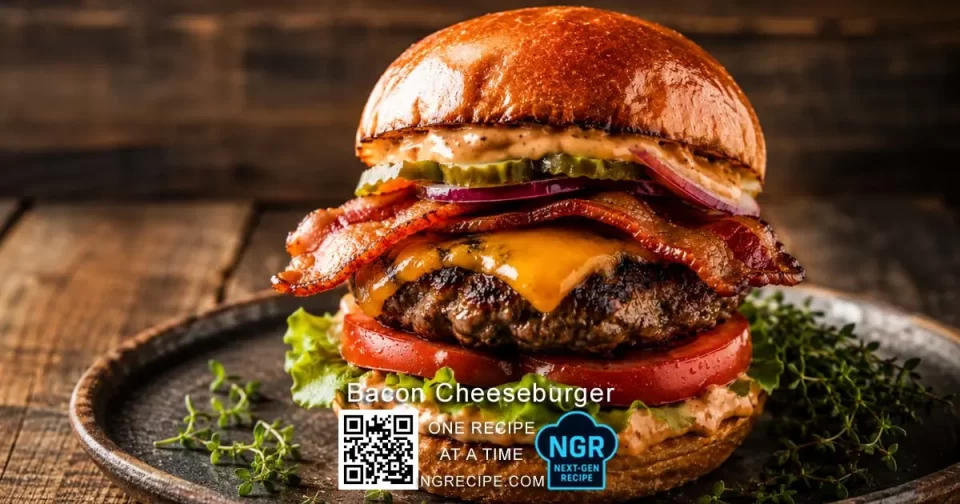
This classic bacon cheeseburger combines a juicy pan-seared beef patty, crisp bacon, melted cheddar cheese, toasted buns, fresh vegetables, dill pickles, and a creamy burger sauce. It is rich, savoury, satisfying, and achievable in a home kitchen without specialised equipment.
Quick Recipe Card
What This Recipe Is
A bacon cheeseburger is an American-style hamburger topped with cooked bacon and melted cheese. This version uses generously sized ground beef patties, pan-seared for a deeply browned crust while remaining moist inside.
The burgers are assembled with crisp lettuce, ripe tomato, sliced onion, dill pickles, and a balanced mixture of mayonnaise, ketchup, and yellow mustard. Toasting the buns with butter improves flavour and helps prevent the sauces and burger juices from making the bread soggy.
The result is a substantial burger with contrasting layers of juicy beef, crisp bacon, creamy melted cheese, cool vegetables, tangy pickles, and toasted bread.
Ingredients
- 680 g (1½ lb) ground beef with approximately 20% fat
- 8 slices bacon
- 80 g (3 oz) cheddar cheese, cut into 4 slices
- 4 burger buns
- 4 large lettuce leaves
- 1 medium tomato, cut into 8 slices
- ½ medium onion, thinly sliced
- 60 g (⅓ cup) sliced dill pickles
- 60 g (¼ cup) mayonnaise
- 30 g (2 tablespoons) ketchup
- 20 g (1 tablespoon plus 1 teaspoon) yellow mustard
- 15 g (1 tablespoon) unsalted butter, softened
- 5 g (¾ teaspoon) salt
- 2 g (1 teaspoon) freshly ground black pepper
Equipment
- Large heavy frying pan or cast-iron skillet
- Wide metal spatula
- Kitchen tongs
- Chopping board
- Sharp knife
- Small mixing bowl
- Measuring spoons
- Plate or tray
- Paper towels
- Instant-read food thermometer
Instructions
Step 1:
Wash and dry the lettuce and tomato. Slice the tomato and onion, then drain the dill pickles well. Keep the prepared vegetables chilled while cooking the burgers.
Step 2:
Transfer the bacon to a plate lined with paper towels. Carefully pour most of the rendered bacon fat from the pan, leaving only a thin coating behind.
Step 3:
Press a shallow indentation into the centre of each patty. Season both sides evenly with the salt and black pepper. Avoid compressing the meat more than necessary.
Step 4:
Toast for 1 to 2 minutes, working in batches if necessary, until the surfaces are golden and lightly crisp. Transfer the toasted buns to a clean plate.
Step 5:
Turn the patties once with the spatula. Cook the second side for another 3 to 5 minutes, depending on thickness, until the centres reach 71°C (160°F).
Step 6:
Transfer the patties to a clean plate and rest them for 3 minutes.
Step 7:
Spread the sauce over the toasted sides of both the bottom and top buns.
Step 8:
Cover with the top buns and serve immediately while the beef is hot, the cheese is melted, and the bacon remains crisp.
Visual Cooking Cues
- The bacon is ready when most of its visible fat has rendered and the meat appears evenly browned with crisp, slightly rippled edges. It should feel firm rather than soft when lifted with tongs.
- Properly toasted buns have an even golden surface with slightly darker contact points. The interior should feel dry and lightly crisp while the outside remains soft.
- The first side of each beef patty is ready to turn when a dark brown crust has formed and the patty releases from the pan with minimal resistance. The edges will begin to look cooked, but the upper centre may still appear red.
- The finished beef should feel firm but not hard. Clear or lightly coloured juices may collect around the patty, and the internal temperature should reach 71°C (160°F).
- The cheddar cheese should soften over the patty and begin to drape around its edges without separating into an oily layer.
Chef Tips
- Use ground beef containing approximately 20% fat. The fat supports moisture, flavour, browning, and a tender texture.
- Keep the beef cold until shaping. Cold fat remains distributed through the patty and renders gradually during cooking.
- Handle the meat gently. Firmly packing or repeatedly kneading the beef creates a dense, springy burger.
- Shape the patties slightly wider than the buns because they contract during cooking.
- The shallow centre indentation helps the patties remain relatively flat instead of swelling into rounded centres.
- Season immediately before cooking. Salting the meat too early can draw out moisture and create a firmer texture.
- Preheat the pan thoroughly before adding the patties. Strong initial heat encourages browning and prevents the meat from steaming.
- Turn each patty only once when possible. Repeated turning can slow crust development, although it does not need to be avoided when heat control requires adjustment.
- Never press the patties with the spatula while cooking. Pressing forces out rendered fat and moisture.
- Drain the dill pickles and dry the lettuce thoroughly. Excess moisture can make the buns soggy.
- Build the burger with lettuce beneath the patty. The lettuce acts as a light moisture barrier between the juicy beef and the bottom bun.
Common Mistakes
- Using very lean ground beef can produce patties that feel dry and crumbly. Beef with approximately 20% fat gives a more succulent result.
- Overworking the ground beef creates compact patties with a firm, sausage-like texture.
- Making patties exactly the same diameter as the buns can leave the finished burgers noticeably smaller after cooking.
- Placing the patties in a lukewarm pan prevents rapid browning and can cause them to cook in released moisture.
- Pressing down on the patties releases flavourful juices and can make the burgers dry.
- Adding cheese too early may cause it to overheat, separate, or slide from the patties.
- Skipping the bun-toasting step makes the bread more vulnerable to moisture from the sauce, vegetables, and meat.
- Assembling the burgers too far in advance allows the lettuce to wilt and the buns to soften.
Troubleshooting
The patties are dry
The beef may have been too lean, overcooked, heavily compressed, or pressed during cooking. Use beef with approximately 20% fat, shape it gently, and remove it from the pan once it reaches 71°C (160°F).
The patties are rounded in the centre
The meat naturally contracts as it cooks. Form the patties slightly wider and press a shallow indentation into the centre before cooking.
The patties are falling apart
The patties may have been shaped too loosely or turned before the first crust formed. Shape them gently but securely, then wait until the underside has browned before turning.
The beef is grey rather than browned
The pan may not have been hot enough, the patties may have been crowded, or excess liquid may have accumulated. Use a well-heated pan and cook in batches when necessary.
The cheese is not melting
Add the cheddar during the final minute of cooking and briefly cover the pan to trap warm air around the patties.
The bacon is cooking unevenly
Begin with a cold pan and use moderate heat. This gives the bacon fat time to render before the lean sections become overly dark.
The bottom bun becomes soggy
Toast the buns thoroughly, drain the pickles, dry the lettuce, and place the lettuce between the bottom bun and the beef patty.
The burger is difficult to eat
The vegetables may be cut too thickly or the components may be stacked unevenly. Use thin onion slices, moderately thin tomato slices, and an even distribution of pickles.
Ingredient Pairings
- Ground beef, cheddar cheese, and bacon form the main savoury foundation. The beef provides richness, the cheddar adds creamy sharpness, and the bacon contributes saltiness and crisp texture.
- Lettuce and tomato provide freshness that offsets the richness of the meat, cheese, and bacon.
- Onion adds a crisp texture and a clean, pungent note that cuts through the fatty components.
- Dill pickles contribute acidity, saltiness, and crunch. Their sharp flavour helps balance the creamy sauce and melted cheese.
- Mayonnaise softens the stronger flavours and creates a smooth coating, while ketchup adds sweetness and acidity.
- Yellow mustard introduces a bright, tangy quality that keeps the sauce from tasting excessively sweet or heavy.
- Butter reinforces the toasted flavour of the buns and helps create a lightly crisp inner surface.
Substitutions
- Ground beef with a slightly lower fat content may be used, but the patties will be less rich and should be monitored carefully to prevent overcooking.
- Turkey bacon may replace pork bacon. Cook it according to its thickness and remove it once browned and crisp.
- American-style cheese may replace cheddar for a softer, more uniform melt.
- A mild provolone or Monterey Jack may be used when a gentler cheese flavour is preferred.
- Gluten-free burger buns may replace standard buns for people avoiding gluten. Check all packaged condiments and bacon separately because formulations vary.
- Dairy-free cheese and a dairy-free spread may replace the cheddar and butter. Melting characteristics differ between products.
- Egg-free mayonnaise may be used when avoiding egg.
- Finely shredded lettuce may replace whole lettuce leaves, although it provides less protection against moisture.
- Red onion may replace the regular onion for a slightly sharper flavour and brighter colour.
- Bread-and-butter pickles may replace dill pickles, but the finished burger will taste noticeably sweeter.
Recipe Family Variations
- Double Bacon Cheeseburger
- Smash Bacon Cheeseburger
- Grilled Bacon Cheeseburger
Serving Suggestions
- Serve the bacon cheeseburgers immediately after assembly so the patties remain hot and the bacon and vegetables retain their texture.
- For easier handling, secure each burger through the centre with a food-safe burger pick and allow diners to remove it before eating.
- The burger is substantial enough to serve as the centre of a full meal. A simple, lightly dressed salad can provide a fresh contrast to its richness.
- For a casual gathering, prepare the vegetables and sauce in advance, then cook the bacon and burgers shortly before serving. Assemble each burger only when it is ready to be eaten.
- For a self-serve meal, arrange the lettuce, tomato, onion, pickles, sauce, bacon, and cheese-covered patties separately so each person can assemble a fresh burger.
Dietary Classification
This recipe contains beef, pork, dairy, gluten, and likely egg from the mayonnaise.
It is not suitable for vegetarian or vegan diets.
It can be adapted for a gluten-free diet by using certified gluten-free buns and checking the bacon, cheese, mustard, mayonnaise, and ketchup labels individually.
It can be adapted for a dairy-free diet by replacing the cheddar cheese and butter with suitable dairy-free alternatives.
The burger is naturally high in protein because of the beef, bacon, and cheese. It is also relatively high in saturated fat and sodium, so portion size and accompanying foods may be considered according to individual dietary needs.
Nutrition Information
Approximate nutrition per serving:
- Calories: 920
- Protein: 51 g
- Carbohydrates: 40 g
- Fat: 61 g
- Saturated Fat: 23 g
- Fiber: 3 g
- Sugar: 9 g
- Sodium: 1,550 mg
Storage / Reheating
For the best texture, store the cooked components separately rather than refrigerating fully assembled burgers.
Allow cooked patties and bacon to cool promptly. Transfer them to separate airtight containers and refrigerate within 2 hours of cooking.
Cooked beef patties can be refrigerated for up to 3 days. Cooked bacon can generally be refrigerated for up to 4 days.
Store washed and sliced vegetables in separate covered containers. Use the sliced tomato as soon as practical because it softens and releases moisture during storage.
Keep the sauce refrigerated in a sealed container and use it within 3 days.
To reheat the patties, place them in a covered pan over medium-low heat with the cheddar already attached. Warm gently until the centres reach 74°C (165°F).
The patties may also be reheated in a microwave at moderate power in short intervals. Avoid prolonged heating, which can make the beef tough.
Reheat the bacon briefly in a dry pan until hot and crisp.
Toast the buns again immediately before assembly. Add fresh lettuce, tomato, onion, and pickles only after the hot components have been reheated.
Freezing fully assembled burgers is not recommended because the vegetables, sauce, and buns lose their intended texture.
Cooked patties can be frozen without the vegetables and sauce for up to 2 months. Wrap them individually, place them in a freezer-safe container, and thaw them in the refrigerator before reheating.
FAQ
Can I prepare the burger patties in advance?
Yes. Shape the patties up to one day in advance, arrange them in a covered container with separation between layers, and refrigerate them. Season them immediately before cooking rather than during storage.
Why should I use ground beef with approximately 20% fat?
The fat improves flavour, browning, tenderness, and moisture. Very lean beef has a greater risk of becoming dry during the high-heat cooking needed to create a browned crust.
Do I need to add egg or breadcrumbs to the patties?
No. A traditional hamburger-style patty does not require egg or breadcrumbs. Gently shaped ground beef will hold together when handled carefully and cooked after the pan is properly heated.
Why is there an indentation in the centre of each patty?
The centre tends to expand as the meat contracts during cooking. A shallow indentation helps compensate for this movement and produces a flatter finished patty.
Can I cook the bacon and burgers in the same pan?
Yes. Cook the bacon first, remove most of the rendered fat, and leave a thin coating in the pan. This reduces cleanup and contributes savoury flavour to the patties.
Should I bring the beef to room temperature before cooking?
No. Keep the patties refrigerated until shortly before cooking. Cold beef is easier to handle, and the fat remains more evenly distributed during the early stages of cooking.
How do I know when the patties are safely cooked?
Insert an instant-read thermometer horizontally into the centre of each patty. Ground beef should reach an internal temperature of 71°C (160°F).
Can I make thinner patties?
Yes. Divide the same quantity of beef into smaller portions or flatten each patty more widely. Thin patties cook rapidly, so reduce the cooking time and monitor the internal temperature closely.
Why should I rest the patties?
A short rest allows the internal heat and moisture to settle slightly before assembly. Three minutes is sufficient for these patties and prevents the cheese from cooling excessively.
How can I keep several burgers warm?
Place the cooked cheese-covered patties on a warm tray and cover them loosely for a short period. Do not assemble the burgers until serving because trapped heat can wilt the lettuce and soften the buns.
Can I omit the sauce?
Yes. The burger can be assembled with individual portions of mayonnaise, ketchup, or mustard, although the combined sauce provides a more even balance of creaminess, sweetness, and acidity.
Can I cook the patties to a lower temperature?
Ground beef should reach 71°C (160°F). Unlike an intact steak, ground meat may distribute surface bacteria throughout the interior during processing.
Why This Recipe Works
Ground beef containing approximately 20% fat creates a useful balance between structure and moisture. As the patty cooks, some of the fat renders while enough remains within the meat to support tenderness and flavour.
The heavy pan provides concentrated contact heat, producing rapid browning on the patty surfaces. Browning develops deeper savoury flavours and a contrasting crust without requiring the entire interior to become dry.
The patties are shaped gently rather than tightly compressed. This preserves small spaces within the ground meat, creating a more tender bite.
The centre indentation controls the tendency of the patties to swell during cooking. This gives them a flatter surface that supports the cheese and burger toppings more evenly.
Cooking the bacon slowly from a cold pan renders its fat before its lean sections become overly dark. The result is crisper, more evenly cooked bacon.
Adding cheddar during the final minute gives it enough heat to melt without prolonged exposure that could cause excessive oil separation.
Toasted buns provide flavour and structural protection. Their dried, lightly browned inner surfaces absorb moisture more slowly than untoasted bread.
The lettuce beneath the patty creates an additional barrier between the beef juices and the bottom bun.
The sauce balances richness through three complementary components. Mayonnaise contributes creaminess, ketchup adds sweetness and acidity, and mustard adds sharper acidity and mild pungency.
Fresh tomato, lettuce, onion, and dill pickles prevent the burger from tasting one-dimensional by adding moisture, acidity, crispness, and fresh aroma.
Recipe Identity
Bacon cheeseburger is the specific identity of this recipe.
Its defining structure consists of a ground beef hamburger patty, cheese, cooked bacon, a split burger bun, and commonly used burger accompaniments.
Removing the bacon would change the identity to a cheeseburger. Removing both the bacon and cheese would reduce it to a standard hamburger.
The recipe belongs to the hamburger family and the cheeseburger subfamily. Bacon is a defining secondary protein rather than a casual garnish in this preparation.
This version is specifically a pan-seared bacon cheeseburger because the beef patties are cooked through direct contact with a heated pan.
Dish Classification
The dish is a hot, assembled main course built around a cooked ground beef patty served inside a split bun.
It belongs to American burger cookery and combines pan-searing, bacon cooking, bun toasting, cheese melting, sauce mixing, and final assembly.
Its main structural elements are bread, ground meat, cured pork, cheese, fresh vegetables, pickled vegetables, and condiments.
The burger is individually portioned and usually eaten by hand.
Its dominant sensory characteristics are savoury richness, browned meat flavour, melted dairy, crisp bacon, tangy pickles, creamy sauce, fresh vegetables, and toasted bread.
Recipe History
The bacon cheeseburger developed from the American hamburger and cheeseburger traditions.
Hamburgers became widely established in the United States as ground beef patties served in split bread or buns. Cheese was later added to create the cheeseburger, which became a recognised burger form of its own.
Bacon became an increasingly familiar burger addition as restaurants and home cooks expanded cheeseburger combinations. Its crisp texture and cured, salty flavour paired naturally with beef and melted cheese.
There is no single preparation method that defines every bacon cheeseburger. Patties may be cooked on a flat griddle, in a skillet, or over a grill, while cheeses, buns, vegetables, and condiments vary by region and personal preference.
The essential identity remains a hamburger-style beef patty combined with cheese and bacon inside a bun.
Cultural Notes
The bacon cheeseburger is strongly associated with casual American dining, diners, drive-ins, burger restaurants, cookouts, and home meals.
It reflects a style of food built around customisation. Diners often adjust the vegetables, condiments, cheese quantity, patty thickness, and bacon crispness while retaining the basic bacon cheeseburger identity.
The dish is commonly connected with informal gatherings, sporting events, outdoor meals, and restaurant comfort food.
Because bacon contains pork, the recipe is not suitable for people who avoid pork for religious, cultural, ethical, or dietary reasons unless an appropriate alternative is used.
The burger is rich and substantial, so it is often served as an occasional comfort food rather than an everyday balanced meal.
Culinary Context
The bacon cheeseburger demonstrates how layering can create balance in a rich handheld dish.
The beef, bacon, cheddar, butter, and mayonnaise provide fat, savoury depth, and fullness. Ketchup, mustard, tomato, and dill pickles provide acidity that prevents the richness from overwhelming the palate.
Lettuce, onion, bacon, and toasted buns contribute different forms of crispness. These contrasts make each bite more dynamic than a burger composed only of soft ingredients.
The dish also illustrates the importance of sequencing. Bacon is cooked first, buns are toasted before the patties, cheese is added near the end of cooking, and cool vegetables are added only during final assembly.
Each technique supports a particular sensory result: crisp bacon, protected buns, browned beef, properly melted cheese, and fresh vegetables.
Advanced Cooking Knowledge Open detailed cooking science and reference notes
Flavor, Texture, and Aroma Profile
The primary flavour is deeply savoury beef supported by salty, cured bacon and tangy cheddar cheese.
The burger sauce is creamy, mildly sweet, and acidic. Mustard gives it a sharper finish that cuts through the richer ingredients.
Dill pickles add a pronounced tangy and salty note. Tomato contributes gentle acidity and natural sweetness, while onion adds clean pungency.
The buns introduce toasted, buttery flavours that frame the filling without overpowering it.
The texture combines a browned beef crust, tender patty centre, crisp bacon, melted cheese, cool lettuce, juicy tomato, crunchy onion, firm pickles, creamy sauce, and a lightly crisp bun interior.
The aroma is dominated by browned beef, cooked bacon, melted cheddar, toasted bread, butter, onion, and mustard.
Flavor Balance
Saltiness comes primarily from the bacon, cheddar cheese, dill pickles, added salt, and prepared condiments.
Richness comes from the beef fat, bacon, cheese, mayonnaise, and butter.
Acidity comes from the ketchup, mustard, tomato, and dill pickles.
Mild sweetness comes from the ketchup, tomato, onion, and burger buns.
Pungency comes from the onion, mustard, and black pepper.
Freshness comes from the lettuce and tomato.
A successful burger keeps these qualities in balance. Excess sauce can hide the beef flavour, while insufficient acidity can make the burger feel heavy.
Flavor Components
Primary savoury component: Ground beef
Cured savoury component: Bacon
Dairy component: Cheddar cheese
Creamy component: Mayonnaise
Sweet-acidic component: Ketchup
Sharp acidic component: Yellow mustard
Pickled acidic component: Dill pickles
Fresh components: Lettuce, tomato, and onion
Toasted component: Buttered burger buns
Seasoning components: Salt and black pepper
Ingredient Notes
Ground beef with approximately 20% fat is preferred because it remains moist under high heat and develops a full beef flavour.
Bacon thickness affects cooking time. Thin slices crisp quickly, while thicker slices require lower heat and more time for the fat to render.
Cheddar cheese provides a recognisable sharpness that stands up to beef and bacon. Medium or mild cheddar generally melts more smoothly than a very mature, dry cheddar.
Burger buns should be broad enough to support the cooked patties. Soft buns create a tender bite, but they benefit significantly from toasting.
Lettuce leaves should be fully dry before assembly. Moist lettuce can weaken the bottom bun.
Tomatoes should be ripe but firm. Very soft tomatoes release excessive moisture and may slide from the burger.
Thin onion slices are easier to bite through than thick rings and distribute pungency more evenly.
Dill pickles should be drained well. Their acidity is important, but excessive brine can make the burger wet and overly salty.
The mayonnaise, ketchup, and mustard should be blended until uniform so each bite receives a balanced amount of sauce.
Ingredient Science
Ground beef is composed of small pieces of muscle, fat, water, and connective tissue. Gentle shaping allows these pieces to remain loosely arranged, producing a tenderer texture after cooking.
Salt dissolves some muscle proteins on the meat surface. Applying it shortly before cooking seasons the exterior without giving it enough time to create a dense, cured texture.
During pan-searing, moisture evaporates from the patty surface. Once the surface becomes sufficiently dry and hot, browning reactions create complex savoury aromas and a dark crust.
Beef fat melts as the patty heats. Some escapes into the pan, while some remains within the meat and contributes to juiciness.
Bacon fat renders gradually when bacon begins in a cold pan. Slow temperature increase gives solid fat time to melt before the lean meat becomes overcooked.
Cheddar softens as its fat and protein structure warms. Brief, controlled heat allows it to melt over the patty without excessive separation.
Bread becomes more resistant to moisture when toasted because surface water evaporates and the crumb becomes firmer.
Mayonnaise acts as an emulsion, creating a creamy sauce that helps carry the flavours of ketchup and mustard across the burger.
Ingredient Roles
Ground beef: Provides the primary protein, structure, savoury flavour, and central patty.
Bacon: Adds cured flavour, saltiness, fat, and crisp texture.
Cheddar cheese: Adds dairy richness, tanginess, and a melted layer over the beef.
Burger buns: Contain the filling and provide a soft, toasted bread component.
Lettuce: Adds freshness, crispness, and a moisture barrier.
Tomato: Adds juiciness, mild sweetness, acidity, and freshness.
Onion: Adds pungency and crunch.
Dill pickles: Add acidity, saltiness, and crisp texture.
Mayonnaise: Adds creaminess and binds the sauce.
Ketchup: Adds sweetness, tomato flavour, and acidity.
Yellow mustard: Adds sharpness and acidity.
Unsalted butter: Encourages even bun browning and adds richness.
Salt: Enhances the natural flavours of the beef.
Black pepper: Adds mild heat and aromatic pungency.
Ingredient Classification
Primary protein: Ground beef
Secondary protein: Bacon
Primary dairy: Cheddar cheese
Bread component: Burger buns
Fresh vegetable components: Lettuce, tomato, and onion
Pickled vegetable component: Dill pickles
Fat components: Beef fat, bacon fat, mayonnaise, cheddar cheese, and butter
Condiment components: Mayonnaise, ketchup, and yellow mustard
Seasoning components: Salt and black pepper
Preparation Techniques
Cold ingredient preparation keeps the vegetables crisp while the hot components cook.
Even slicing helps the tomato, onion, and pickles remain stable inside the assembled burger.
Dividing the beef by weight creates patties with similar dimensions and cooking times.
Gentle shaping preserves a tender texture by limiting compression of the ground meat.
Forming the patties slightly wider than the buns compensates for contraction during cooking.
Creating a shallow centre indentation helps prevent the patties from becoming excessively domed.
Draining the bacon and pickles controls excess fat and moisture.
Mixing the condiments before assembly produces consistent flavour distribution.
Cooking Techniques
Pan-searing cooks the beef through direct contact with a hot surface and develops a browned crust.
Cold-pan bacon cooking renders the fat gradually and promotes even crispness.
Toasting browns and dries the cut surfaces of the buns.
Covered melting traps warm air around the cheddar and helps it soften quickly.
Resting allows the cooked patties to settle briefly before assembly.
Assembling in a deliberate sequence protects the buns and distributes the components evenly.
Heat Management
Use medium heat for the bacon. Excessively high heat can burn the lean sections before the fat renders fully.
Use medium heat when toasting the buttered buns. Butter and bread solids can darken rapidly.
Use medium-high heat for the beef patties. The pan must be hot enough to brown the meat but not so hot that the crust burns before the centre reaches a safe temperature.
If the exterior darkens too rapidly, reduce the heat slightly after turning the patties.
Cover the pan only briefly when melting the cheese. Prolonged covering traps steam and can soften the crust.
Use an instant-read thermometer rather than relying only on colour. Ground beef colour can vary even when properly cooked.
Texture Development
The patty crust develops through direct contact between the meat and the hot pan.
The patty centre remains tender when the beef contains adequate fat, is shaped gently, and is not overcooked.
Bacon becomes crisp as its fat renders and surface moisture evaporates.
Cheddar becomes soft and cohesive when heated briefly over the cooked patties.
The toasted bun interior becomes lightly crisp while the exterior stays soft.
Lettuce, onion, and pickles contribute firm, fresh crunch.
Tomato adds a softer, juicy texture that contrasts with the crisp vegetables and bacon.
The sauce connects the ingredients with a smooth, creamy texture.
Cooking Time Control
Bacon cooking time varies according to thickness, pan material, and heat strength. Use browning and crispness as the primary indicators.
Bun toasting usually takes only 1 to 2 minutes. Check the cut surfaces frequently because they can darken quickly.
Patty cooking time depends on diameter, thickness, starting temperature, and pan heat. A 170 g (6 oz) patty commonly requires approximately 6 to 9 minutes of total pan time.
Cheese needs approximately 1 minute to melt when placed on a hot patty.
Resting time should remain brief. A 3-minute rest helps the patties settle without allowing them to cool substantially.
Flavor Pairing Logic
Beef and cheddar work together because the cheese reinforces savoury richness while adding tanginess.
Bacon intensifies the beef flavour through smoke-like cured aromas, saltiness, and crisp texture.
Pickles and mustard provide strong acidity, which counterbalances the combined fat of the beef, bacon, cheese, mayonnaise, and butter.
Ketchup softens the sharper mustard and pickle flavours with sweetness.
Tomato connects the fresh and condiment components through its combination of moisture, sweetness, and acidity.
Onion adds pungency that remains distinct against the rich meat and cheese.
Lettuce contributes freshness without competing strongly with the central flavours.
The toasted bun provides a mild, buttery base that supports all components and adds a roasted aroma.
Leftover Ideas
Chop a leftover cooked patty and bacon, reheat them thoroughly, and serve them over fresh lettuce with tomato, onion, pickles, and a small amount of the burger sauce.
Crumble reheated beef and bacon into a toasted bun and top with melted cheddar for a loosely assembled chopped bacon cheeseburger.
Slice a leftover patty and serve it with the remaining tomato, onion, pickles, and sauce in a fresh toasted bun.
Leftover cooked components should be reheated only once and must reach 74°C (165°F) before serving.
Do not reuse lettuce or tomato that has remained inside a stored assembled burger if it has become wilted, warm, or excessively wet.
Cooking Safety Notes
Keep raw ground beef separate from cooked bacon, buns, vegetables, sauce, and serving plates.
Wash hands thoroughly after handling raw beef and before touching ready-to-eat ingredients.
Use separate utensils or thoroughly cleaned utensils for raw and cooked meat.
Do not place cooked patties back on the plate or tray that held the raw patties unless it has been washed.
Cook ground beef to an internal temperature of 71°C (160°F).
Insert the thermometer into the centre of the patty from the side for the most representative reading.
Refrigerate perishable ingredients and leftovers within 2 hours, or within 1 hour in very hot conditions.
Reheat cooked leftovers to 74°C (165°F).
Take care when draining bacon fat because it can cause severe burns. Allow it to cool before transferring or discarding it appropriately.
Never pour bacon fat directly into a sink because it can solidify and obstruct plumbing.
Sustainability Notes
Purchase only the quantity of beef, bacon, cheese, and vegetables needed for the planned servings.
Choose burger buns sold in quantities that match the recipe or freeze unused buns before they become stale.
Use slightly stale but safe buns for toasting rather than discarding them.
Save suitable onion, tomato, and lettuce trimmings for another meal when they remain clean and fresh.
Prepare only the amount of sauce needed to reduce condiment waste.
Store leftovers promptly and keep components separate so they retain better quality and are more likely to be eaten.
Allow rendered bacon fat to cool and solidify before disposal according to local waste practices.
Reusable kitchen cloths may be used for general cleaning, but disposable towels are safer for direct contact with raw meat juices.
Recipe Classification
Primary dish type: Burger
Parent family: Hamburger
Subfamily: Cheeseburger
Specific recipe identity: Bacon Cheeseburger
Cuisine: American
Country: United States
Meal role: Main Course
Primary protein: Ground Beef
Secondary protein: Bacon
Primary dairy: Cheddar Cheese
Bread component: Burger Buns
Fresh components: Lettuce, Tomato, Onion
Pickled component: Dill Pickles
Condiment profile: Mayonnaise, Ketchup, Yellow Mustard
Cooking methods: Pan-Searing, Toasting, Assembling
Serving style: Hot Assembled Burger
Difficulty level: Easy
Occasions: Weeknight Dinner, Game Day, Casual Gathering
