Hamburger
A classic hamburger is a seasoned ground beef patty cooked over high heat and served in a toasted bun with crisp vegetables and simple condiments. This version focuses on a juicy interior, a browned crust, balanced toppings, and practical technique so the burger holds together, cooks evenly, and stays satisfying rather than greasy or soggy.
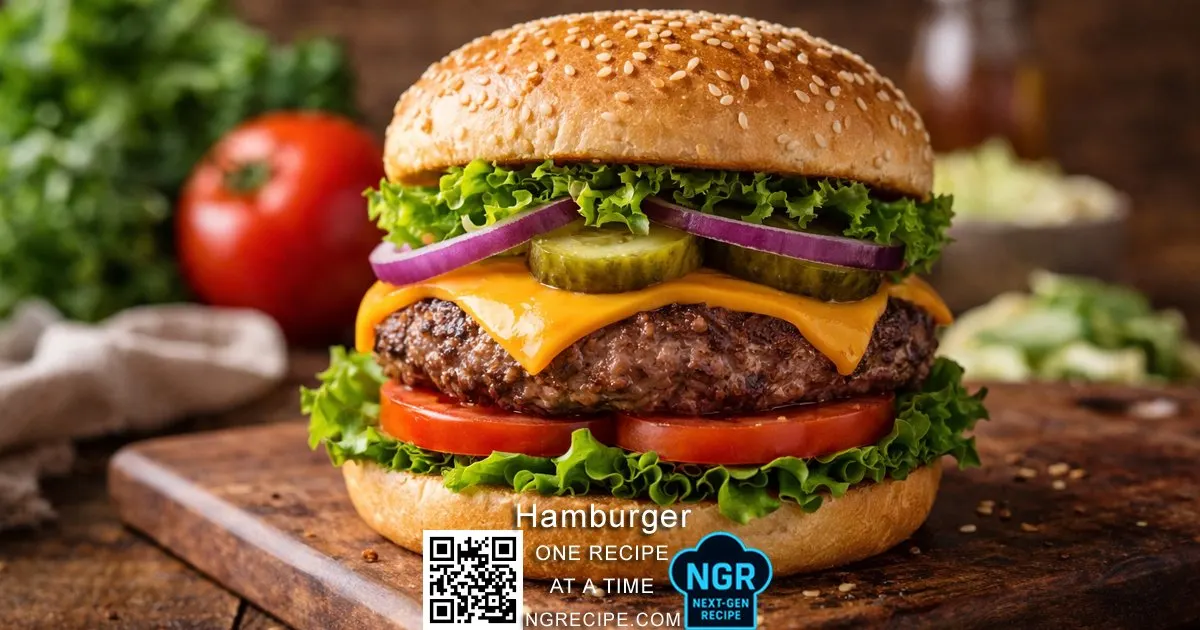
Quick Recipe Card
What This Recipe Is
A hamburger is a hot sandwich built around a ground beef patty served in a sliced bun. In its most recognisable form, it is simple, beef-forward, and designed around contrast: savoury meat, soft toasted bread, cool fresh vegetables, and sharp condiments.
Ingredients
- 680 g ground beef, about 80/20 lean-to-fat ratio (1 1/2 lb)
- 1 1/2 tsp fine salt (1 1/2 tsp)
- 1 tsp freshly ground black pepper (1 tsp)
- 2 tsp neutral oil, if pan-cooking (2 tsp)
- 4 burger buns (4 buns)
- 4 slices cheddar cheese, optional but classic (4 slices)
- 8 thin slices onion, preferably white or red (8 slices)
- 4 lettuce leaves (4 leaves)
- 8 tomato slices (8 slices)
- 16 pickle slices (16 slices)
- 4 tbsp mayonnaise (1/4 cup)
- 2 tbsp yellow mustard (2 tbsp)
- 2 tbsp ketchup (2 tbsp)
Equipment
- Large cast-iron skillet, heavy frying pan, griddle, or grill
- Spatula
- Mixing bowl
- Kitchen scale or measuring spoons
- Plate or tray for formed patties
- Knife and chopping board
- Instant-read thermometer, helpful for doneness control
Instructions
Step 1:
Divide the ground beef into 4 equal portions of about 170 g each (6 oz each). Shape each portion gently into a patty about 10 to 11 cm wide (4 to 4 1/2 inches wide) and 1.5 to 2 cm thick (about 5/8 to 3/4 inch thick). Press a shallow dent into the centre of each one. Do not overwork the meat.
Step 2:
Season both sides of the patties with the salt and black pepper just before cooking.
Step 3:
Heat a large skillet, griddle, or grill over medium-high to high heat. If using a skillet or griddle, add the neutral oil.
Step 4:
Place the patties on the hot surface and cook without pressing them down. Cook for 4 to 5 minutes on the first side until the bottom is well browned.
Step 5:
Flip the patties and cook for 3 to 4 minutes more, or until the internal temperature reaches 71°C (160°F) for fully cooked ground beef. In the last 1 minute, top each patty with a slice of cheddar cheese if using.
Step 6:
While the patties cook or rest, toast the burger buns cut-side down until lightly golden and warm.
Step 7:
Spread the bottom bun halves with the mayonnaise. Spread the top bun halves with the mustard and ketchup.
Step 8:
Build each burger with lettuce, the cooked beef patty, onion, tomato, and pickle. Close with the top bun.
Step 9:
Rest the assembled burgers for about 1 minute only if needed for easier handling, then serve immediately.
Visual Cooking Cues
- The raw patty should look loosely formed, not compressed.
- The pan should sizzle the moment the patty touches it.
- The first side is ready to flip when the edges darken slightly and the underside releases cleanly.
- The cheese should look softened and melted, not oily and separated.
- The bun should be lightly golden, not hard or deeply browned.
- The finished burger should look tall but stable, not wet or collapsed.
Chef Tips
- Use cold beef for easier shaping and cleaner edges.
- Season the outside just before cooking for better texture.
- A centre dent helps prevent doming.
- Do not press burgers with a spatula while cooking, because that squeezes out juices.
- Toast buns every time, even for very soft buns.
- Slice tomatoes thick enough to stay in place but not so thick that they slide.
Common Mistakes
- Overmixing the ground beef
- Packing patties too tightly
- Using very lean beef
- Cooking on a pan that is not hot enough
- Flipping repeatedly
- Pressing the burger while cooking
- Skipping bun toasting
- Overloading the burger with wet toppings
Troubleshooting
- Burger is dry: The beef was too lean, overcooked, or packed too tightly.
- Burger fell apart: The patty may have been too loosely shaped or flipped too early before the crust set.
- Burger puffed into a ball: The centre dent was skipped or too shallow.
- Burger is greasy: The heat may have been too low, so the patty steamed instead of browning properly.
- Bun became soggy: Toast the bun more thoroughly and keep wet condiments from soaking directly into the bread for too long.
- Burger lacks flavour: Salt level may be too low, or the patty did not brown enough.
- Vegetables keep slipping out: Use thinner onion and tomato slices and avoid stacking too many slippery layers together.
Ingredient Pairings
- Cheddar cheese with beef and onion
- Pickles with ketchup and mustard
- Lettuce with mayonnaise for cool contrast
- Tomato with cheddar for juicy richness
- Onion with mustard for sharpness
- Toasted bun with beef fat and browned crust
Substitutions
- Ground beef: Use ground chuck if available; it is a strong classic choice.
- Cheddar cheese: Use American cheese for a softer melt and milder flavour.
- Burger buns: Use brioche buns for a richer bun, though they taste slightly sweeter.
- Yellow mustard: Use Dijon for a sharper flavour.
- Mayonnaise: Omit it if you prefer a less rich burger.
- Tomato: Omit when tomatoes are out of season and bland.
Recipe Family Variations
- Cheeseburger: A classic hamburger topped with melted cheese, usually cheddar or American, while keeping the same core burger structure.
- Slider: A smaller hamburger served on a small bun, typically with a thinner patty and a more compact format.
- Patty Melt: A close hamburger-family branch in which the beef patty is served with melted cheese and onion between sliced bread rather than a burger bun.
- Smash Burger: A hamburger made by pressing a beef ball onto a very hot flat surface to create a thinner patty with extra crust and browned edges.
Serving Suggestions
- Serve with oven chips, fries, potato wedges, or a crisp salad.
- Pair with coleslaw for cool crunch.
- Add extra pickles on the side for brightness.
- Serve with grilled corn or a simple cucumber salad in warm weather.
Dietary Classification
- Not vegetarian
- Not vegan
- Nut-free if buns and condiments are nut-free
- Can be made without cheese
- Can be made lower in carbohydrates by serving without the bun
Nutrition Information
Approximate per serving, including bun, cheese, vegetables, and condiments:
- Calories: 650
- Protein: 34 g
- Fat: 38 g
- Carbohydrates: 38 g
- Fiber: 3 g
- Sodium: 980 mg
Storage / Reheating
Storage
Store cooked patties separately from buns, vegetables, and condiments for best quality.
- Refrigerate cooked patties in a covered container for up to 3 days.
- Refrigerate sliced vegetables separately and use within 1 to 2 days for freshness.
- Do not store fully assembled burgers for long, as the buns become soggy.
Reheating
- Reheat cooked patties in a covered skillet over low to medium heat until hot throughout.
- You can also reheat in an oven at 180°C (350°F) for about 8 to 10 minutes.
- Re-toast buns briefly before serving.
- Reassemble with fresh lettuce, tomato, onion, pickle, mayonnaise, mustard, and ketchup.
FAQ
Can I cook this on a grill instead of a pan?
Yes. A grill adds smokiness and works very well, especially for moderately thick patties.
Why should I not mix the salt into the meat too early?
Salt can tighten the texture if worked deeply into ground meat too early, making the burger denser.
How do I stop the burger from shrinking too much?
Shape the patty slightly wider than the bun and make a centre dent before cooking.
Can I make the patties ahead?
Yes. Shape them a few hours ahead and keep them chilled, covered, until cooking time.
Do I need cheese?
No. A hamburger is complete without cheese. Adding cheese makes it a cheeseburger-style variation.
Why is my burger not browning well?
The pan may not be hot enough, the surface may be crowded, or the patty may be too wet.
Can I freeze the patties?
Yes. Freeze raw shaped patties between sheets of baking paper and thaw safely in the refrigerator before cooking.
Why This Recipe Works
- Using beef with moderate fat gives a juicy burger without making it dense.
- Gentle handling keeps the patty tender instead of sausage-like.
- A shallow dent in the centre helps the patty cook flatter rather than puffing up.
- High heat builds a strong browned crust, which improves flavour.
- Toasting the buns reduces sogginess and helps them hold condiments and meat juices.
- Layering lettuce below the patty or between wet elements can help protect the bun from becoming soggy.
Recipe Identity
- A classic American-style hamburger
- Built from a formed beef patty rather than a loose meat filling
- Best known as a casual comfort food with broad home and restaurant appeal
- Most authentic when the beef flavour remains the centre of the dish
Dish Classification
- Dish type: Hot sandwich
- Course: Main course
- Meal type: Lunch or dinner
- Traditional or modern dish: Traditional modern classic
- Street food or home cooking: Both
- Festival or everyday food: Everyday food, cookout food, and casual celebration food
Recipe History
The hamburger is closely associated with the United States, where the beef patty-in-bun format became one of the most influential casual foods of the modern era. Its roots connect to minced beef traditions brought by immigrants and to the growth of diners, fairs, lunch counters, roadside stands, and backyard grilling culture. Over time, the hamburger evolved into both a home-cooked staple and an international fast-food icon.
Cultural Notes
The hamburger is one of the most recognisable foods associated with American casual dining. It exists in home kitchens, diners, burger shops, roadside grills, and backyard cookouts. While modern burgers can become elaborate, the classic hamburger remains defined by a simple seasoned beef patty, bun, and balanced toppings.
Advanced Cooking Knowledge Open detailed cooking science and reference notes
Flavor, Texture, and Aroma Profile
The flavour is deeply savoury and slightly roasted from surface browning. The texture should be juicy and tender inside, browned outside, soft in the bun, crisp from lettuce and pickle, and lightly creamy or tangy from condiments. The aroma is meaty, toasted, and slightly smoky if grilled.
Flavor Balance
A good hamburger balances rich beef fat, salt, toasted bread, fresh moisture from vegetables, and bright acidity from pickle, mustard, or ketchup. Without that balance, the burger can taste flat, heavy, or greasy.
Flavor Components
- Sweet: Tomato, ketchup, and toasted bun sweetness
- Salt: Salt in the patty, cheese, pickles, and condiments
- Acid: Pickles, mustard, ketchup, and tomato
- Bitter: Mild background notes from charred edges and toasted bun
- Umami: Beef, browned crust, cheese, and ketchup
- Aromatic elements: Onion, black pepper, toasted bread, and grilled beef aroma
Ingredient Notes
- Choose ground beef with enough fat for flavour and juiciness. Very lean beef often produces dry burgers.
- Soft burger buns are classic, but they should still be toasted for structure.
- Cheddar adds saltiness and melt, but the burger is still complete without cheese.
- Onion can be served raw for sharpness or lightly griddled for sweetness.
- Pickles add acidity, which helps cut through beef richness.
Ingredient Science
Ground beef burgers rely on protein bonding for structure and fat for juiciness. Overmixing strengthens the protein network too much, making the patty tight and springy. Salt enhances flavour, but mixing it deeply into the meat too early can firm the texture. Browning on the surface creates roasted flavours through the Maillard reaction, which is why high heat matters.
Ingredient Roles
- Ground beef: Main structure, fat, and umami
- Salt: Essential seasoning and flavour lift
- Black pepper: Mild heat and aromatic depth
- Neutral oil: Supports surface contact in a pan
- Burger buns: Soft structure and contrast to the patty
- Cheddar cheese: Melted richness and savoury depth
- Onion: Sharp or sweet aromatic contrast
- Lettuce: Crisp freshness
- Tomato: Juicy sweetness and acidity
- Pickle: Acid and crunch
- Mayonnaise: Creamy moisture
- Mustard: Tang and brightness
- Ketchup: Sweet-tangy balance
Ingredient Classification
- Primary protein: Ground beef
- Bread component: Burger buns
- Fresh produce: Onion, lettuce, tomato, pickle
- Dairy: Cheddar cheese
- Condiments: Mayonnaise, mustard, ketchup
- Seasonings: Salt, black pepper
- Cooking fat: Neutral oil
Preparation Techniques
- Divide the beef into equal portions before shaping.
- Form patties gently, about 1.5 to 2 cm thick (about 5/8 to 3/4 inch).
- Press a shallow dent into the centre of each patty.
- Slice the onion and tomato evenly for stable stacking.
- Wash and dry the lettuce so it does not water down the burger.
- Split the buns and prepare them for toasting.
Cooking Techniques
- Use high heat for strong surface browning.
- Flip only once when possible for better crust formation.
- Add cheese near the end so it melts without overcooking the beef.
- Toast buns cut-side down until lightly golden.
- Let the cooked patties rest briefly so juices settle.
Heat Management
- Low heat stages: None for the main patty cooking; low heat is only useful if holding toasted buns warm.
- Medium heat stages: Toasting buns can be done over medium heat.
- High heat stages: Main burger cooking should be done over medium-high to high heat.
- Temperature cues: The pan or grill should be hot enough that the patty sizzles immediately on contact. For food safety, cook ground beef to at least 71°C (160°F) internal temperature.
Texture Development
A well-made hamburger needs a browned crust and a juicy centre. The crust develops from firm contact with a hot surface. The interior stays tender when the meat is not packed tightly. Toasted buns create a dry barrier that resists sogginess. Lettuce adds crispness, while pickle sharpens the bite.
Cooking Time Control
Cooking time depends on patty thickness, fat level, pan heat, and starting temperature of the meat. For average patties, 4 to 5 minutes on the first side and 3 to 4 minutes on the second side usually works. Use a thermometer when precision matters, especially for thicker patties.
Flavor Pairing Logic
Hamburgers work because rich beef needs acidity and freshness. Pickles, mustard, and tomato lighten the palate, while cheese and mayonnaise deepen richness. Onion adds aromatic bite, and the toasted bun contributes light sweetness and structure.
Leftover Ideas
- Chop leftover cooked patties and use in a burger bowl with lettuce and tomato.
- Crumble reheated patty meat into a toasted sandwich with cheese and onion.
- Slice the patties and add to a lunch wrap with lettuce, pickle, and mustard.
Cooking Safety Notes
- Ground beef should be cooked to at least 71°C (160°F) internal temperature.
- Keep raw beef separate from vegetables and buns.
- Wash hands, knife, board, and plates after contact with raw meat.
- Do not place cooked patties back on the plate that held raw beef unless it has been washed.
- Refrigerate leftovers promptly.
Sustainability Notes
- Choose locally produced beef when practical.
- Use seasonal tomatoes and lettuce when possible.
- Toast and use all buns to reduce bread waste.
- Leftover vegetables can be used in salads or sandwiches the next day.
