Old Forge–Style Pizza
Old Forge–style pizza is a distinctive northeastern Pennsylvania tray pizza with a crisp, oil-fried base, a soft and pleasantly chewy interior, a restrained tomato-onion sauce, and a smooth blanket of mild melted cheese. Baked in a rectangular metal pan and served in rectangular “cuts,” it offers a regional pizza experience that is notably different from New York, Sicilian, or Detroit-style pizza.
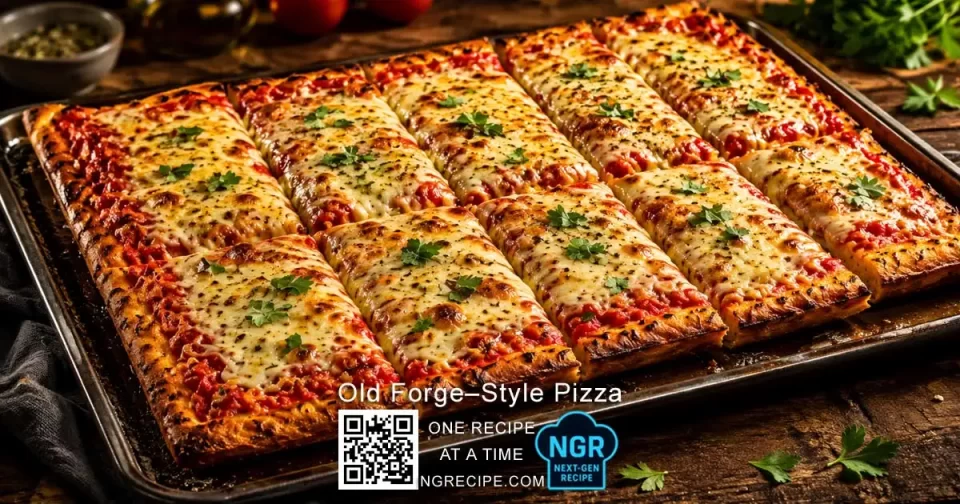
Quick Recipe Card
What This Recipe Is
Old Forge–style pizza is a regional American pan pizza associated with Old Forge and the surrounding communities of northeastern Pennsylvania. Local pizzerias traditionally sell it by the rectangular “cut” or by the whole “tray,” rather than by the slice or pie.
This recipe represents the classic red-pizza branch of the Old Forge family. Its defining features are a well-oiled rectangular pan, a moderately thick yeast-raised crust, a thin layer of simple tomato sauce, and a mild, creamy cheese blend. The dough should be crisp and lightly fried underneath while remaining tender and airy inside.
Unlike Detroit-style pizza, the cheese is not deliberately pushed against the pan to create a deeply caramelized edge. Unlike Sicilian pizza, the crust is generally less bread-like and the topping layer is more restrained. The finished pizza should feel balanced, soft, crisp, mild, and highly comforting.
Ingredients
- 285 ml (1 cup plus 3 tablespoons) lukewarm water, about 38°C (100°F)
- 5 g (1 1/2 teaspoons) instant yeast
- 12 g (1 tablespoon) granulated sugar
- 425 g (3 1/2 cups) bread flour
- 9 g (1 1/2 teaspoons) fine sea salt
- 30 ml (2 tablespoons) olive oil, for the dough
- 35 ml (2 tablespoons plus 1 teaspoon) olive oil, for the pan
- 300 g (1 1/4 cups) tomato passata
- 30 g (about 3 tablespoons) finely grated yellow onion
- 1 g (1/2 teaspoon) dried oregano
- 3 g (1/2 teaspoon) fine sea salt, for the sauce
- 4 g (1 teaspoon) granulated sugar, for the sauce
- 220 g (7 3/4 ounces) white American cheese, thinly sliced or coarsely grated
- 180 g (6 1/3 ounces) low-moisture whole-milk mozzarella, coarsely grated
Equipment
- Digital kitchen scale
- Measuring jug
- Large mixing bowl
- Sturdy spoon or dough whisk
- Clean work surface
- Dough scraper
- 30 × 40 cm (12 × 16-inch) dark metal baking pan
- Small mixing bowl
- Fine grater
- Box grater
- Offset spatula or back of a spoon
- Oven rack
- Pizza wheel or sharp chef’s knife
- Thin metal spatula
Instructions
Step 1:
Combine the lukewarm water, instant yeast, and 12 g (1 tablespoon) granulated sugar in a large mixing bowl. Stir briefly and let the mixture stand for about 5 minutes, until the yeast is evenly dispersed and the surface looks lightly creamy.
Step 2:
Add the bread flour, 9 g (1 1/2 teaspoons) fine sea salt, and 30 ml (2 tablespoons) olive oil. Mix until no dry flour remains and a rough, slightly sticky dough forms.
Step 3:
Turn the dough onto a lightly oiled work surface. Knead for 7 to 9 minutes, until it becomes smoother, elastic, and slightly tacky but no longer wet. Avoid adding extra flour unless the dough is genuinely unmanageable.
Step 4:
Return the dough to the mixing bowl, cover it, and let it rise in a warm place for 60 to 75 minutes. It should become noticeably puffy and nearly double in volume.
Step 5:
Pour 35 ml (2 tablespoons plus 1 teaspoon) olive oil into the baking pan. Spread it across the base and into the corners. Transfer the risen dough to the pan and turn it once so both sides receive a light coating of oil.
Step 6:
Gently press and stretch the dough toward the edges of the pan. When it begins to resist, stop and let it rest for 10 minutes. Continue pressing until it reaches the corners without tearing. Cover the pan and let the dough proof for another 30 to 35 minutes.
Step 7:
While the dough proofs, combine the tomato passata, grated yellow onion, dried oregano, 3 g (1/2 teaspoon) fine sea salt, and 4 g (1 teaspoon) granulated sugar. Stir until evenly blended. Preheat the oven to 245°C (475°F) with a rack positioned in the lower third.
Step 8:
Gently press any unusually large air pockets out of the proofed dough without flattening the entire surface. Spread the sauce in a thin, even layer, leaving a narrow border around the perimeter. Distribute the white American cheese evenly over the sauce, followed by the low-moisture mozzarella.
Step 9:
Bake for 13 to 17 minutes, rotating the pan once if the oven heats unevenly. The cheese should be completely melted, the top should have scattered golden spots, and the underside should be crisp and deep golden brown.
Step 10:
Let the pizza rest in the pan for 5 minutes. Loosen the edges with a thin metal spatula, transfer the pizza to a cutting surface, and rest it for another 5 minutes. Cut it into 8 rectangular pieces and serve warm.
Visual Cooking Cues
- The kneaded dough should appear smooth and elastic while retaining a slight tackiness. It should stretch without immediately tearing and should slowly spring back when pressed.
- After the first rise, the dough should look aerated and expanded rather than dense. When pressed into the pan, it should gradually relax and reach the corners without being forcibly pulled.
- The final proofed dough should appear puffy, with a few visible bubbles beneath the surface. It should not rise as dramatically as focaccia.
- The sauce layer should remain thin enough that patches of dough are almost visible beneath it. Excess sauce can make the center heavy and prevent proper browning.
- The cheese should melt into a smooth, cohesive layer with light golden mottling. It should not become dark, dry, or heavily blistered.
- The finished underside should be evenly golden to deep golden brown, with a lightly fried appearance caused by the olive oil in the pan. The interior crumb should remain soft, airy, and pleasantly chewy.
Chef Tips
- Use a dark-colored metal pan for stronger bottom browning. Glass and pale aluminum pans transfer heat differently and may produce a softer base.
- Measure the flour by weight whenever possible. Scooped flour can become compacted, making the dough unnecessarily dry and dense.
- Allow the dough to rest when it resists stretching. Resting relaxes the gluten and makes it easier to extend the dough without tearing or forcing it.
- Keep the sauce layer restrained. Old Forge–style pizza depends on balance between the crust, sauce, and cheese rather than an especially heavy topping layer.
- Grate or tear the American cheese before distributing it if the slices are difficult to arrange evenly. It should form a consistent layer rather than isolated patches.
- Let the baked pizza rest briefly before cutting. This helps the cheese settle, allows steam to escape, and reduces the chance of compressing the soft interior crumb.
- Check the underside rather than judging doneness from the cheese alone. The bottom crust is one of the pizza’s most important structural features.
Common Mistakes
- Adding excessive flour during kneading can create a dry, tough crust. The dough is supposed to feel slightly tacky.
- Using too little oil in the pan prevents the base from developing its characteristic crisp, lightly fried texture.
- Forcing the dough into the corners immediately can tear it and create uneven thickness. Stretch it gradually with a short resting interval.
- Applying a thick layer of tomato sauce can weigh down the dough and produce a damp center.
- Using only fresh mozzarella can release too much moisture. Low-moisture mozzarella provides more predictable melting and browning.
- Using only aged or strongly flavored cheese can overwhelm the mild regional character of the pizza.
- Baking solely by the appearance of the top may leave the underside pale. Lift one corner carefully and inspect the bottom crust.
- Cutting immediately after baking can cause the cheese to slide and the soft crumb to compress.
Troubleshooting
If the dough feels excessively sticky, knead it for another minute before adding flour. If necessary, add bread flour only 5 g (about 2 teaspoons) at a time.
If the dough repeatedly shrinks while being stretched, cover it and let it rest for 10 to 15 minutes. The gluten is too tense and needs time to relax.
If the crust remains pale underneath, place the pan one rack lower during the final few minutes or extend the baking time slightly.
If the bottom becomes dark before the cheese is fully melted, move the pan to the center rack and reduce the oven temperature to 230°C (450°F).
If the center is soggy, use a thinner sauce layer, confirm that the oven is fully preheated, and avoid using high-moisture cheese.
If the crust is dense, the dough may have been under-kneaded, under-proofed, or made with inactive yeast.
If the cheese becomes oily, it may have been baked too long or at an excessively high temperature after melting.
If the pizza sticks to the pan, loosen the perimeter carefully with a thin metal spatula and work gradually beneath the crust. A properly oiled metal pan should release the pizza cleanly.
Ingredient Pairings
- Bread flour provides the gluten strength needed for an airy but structurally stable pan crust.
- Olive oil supports browning, creates a crisp underside, and keeps the interior crumb tender.
- Tomato passata gives the sauce a smooth consistency that spreads thinly and evenly.
- Grated yellow onion adds mild sweetness and savory depth without creating a chunky sauce.
- Dried oregano adds a restrained herbal aroma associated with classic American pizzeria sauce.
- White American cheese contributes smooth melting, mild saltiness, and the creamy character associated with the regional style.
- Low-moisture mozzarella provides stretch, structure, and light golden browning.
- The mild cheese blend balances the tangy tomato sauce without overpowering the crust.
Substitutions
- All-purpose flour may replace bread flour, although the crust will be slightly softer and less chewy. Reduce the water by approximately 10 to 15 ml if the dough feels unusually loose.
- Active dry yeast may replace instant yeast. Dissolve it in the lukewarm water with the sugar and let it stand for 8 to 10 minutes before mixing the dough.
- Neutral vegetable oil may replace the olive oil used in the pan, though olive oil provides a fuller flavor.
- Smooth canned tomato purée may replace the tomato passata. Avoid heavily seasoned prepared pizza sauce, which can obscure the simple regional flavor profile.
- Mild provolone may replace part of the low-moisture mozzarella, but it will create a sharper and more pronounced cheese flavor.
- Yellow American cheese may replace white American cheese without substantially changing the texture, although the finished appearance will be more golden.
- Part-skim low-moisture mozzarella may be used, but whole-milk mozzarella generally produces a softer and richer melt.
Recipe Family Variations
- Old Forge White Pizza
- Old Forge Double-Crust White Pizza
Serving Suggestions
- Serve the pizza warm after a short resting period so the cheese remains soft while the crust retains its crisp underside.
- A simple green salad provides a fresh contrast to the rich cheese and oil-crisped crust.
- For a casual gathering, present the pizza as a full tray and cut it into compact rectangular portions that can be eaten by hand.
- Serve smaller cuts as an appetizer or party snack, or pair two cuts with a salad for a substantial meal.
- The pizza is traditionally satisfying without elaborate garnishes. Its regional identity comes from the crust, restrained sauce, and distinctive cheese layer.
Dietary Classification
This recipe is meat-free and suitable for many ovo-lacto vegetarian diets.
Commercial American cheese and mozzarella may be produced with animal-derived or microbial enzymes. Diners following a strict vegetarian diet should check the cheese packaging.
The recipe contains gluten, wheat, milk, and dairy products.
It is not suitable for vegan, dairy-free, gluten-free, ketogenic, or low-sodium diets without substantial modification.
Nutrition Information
Approximate nutrition per serving:
- Calories: 445
- Protein: 20 g
- Carbohydrates: 50 g
- Fat: 18 g
- Saturated Fat: 8 g
- Fiber: 3 g
- Sugar: 5 g
- Sodium: 930 mg
Storage / Reheating
Cool leftover pizza completely before storing it. Place the cuts in an airtight container with parchment paper between layers and refrigerate for up to 4 days.
For longer storage, wrap individual cuts securely and freeze them in an airtight container for up to 2 months. Thaw overnight in the refrigerator before reheating, or reheat directly from frozen at a lower temperature.
For the best texture, reheat refrigerated pizza in a dry skillet over medium-low heat. Cover the skillet for 2 to 3 minutes to warm the cheese, then uncover and continue heating until the bottom becomes crisp.
To reheat several cuts, place them on a preheated baking sheet and warm them at 190°C (375°F) for 7 to 10 minutes.
An air fryer may be used at 175°C (350°F) for 3 to 5 minutes. Check frequently because the cheese can brown quickly.
Microwaving is convenient but softens the crust. Heat only until warmed through and avoid prolonged cooking.
FAQ
Why is Old Forge pizza served in rectangular cuts?
The pizza is baked in a rectangular metal tray, so rectangular portions are the most practical and traditional way to divide it. In the Old Forge region, customers commonly order individual “cuts” or an entire “tray.”
Is Old Forge pizza the same as Sicilian pizza?
No. Both can be baked in rectangular pans, but Old Forge pizza generally has a thinner, less bread-like crust, a more restrained topping layer, and a characteristic mild cheese blend.
Is it the same as Detroit-style pizza?
No. Detroit-style pizza commonly has cheese spread to the pan edges, producing a deeply caramelized cheese crust. Old Forge pizza usually has a narrower cheese coverage and a softer, milder overall profile.
Why does this recipe use American cheese?
American cheese melts smoothly and contributes the mild, creamy character associated with many Old Forge red pizzas. It is blended with low-moisture mozzarella so the topping has both creaminess and structure.
Can I prepare the dough in advance?
Yes. After kneading, place the dough in a lightly oiled covered container and refrigerate it for up to 24 hours. Let it stand at room temperature for 60 to 90 minutes before stretching it into the pan.
Can I use a glass baking dish?
A glass dish can be used, but it may produce different browning and a softer bottom. A dark metal pan is more reliable for developing the characteristic crisp underside.
Why does the dough need two rising periods?
The first rise develops gas, flavor, and dough structure. The second rise occurs after the dough is stretched into the pan and creates the light, tender interior needed for the finished crust.
How do I know whether the bottom is properly baked?
Carefully lift one corner with a thin spatula. The base should be evenly golden to deep golden brown and should feel firm and crisp rather than pale or flexible.
Can the pizza be made without onion?
The grated onion contributes mild sweetness and a recognizable savory quality to the sauce. It may be omitted, but the sauce will taste simpler and slightly less rounded.
Should the sauce be cooked before assembling the pizza?
No. The thin layer of tomato passata cooks sufficiently during baking. Precooking can make the sauce overly concentrated for this style.
Why is my cheese layer separating?
Cheese can release excess oil when it is baked too long, heated too aggressively, or made with an unsuitable high-fat blend. Remove the pizza once the cheese is fully melted and lightly spotted.
Can I double the recipe?
Yes. Prepare two separate trays rather than placing double the dough into one pan. Overloading a single pan will change the crust thickness and baking time.
Why This Recipe Works
Bread flour gives the dough enough gluten strength to hold fermentation gases while maintaining a chewy, stable crumb. The moderate hydration keeps the interior soft without making the dough too difficult to handle.
A measured amount of olive oil inside the dough tenderizes the crumb, while the larger coating in the pan transfers heat efficiently and creates the crisp, lightly fried base characteristic of the style.
The two-stage proofing process allows the dough to develop volume before it is stretched and then recover after handling. This produces a more even, airy interior.
The uncooked tomato sauce remains fresh and bright because it is applied thinly and cooks directly on the pizza. Grated onion disperses into the passata, adding savory sweetness without creating large pieces.
White American cheese melts into a smooth, cohesive layer, while low-moisture mozzarella supplies elasticity and gentle browning. The blend creates a mild topping that complements rather than dominates the crust.
The high oven temperature sets the dough quickly, melts the cheese, and promotes bottom browning before the interior loses too much moisture.
Recipe Identity
Old Forge–style pizza is a rectangular Pennsylvania regional pan pizza recognized by its oil-crisped bottom, soft yeast-raised crumb, thin tomato layer, and mild blended-cheese topping.
This recipe specifically represents the red branch of the Old Forge pizza tradition rather than the white or double-crust white forms.
Its identity depends on the interaction of the pan, crust, sauce restraint, cheese character, rectangular presentation, and local cut-and-tray serving language. Changing only the pan shape or using a heavy conventional pizza topping does not fully reproduce the style.
Dish Classification
Old Forge–style pizza is classified as a regional American pizza, a yeast-leavened flatbread, a pan-baked main course, and an Italian American community food.
It belongs to the broader pizza family but forms a distinct regional substyle rather than functioning as another name for Sicilian, grandma, or Detroit-style pizza.
The red version combines a topped yeast crust with tomato sauce and cheese, while the broader Old Forge family also includes white and enclosed double-crust preparations.
Recipe History
Old Forge pizza developed as a regional Italian American food in and around Old Forge, Pennsylvania, within the coal-producing communities of northeastern Pennsylvania.
Local establishments adapted pizza to rectangular bakery-style trays and developed a recognizable combination of soft pan crust, simple tomato sauce, and mild blended cheese. Over time, the local terminology of ordering pizza by the “cut” or “tray” became closely tied to the dish.
Different Old Forge pizzerias maintain their own dough formulas, sauce seasoning, cheese blends, and baking methods. As a result, there is no single formula that represents every local establishment, but the regional structure remains recognizable.
The tradition includes both red and white pizzas, with some white versions enclosed beneath a second layer of dough. These preparations remain part of the area’s culinary identity.
Cultural Notes
Old Forge pizza is strongly connected to local community life in northeastern Pennsylvania. It is commonly associated with family meals, neighborhood pizzerias, celebrations, social gatherings, and multigenerational food traditions.
The words “cut” and “tray” are more than serving descriptions. They reflect a regional ordering vocabulary that distinguishes the local pizza culture from places where customers order slices and pies.
Local preferences can be deeply tied to particular pizzerias. Differences in cheese flavor, sauce sweetness, crust thickness, and bottom crispness are often treated as meaningful expressions of house style.
Although the dish is rooted in Italian American foodways, it has evolved into a specifically Pennsylvanian regional specialty with its own preparation and service conventions.
Culinary Context
Old Forge pizza occupies a distinctive position among American pan pizzas. Its crust is thicker than a standard New York-style base but generally less bread-like than traditional Sicilian pizza.
The cheese profile is typically milder and creamier than pizzas based entirely on aged mozzarella or sharp provolone. This soft cheese character is one of the reasons American cheese is useful in a home interpretation.
The use of a heavily oiled pan connects the style to other pan-baked pizzas, but its restrained edge treatment and regional cheese blend separate it from Detroit-style pizza.
The dish is best understood as a complete regional system rather than merely a rectangular pizza. Pan selection, dough texture, topping restraint, cheese composition, cutting pattern, and service terminology all contribute to its identity.
Advanced Cooking Knowledge Open detailed cooking science and reference notes
Flavor, Texture, and Aroma Profile
The crust has a crisp, lightly fried bottom followed by a soft, airy, and moderately chewy interior. The top surface remains tender beneath the sauce and cheese.
The tomato layer is bright, mildly sweet, lightly savory, and gently herbal. Grated onion provides depth without dominating the sauce.
The cheese tastes creamy, mild, milky, and moderately salty. The American cheese creates smoothness, while the mozzarella adds familiar dairy flavor and light browning.
The aroma combines warm yeast bread, toasted olive oil, baked tomato, onion, oregano, and melted cheese.
Flavor Balance
The tomato passata provides acidity that balances the richness of the cheese and olive oil.
The small amount of sugar softens sharp tomato acidity without turning the sauce noticeably sweet.
Salt in the dough strengthens its flavor, while salt in the sauce prevents the tomato layer from tasting flat.
The mild cheese blend allows the fermented dough and tomato sauce to remain clearly perceptible.
Dried oregano contributes enough herbal aroma to identify the sauce as pizzeria-style without obscuring the regional simplicity of the dish.
Flavor Components
Primary savory components: Bread flour, cheese, tomato passata, onion, and salt.
Primary acidic component: Tomato passata.
Primary fat components: Olive oil, American cheese, and mozzarella.
Primary aromatic components: Fermented dough, onion, oregano, tomato, and toasted olive oil.
Primary sweet components: Granulated sugar, cooked tomato, and yellow onion.
Primary dairy components: White American cheese and low-moisture mozzarella.
Ingredient Notes
Bread flour is preferred because its higher protein content supports a strong gluten network and a pleasantly chewy crumb.
The water should feel warm but not hot. Excessively hot water can damage the yeast, while cold water will slow fermentation.
Instant yeast can be mixed directly with flour, but dispersing it in the water helps confirm even distribution.
Olive oil in the dough improves tenderness. Olive oil in the pan has the separate role of conducting heat and crisping the base.
Tomato passata works well because it is smooth, uncooked, and easy to spread in a thin layer.
Finely grated onion blends into the sauce more effectively than diced onion and releases sweetness during baking.
White American cheese should be mild and melt smoothly. Individually wrapped slices can work, but good-quality deli cheese generally produces a cleaner flavor.
Low-moisture mozzarella limits water release and helps the pizza bake evenly.
Ingredient Science
Water hydrates the flour proteins and starches. During kneading, the hydrated proteins form gluten, creating an elastic network that traps carbon dioxide produced by the yeast.
Sugar supplies a small amount of readily available energy for yeast activity and contributes modestly to browning.
Salt strengthens the gluten network, controls fermentation, and improves the flavor of the dough.
Olive oil coats portions of the flour and gluten structure, tenderizing the crumb. In the pan, oil fills microscopic spaces between the dough and metal, increasing heat transfer and encouraging crispness.
During baking, yeast activity accelerates briefly before the heat stops fermentation. Expanding gases and steam create oven spring.
Tomato acids balance dairy fat, while evaporation concentrates the sauce without requiring precooking.
Processed American cheese contains emulsifying salts that help fat and water remain evenly dispersed as the cheese melts. Mozzarella supplies a more elastic protein structure and light surface browning.
Ingredient Roles
Water: Hydrates the flour and controls dough consistency.
Instant yeast: Ferments the dough and creates carbon dioxide for leavening.
Granulated sugar: Supports fermentation, moderates tomato acidity, and assists browning.
Bread flour: Forms the structural gluten network.
Fine sea salt: Seasons the dough and sauce while regulating fermentation.
Olive oil: Tenderizes the dough, prevents sticking, transfers heat, and crisps the crust.
Tomato passata: Forms the primary sauce layer.
Yellow onion: Adds savory sweetness and aromatic depth.
Dried oregano: Supplies restrained herbal character.
White American cheese: Creates a creamy, smooth-melting cheese layer.
Low-moisture mozzarella: Adds dairy flavor, stretch, structure, and browning.
Ingredient Classification
Dough ingredients: Water, instant yeast, granulated sugar, bread flour, fine sea salt, and olive oil.
Sauce ingredients: Tomato passata, yellow onion, dried oregano, fine sea salt, and granulated sugar.
Cheese ingredients: White American cheese and low-moisture mozzarella.
Structural ingredient: Bread flour.
Leavening ingredient: Instant yeast.
Primary cooking fat: Olive oil.
Primary acidic ingredient: Tomato passata.
Primary aromatic ingredients: Yellow onion and dried oregano.
Preparation Techniques
Accurate weighing improves hydration control and produces repeatable dough.
Mixing hydrates the flour and distributes the yeast, salt, sugar, and oil.
Kneading develops the gluten network required for gas retention and dough elasticity.
Bulk proofing allows fermentation to expand and flavor the dough before shaping.
Resting during stretching relaxes the gluten and prevents shrinkage.
Pan proofing restores airiness after the dough has been handled and spread.
Finely grating the onion distributes its flavor through the sauce without adding bulky pieces.
Coarsely grating the cheeses promotes even coverage and controlled melting.
Cooking Techniques
Pan-baking uses direct contact between an oiled metal pan and the dough to create a crisp base.
High-temperature baking sets the crust quickly and melts the cheese before the dough becomes dry.
Lower-rack placement increases heat exposure beneath the pan and improves bottom browning.
Rotating the tray compensates for uneven oven heat.
Post-bake resting allows the crumb and melted cheese to stabilize before cutting.
Heat Management
Preheat the oven fully before baking. A partially heated oven can produce a pale, dense crust and excessive moisture in the center.
Use the lower third of the oven to direct sufficient heat toward the pan base.
A dark metal pan absorbs radiant heat efficiently and typically browns the crust more strongly than a reflective pan.
If the bottom browns too quickly, move the pizza upward rather than immediately lowering the temperature.
If the cheese melts before the base is crisp, continue baking on a lower rack while watching the cheese closely.
Avoid opening the oven repeatedly, as each opening releases heat and delays crust setting.
Texture Development
Kneading develops elasticity and prevents the dough from crumbling or tearing during stretching.
The first rise creates internal gas pockets. Gentle handling preserves enough of these pockets to form an airy crumb.
The second rise allows the stretched dough to recover and expand evenly across the pan.
Oil beneath the dough promotes a crisp shell through efficient heat transfer.
Moderate dough thickness produces contrast between the crisp base and soft interior.
A short post-bake rest prevents trapped steam from making the bottom immediately soft.
Cooking Time Control
Begin checking the pizza after 12 minutes because pan material, oven calibration, and dough thickness can change the baking rate.
The cheese may appear fully melted before the base is finished. Use the underside as the main doneness indicator.
Extend baking in 1- to 2-minute intervals when additional browning is needed.
A refrigerated dough may require additional room-temperature resting before baking, but the oven cooking time should remain similar once the dough is properly proofed.
Avoid overbaking in an attempt to create a very dark top. The regional style should retain a soft interior and creamy cheese layer.
Flavor Pairing Logic
The acidity of tomato naturally balances the fat and salt of melted cheese.
Mild cheese keeps the dough fermentation and tomato flavor prominent.
Onion adds sweetness and sulfur-based savory aroma, connecting the tomato sauce to the dairy topping.
Oregano reinforces familiar American pizzeria aromas while remaining compatible with tomato and cheese.
The browned base contributes toasted and lightly nutty flavors that contrast with the soft crumb.
Olive oil carries aromatic compounds and increases the perception of richness.
Leftover Ideas
Reheat individual cuts until crisp and serve them as a quick lunch.
Cut reheated pizza into smaller rectangles for a party platter or casual appetizer.
Warm leftover cuts in a skillet and serve them with a fresh salad for a balanced meal.
Freeze portions individually so single servings can be reheated without thawing the entire batch.
Avoid repurposing the pizza into heavily sauced dishes, as this removes the crust texture that defines the style.
Cooking Safety Notes
Wash hands, utensils, and work surfaces before preparing the dough and toppings.
Check the yeast package for freshness and proper storage.
Do not taste raw dough because uncooked flour can contain harmful microorganisms.
Use oven mitts when handling the hot metal tray. Oil in the pan can remain extremely hot after baking.
Keep the pan level when transferring it to and from the oven to prevent hot oil from spilling.
Use a stable cutting surface and keep fingers away from the pizza wheel or knife.
Refrigerate leftovers within 2 hours of baking.
Reheat stored pizza until it is steaming hot throughout, especially after several days of refrigeration.
Sustainability Notes
Measure ingredients accurately to reduce waste and avoid failed dough.
Use a durable metal baking pan that can be reused for many years.
Store leftover tomato passata in a sealed container and use it promptly in soups, sauces, or another pizza.
Freeze extra cheese in measured portions if it will not be used before its freshness declines.
Refrigerate or freeze leftover pizza rather than discarding it.
Bake multiple trays during the same oven session when feeding a large group to make more efficient use of preheating energy.
Choose locally produced flour, cheese, and tomatoes when practical and appropriate.
Recipe Classification
Primary dish type: Pizza
Parent family: Pan Pizza
Subfamily: Old Forge Pizza
Specific recipe identity: Old Forge–style Red Pizza
Cuisine: Pennsylvania Regional American
Country: United States
Meal role: Main Course
Primary dairy: White American Cheese
Bread component: Yeast-Raised Pan Crust
Fresh components: Yellow Onion
Condiment profile: Light Tomato-Onion Sauce
Cooking methods: Mixing, Kneading, Proofing, Pan-Baking
Serving style: Rectangular Cuts
Difficulty level: Intermediate
Occasions: Family Dinner, Game Day, Casual Gathering
