Smash Burger
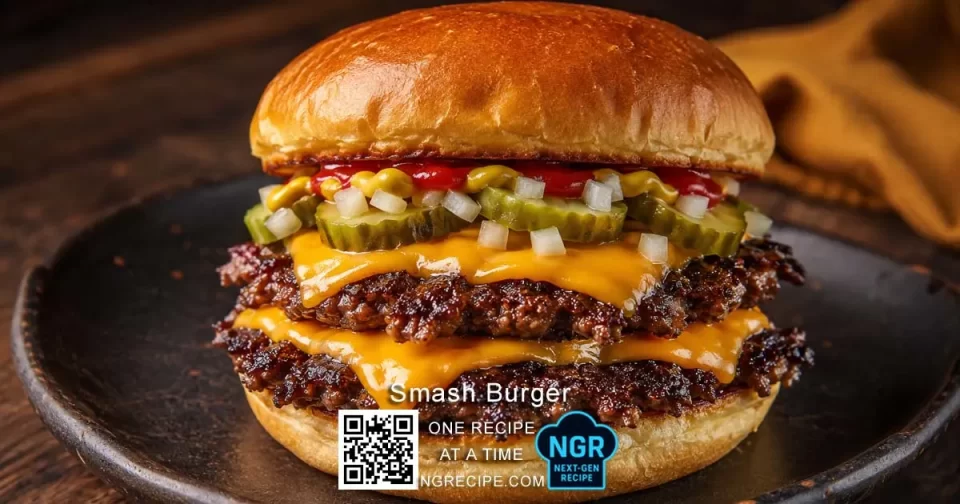
This classic smash burger layers two thin, deeply browned beef patties with melted American cheese, crisp-edged toasted buns, dill pickles, diced onion, ketchup, and yellow mustard. Brief, forceful smashing on a very hot cooking surface creates the signature lacy crust while keeping the centre juicy.
Quick Recipe Card
What This Recipe Is
A smash burger is an American griddle-style hamburger made by pressing a loosely formed ball of ground beef firmly against a very hot, flat cooking surface. The pressure maximises contact between the meat and the metal, producing an exceptionally thin patty with a dark, crisp, irregular edge.
This recipe makes four double-patty cheeseburgers. The patties are intentionally small and thin so they cook quickly and develop more browned surface area than one thick patty. American cheese melts smoothly between the patties, while pickles, onion, ketchup, and mustard provide acidity, freshness, sweetness, and tang.
A smash burger is different from a thick pub-style burger. It should be smashed only at the beginning of cooking, cooked rapidly, scraped cleanly from the surface, and served immediately.
Ingredients
- 680 g (1½ lb) 80% lean ground beef
- 8 g (1¼ teaspoons) kosher salt
- 3 g (1 teaspoon) freshly ground black pepper
- 160 g (8 slices) American cheese
- 4 soft burger buns
- 30 g (2 tablespoons) unsalted butter, softened
- 60 g (½ cup) dill pickle slices, drained
- 60 g (½ cup) yellow onion, finely diced
- 60 g (¼ cup) ketchup
- 40 g (2 tablespoons plus 2 teaspoons) yellow mustard
Equipment
- Digital kitchen scale
- Large cast-iron skillet or flat cast-iron griddle
- Sturdy, wide metal spatula
- Burger press or second rigid metal spatula
- 8 small squares of baking parchment
- Instant-read food thermometer
- Small bowls for the toppings and condiments
- Heat-resistant plate or tray
Instructions
Step 1:
Drain the dill pickle slices well and finely dice the yellow onion. Measure the ketchup and yellow mustard into separate small bowls. Split the burger buns without tearing their hinges.
Step 2:
Divide the ground beef into eight equal 85 g (3 oz) portions. Handle each portion as little as possible and gently gather it into a loose ball. Do not compress the meat or mix the salt and black pepper into it.
Step 3:
Heat the cast-iron skillet or griddle over medium heat. Spread the softened unsalted butter evenly over the cut sides of the burger buns. Place the buns cut-side down on the hot surface and toast for 1–2 minutes, until evenly golden. Transfer them to a plate and carefully wipe away any dark butter residue.
Step 4:
Immediately cover each ball with a square of baking parchment. Press down firmly with the burger press or metal spatula for about 10 seconds, flattening each portion to approximately 6 mm (¼ inch) thick. Remove the parchment, then season the exposed surfaces evenly with the kosher salt and black pepper.
Step 5:
Flip each patty once. Immediately place one slice of American cheese over each patty and cook for another 45–60 seconds, until the cheese has melted and the beef has reached 71°C (160°F). Repeat with the remaining beef portions, salt, black pepper, and American cheese.
Step 6:
Stack two cheese-covered patties for each burger. Spread yellow mustard over each bottom bun and place one double-patty stack on top. Divide the diced yellow onion and dill pickle slices among the burgers, add the ketchup, and close with the toasted top buns. Serve immediately while the patties are hot and their edges remain crisp.
Visual Cooking Cues
- The toasted bun surfaces should be evenly golden, not dark brown or scorched.
- The raw beef portions should remain loosely gathered rather than tightly packed.
- A properly smashed patty will be very thin, with uneven, feathered edges.
- Small beads of moisture should appear on the upper surface before the patty is flipped.
- The underside should have a dark brown crust that releases when scraped firmly.
- The cheese should soften completely and drape over the edges of each patty.
- The finished burger should have crisp patty edges, a juicy centre, and a bun that holds its structure.
Chef Tips
- Use 80% lean ground beef. Its fat content supports browning, moisture, and flavour.
- Keep the beef refrigerated until shortly before cooking so the fat remains firm.
- Form loose beef balls rather than compact patties. Dense meat resists spreading and can become tough.
- Preheat the cooking surface thoroughly. Insufficient heat causes the beef to release liquid and steam.
- Smash within the first few seconds after the beef touches the surface.
- Apply decisive, even pressure for one brief smash. Repeated pressing later in cooking forces out juices.
- Use a rigid metal spatula with a thin edge so the browned crust can be scraped up cleanly.
- Avoid crowding the skillet. The surface temperature must remain high throughout cooking.
- Assemble each burger as soon as its patties are ready.
Common Mistakes
- Choosing very lean beef, which produces a drier patty with less flavour.
- Compressing the beef tightly before cooking.
- Salting the beef mixture in advance, which can create a springy, sausage-like texture.
- Placing the beef on a surface that is not fully heated.
- Smashing the patties after their crust has begun to form.
- Moving the patties before the first side is deeply browned.
- Using a flexible spatula that cannot apply enough pressure.
- Failing to scrape underneath the crust before flipping.
- Cooking too many patties at once in a small skillet.
- Leaving the assembled burgers to stand before serving.
Troubleshooting
- Patties are grey rather than browned: The cooking surface was not hot enough or was overcrowded. Preheat it longer and cook fewer patties per batch.
- Patties are thick in the centre: Apply firmer, more even pressure during the initial smash.
- Beef sticks to the press: Place baking parchment between the beef and the press.
- Crust remains attached to the skillet: Use a sharp-edged metal spatula and scrape firmly against the cooking surface.
- Patties are dry: Shorten the cooking time, avoid repeated pressing, and confirm that the beef is 80% lean.
- Cheese does not melt: Add it immediately after flipping while the patty and cooking surface are still very hot.
- Buns become soggy: Drain the pickles thoroughly, toast the cut surfaces, and assemble just before serving.
- Burger is difficult to eat: Keep the beef portions close to 85 g (3 oz) and distribute the toppings evenly.
Ingredient Pairings
- Ground beef and American cheese provide a rich, savoury foundation with a smooth, creamy finish.
- Dill pickles cut through the richness with acidity, saltiness, and crunch.
- Yellow onion supplies fresh sharpness without overwhelming the thin patties.
- Ketchup adds sweetness and mild acidity.
- Yellow mustard contributes tang and a gentle savoury bite.
- Soft toasted buns contrast with the crisp patty edges while containing the juices.
- Butter promotes even browning and adds richness to the bun surfaces.
- Salt strengthens the beef flavour, while black pepper provides warm aromatic depth.
Substitutions
- Ground chuck with approximately 20% fat can replace packaged 80% lean ground beef.
- Thinly sliced mild cheddar can replace American cheese, although it will not melt as uniformly.
- Potato buns or soft sesame-seed buns can replace plain burger buns.
- Gluten-free burger buns can be used for a gluten-free adaptation.
- Lactose-free melting cheese and a suitable dairy-free spread can replace the American cheese and butter when required.
- Finely diced white onion can replace yellow onion for a sharper flavour.
- Bread-and-butter pickles can replace dill pickles, but they will make the burger noticeably sweeter.
- Reduced-sodium ketchup, mustard, pickles, and cheese can help lower the total sodium.
Recipe Family Variations
- Single-Patty Smash Burger
- Triple Smash Burger
- Smash Burger Sliders
Serving Suggestions
- Serve the burgers immediately with crisp French fries, potato wedges, coleslaw, a simple green salad, or grilled vegetables. Their rich, salty profile also pairs well with sparkling water, lemonade, iced tea, or a chilled malt-style drink.
- For casual gatherings, prepare the toppings and toast the buns in advance, but portion and cook the beef immediately before serving. If cooking for several people, serve the burgers in small batches so every guest receives crisp, freshly cooked patties.
Dietary Classification
This is a high-protein, meat-based main course. It is not vegetarian or vegan.
The standard recipe contains dairy from the American cheese and butter and gluten from the burger buns. Ingredient formulations vary, so packaged buns, cheese, pickles, ketchup, and mustard should be checked when cooking for someone with a food allergy or dietary restriction.
A gluten-free adaptation is possible with certified gluten-free buns. A lactose-free adaptation requires suitable cheese and butter replacements. Because the core identity depends on ground beef, replacing the beef would create a separate plant-based or alternative-protein burger recipe.
Nutrition Information
Approximate nutrition per serving:
- Calories: 790
- Protein: 46 g
- Carbohydrates: 35 g
- Fat: 51 g
- Saturated Fat: 22 g
- Fiber: 2 g
- Sugar: 8 g
- Sodium: 1,900 mg
Storage / Reheating
Cooked patties can be refrigerated in a sealed container for up to 3–4 days. Store the buns, patties, fresh onion, pickles, and condiments separately. Fully assembled burgers soften during storage and do not retain their original crisp texture.
Cooked patties can be frozen for up to 2 months. Separate them with baking parchment, seal them in a freezer-safe container, and thaw them in the refrigerator before reheating.
For the best texture, reheat the patties in a covered skillet over medium-low heat until the centres reach 74°C (165°F). A short skillet reheating preserves the edges better than prolonged microwave heating. Add freshly toasted buns and chilled toppings after the patties are hot.
Uncooked ground beef portions should be refrigerated promptly and used within 1–2 days or frozen.
FAQ
Why is it called a smash burger?
The name refers to the technique of pressing a loose ball of beef firmly onto a hot, flat cooking surface. This creates a thin patty with extensive surface contact and a deeply browned crust.
Should I smash the burger more than once?
No. Apply firm pressure only during the first few seconds of cooking. Pressing again after the meat begins cooking can squeeze out moisture and fat.
Can I make a smash burger in a regular frying pan?
Yes, provided the pan is heavy, flat, and able to tolerate high heat. Cast iron is particularly effective because it retains heat when the cold beef is added.
Why should the beef not be formed into patties in advance?
Loose beef balls spread more readily under pressure and create thinner, more irregular edges. Preformed compact patties tend to remain dense and may not develop the characteristic lacy crust.
Can I cook all eight patties at once?
Only if the griddle is large enough to keep the patties separated and maintain strong heat. On a standard skillet, cooking in smaller batches produces better browning.
How do I know when the patties are safely cooked?
Because the patties are thin, they cook rapidly. Confirm that the thickest area reaches 71°C (160°F) with an instant-read thermometer.
Why is American cheese commonly used?
American cheese melts quickly and evenly, forming a smooth layer that adheres well to thin patties. Its mild flavour also supports rather than masks the browned beef.
Can the burgers be prepared ahead?
The toppings can be prepared and the beef can be portioned shortly in advance, but the patties should be cooked and assembled immediately before serving. Their crisp edges soften as they stand.
Why This Recipe Works
The recipe uses two thin patties instead of one thick patty, increasing the amount of beef that touches the hot cooking surface. This greater contact area produces more browning and a stronger roasted, savoury flavour.
A brief initial smash creates thin edges without repeatedly squeezing the meat. Leaving the first side undisturbed allows a continuous crust to develop. Scraping rather than gently lifting the patty preserves that crust during flipping.
The 80% lean beef provides enough fat to keep the thin patties succulent. American cheese melts during the short second-side cooking time and helps bind the stacked patties together.
The toppings balance the burger structurally and in flavour. Pickles and mustard provide acidity, onion adds freshness, ketchup brings sweetness, and the toasted buns contribute a soft but resilient outer layer.
Recipe Identity
The smash burger is defined primarily by its cooking technique and patty structure. Loose portions of ground beef are flattened directly against a very hot griddle or skillet, producing thin patties with deeply browned, irregular edges.
This version belongs to the double cheeseburger branch of the smash burger family. Its defining elements are two griddle-smashed beef patties, melting cheese, a soft toasted bun, pickles, onion, ketchup, and mustard.
The recipe should not be confused with a conventional thin burger formed before cooking. Direct smashing on the cooking surface is essential to its identity.
Dish Classification
The smash burger is an American main-course sandwich and a technique-defined member of the hamburger family. Because this preparation contains cheese, it also belongs to the cheeseburger subfamily.
It is typically served hot as a handheld lunch or dinner. Its preparation combines pan-searing on a flat surface, bun toasting, cheese melting, stacking, and final assembly.
Recipe History
The smash burger developed from the broader tradition of American hamburgers cooked on flat metal griddles. Thin patties were practical for diners, lunch counters, and short-order kitchens because they cooked quickly and could develop strong browning within a short service time.
The technique later became a recognised burger style in its own right. Its identity increasingly centred on loosely portioned beef, firm contact with a hot griddle, crisp irregular edges, and rapid cooking.
Contemporary versions range from single patties to tall multi-patty stacks, but the direct-on-griddle smashing technique remains the defining feature.
Cultural Notes
Smash burgers reflect the informal, accessible character of American burger culture. They are closely associated with diners, counter-service restaurants, roadside food stops, and casual home cooking.
Their appeal lies in immediacy rather than elaborate presentation. The cook, cooking surface, and timing are all visible in the finished texture: dark edges, melted cheese, a soft bun, and simple condiments.
Regional and personal preferences influence the bun, cheese, onions, pickles, and condiments. These choices can vary, while the thin griddle-smashed patty remains central.
Culinary Context
The smash burger occupies the crisp, thin-patty end of the hamburger spectrum. Unlike thick burgers that rely on a pronounced interior doneness gradient, smash burgers rely on high surface browning, rendered fat, and contrasting textures.
The method is particularly suited to cast iron and flat griddles because these surfaces provide broad, direct contact. It also works well in home kitchens because each patty cooks in only a few minutes.
Although simple in appearance, the dish depends on heat management, controlled pressure, correct beef composition, and efficient assembly. Small errors in those areas can significantly change the crust and juiciness.
Advanced Cooking Knowledge Open detailed cooking science and reference notes
Flavor, Texture, and Aroma Profile
The dominant flavour is deeply browned, savoury beef supported by salty, creamy cheese. Ketchup contributes mild sweetness, mustard and pickles provide acidity, and raw onion adds a clean, sharp finish.
The patties have crisp, lacy edges and thin, juicy interiors. Melted cheese creates a soft layer between the meat and toppings, while the toasted buns remain tender with lightly crisp cut surfaces.
The aroma combines roasted beef, rendered fat, toasted bread, warm butter, pepper, onion, and tangy condiments.
Flavor Balance
Richness comes from beef fat, cheese, and butter. Salt intensifies the savoury character, while pickle and mustard acidity prevents the burger from tasting heavy.
Ketchup softens the sharper notes with sweetness. Fresh onion adds aromatic contrast, and the relatively mild bun keeps the stronger beef and condiment flavours in focus.
The quantities are controlled so the toppings support the patties rather than burying their browned flavour.
Flavor Components
- Savoury: Ground beef and American cheese
- Salty: Kosher salt, cheese, and dill pickles
- Rich: Beef fat, cheese, and butter
- Acidic: Dill pickles, ketchup, and yellow mustard
- Sweet: Ketchup and burger buns
- Sharp: Yellow onion and yellow mustard
- Aromatic: Black pepper, toasted buns, and browned beef
Ingredient Notes
Ground beef containing approximately 20% fat offers a dependable balance of browning and juiciness. Meat that is significantly leaner can cook dry before a strong crust develops.
American cheese is selected for its rapid, uniform melting. Thin slices are important because the patties cook very quickly after flipping.
Soft burger buns compress comfortably around the double patty and are less likely to force the fillings out. Toasting protects their cut surfaces from meat juices and condiments.
Drained pickles provide acidity and crunch without adding excessive moisture. Finely diced onion distributes more evenly than thick slices.
Ingredient Science
Ground beef browns efficiently when its surface is dry and pressed into close contact with very hot metal. High heat drives away surface moisture, allowing browning reactions to create roasted aromas, darker colour, and a crisp crust.
Fat melts as the patty cooks, supporting heat transfer and carrying flavour. A very lean mixture contains less fat and therefore provides less protection against dryness.
Salt is applied to the outer surface immediately after smashing. Mixing it into the beef earlier would dissolve meat proteins and encourage a firmer, more elastic texture.
American cheese contains emulsifying components that help its fat and moisture remain integrated as it melts. This gives it a smoother texture than many aged cheeses.
Ingredient Roles
- Ground beef: Forms the patties and supplies protein, fat, savoury flavour, and browned crust.
- Kosher salt: Seasons the beef and strengthens its natural flavour.
- Black pepper: Adds warm, aromatic pungency.
- American cheese: Provides creaminess, saltiness, and a cohesive melted layer.
- Burger buns: Contain the fillings and provide soft structural contrast.
- Unsalted butter: Promotes even bun browning and adds richness.
- Dill pickles: Supply acidity, saltiness, moisture, and crunch.
- Yellow onion: Adds freshness, sharpness, and crisp texture.
- Ketchup: Provides sweetness, acidity, and moisture.
- Yellow mustard: Adds tang and savoury sharpness.
Ingredient Classification
- Primary protein: Ground beef
- Primary dairy: American cheese
- Added cooking fat: Unsalted butter
- Bread component: Burger buns
- Fresh aromatic vegetable: Yellow onion
- Pickled vegetable: Dill pickles
- Sweet-acidic condiment: Ketchup
- Tangy condiment: Yellow mustard
- Primary seasoning: Kosher salt
- Aromatic seasoning: Black pepper
Preparation Techniques
Loose portioning protects the open texture of the ground beef. Each portion is gathered only enough to hold together before reaching the skillet.
Fine dicing allows the onion to spread evenly across the small patty surface. Draining the pickles limits excess moisture that could soften the bun.
Spreading softened butter over the cut buns creates consistent coverage and more even toasting.
Preparing all toppings before cooking is essential because the patties cook rapidly and should be assembled without delay.
Cooking Techniques
Pan-searing creates the patties’ dark crust through direct contact with a very hot flat surface. The initial smash increases that contact and determines the patty’s final thickness.
Toasting browns and strengthens the cut surfaces of the buns. Scraping preserves the patty crust when the burger is flipped.
Cheese melting takes place during the brief second-side cooking period. Stacking and assembling complete the burger while the patties remain hot.
Heat Management
Begin with medium heat for the buttered buns so they toast without burning. After removing the buns and cleaning the surface, raise the heat to high for the beef.
The skillet or griddle must recover its heat before each batch. If a new beef portion does not sizzle strongly on contact, allow the surface to reheat.
Avoid filling a small pan with too many cold portions. Overcrowding lowers the surface temperature and traps steam around the patties.
If the skillet begins smoking heavily or the crust burns before the upper surface releases juices, reduce the heat slightly between batches.
Texture Development
The patty’s texture depends on minimal handling, a decisive initial smash, and undisturbed cooking. Loose meat spreads into irregular thin edges that become crisp faster than the centre.
The interior remains juicy because the cooking time is short and the beef contains sufficient fat. Repeated pressing removes that moisture and creates a drier result.
Toasted buns, crisp pickles, fresh onion, melted cheese, and crusted beef create distinct but complementary layers.
Cooking Time Control
The first side requires approximately 60–90 seconds, depending on the surface temperature and exact patty thickness. It is ready when the edges are dark and crisp and moisture appears on top.
The second side generally needs only 45–60 seconds. Thin patties can overcook quickly, so the cheese should be added immediately after flipping.
A thermometer reading of 71°C (160°F) confirms that the ground beef is safely cooked. Check promptly so the patties do not remain on the heat longer than necessary.
Flavor Pairing Logic
Rich beef and cheese benefit from ingredients that provide acidity and freshness. Dill pickles and mustard cut through fat, while onion adds aromatic sharpness.
Ketchup introduces enough sweetness to round out the salt and acidity. The toasted buttered buns provide a mild, slightly sweet frame that does not compete with the browned beef.
Black pepper complements roasted meat aromas without changing the classic condiment profile.
Leftover Ideas
Reheated patties can be chopped and folded into scrambled eggs, added to a warm sandwich, served over roasted potatoes, or used as a protein topping for a simple salad.
For the closest result to the original dish, reheat the patties in a skillet and assemble them with freshly toasted buns, chilled pickles, diced onion, ketchup, and mustard.
Avoid storing leftover patties inside assembled burgers, as the buns will absorb moisture and lose their texture.
Cooking Safety Notes
Keep raw ground beef refrigerated until needed. Wash hands thoroughly after handling it, and clean any utensils or surfaces that have touched the raw meat.
Do not place cooked patties on the tray that held the raw beef unless the tray has been washed. Use a clean plate for finished patties.
Cook the ground beef to 71°C (160°F). Reheated leftovers should reach 74°C (165°F).
Cast iron, metal spatulas, and rendered fat become extremely hot. Use heat-resistant protection and keep the cooking area clear of splashing water.
Refrigerate leftovers within 2 hours, or within 1 hour when the surrounding temperature is above 32°C (90°F).
Sustainability Notes
Purchase only the amount of beef needed and freeze unused portions promptly. Correct portioning reduces both food waste and oversized servings.
Store buns securely and freeze extras before they become stale. Pickles and condiments should remain refrigerated according to their package instructions so they can be used in later meals.
A reusable burger press can reduce reliance on disposable equipment. When using baking parchment, cut only the small pieces required for the patties.
Rendered beef fat should be allowed to cool and placed in an appropriate waste container rather than poured into a sink.
Recipe Classification
Primary dish type: Burger
Parent family: Hamburger
Subfamily: Cheeseburger
Specific recipe identity: Smash Burger
Cuisine: American
Country: United States
Meal role: Main Course
Primary protein: Ground Beef
Primary dairy: American Cheese
Bread component: Burger Buns
Fresh components: Yellow Onion
Pickled component: Dill Pickles
Condiment profile: Ketchup and Yellow Mustard
Cooking methods: Pan-Searing, Toasting, Assembling
Serving style: Hot Assembled Burger
Difficulty level: Easy
Occasions: Weeknight Dinner, Game Day, Casual Gathering
