Trenton Tomato Pie
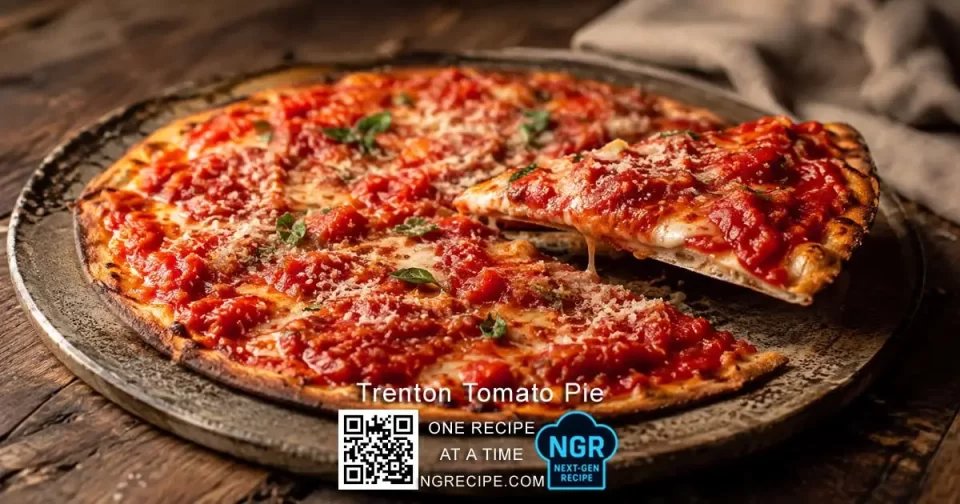
Trenton Tomato Pie is a thin, crisp, round pizza from New Jersey distinguished by its reverse layering: mozzarella goes directly onto the dough before a bright, lightly seasoned tomato topping. This home-oven version preserves the style’s tomato-forward character, restrained cheese layer, crisp underside, and rustic patches of sauce.
Quick Recipe Card
What This Recipe Is
Trenton Tomato Pie is a regional Italian American pizza associated with Trenton, New Jersey. Unlike a conventional pizza, which usually places tomato sauce beneath the cheese, this style puts a modest layer of mozzarella directly on the dough and distributes crushed tomatoes over it.
The pie is traditionally round rather than rectangular, with a thin base, crisp underside, irregular tomato coverage, and less cheese than many mainstream American pizzas. The tomato remains the dominant flavour, while the cheese forms a protective layer that helps prevent the crust from becoming soggy.
This dish should not be confused with Philadelphia-style tomato pie, which is commonly a thicker, rectangular bakery pie served with tomato sauce and little or no mozzarella. Trenton Tomato Pie is closer in structure to a thin-crust pizza, but its cheese-first assembly gives it a distinct identity.
Ingredients
- For the dough:
- 160 ml lukewarm water (⅔ cup), about 35°C (95°F)
- 1 g instant yeast (¼ teaspoon)
- 250 g bread flour (about 2 cups), plus 15 g (2 tablespoons) for dusting
- 5 g fine sea salt (¾ teaspoon)
- 5 ml olive oil (1 teaspoon)
- For the tomato and cheese topping:
- 400 g canned whole peeled tomatoes (one 14-ounce can), drained to yield about 250 g
- 2 g fine sea salt (⅓ teaspoon)
- 5 ml olive oil (1 teaspoon)
- 1 g dried oregano (½ teaspoon)
- 170 g low-moisture whole-milk mozzarella, coarsely grated (6 ounces)
- 15 g Pecorino Romano, finely grated (½ ounce)
Equipment
- Digital kitchen scale
- Measuring spoons
- Large mixing bowl
- Small bowl
- Fine-mesh strainer
- Wooden spoon or dough whisk
- Clean work surface
- Bench scraper
- Clean kitchen towel or reusable bowl cover
- Baking steel or pizza stone
- Pizza peel or rimless baking sheet
- Baking parchment, if needed for easier launching
- Large spoon
- Oven gloves
- Pizza wheel or sharp chef’s knife
- Wire rack
Instructions
Step 1:
Pour the lukewarm water into a large mixing bowl and sprinkle in the instant yeast. Stir briefly, then leave it for 2 minutes to distribute through the water.
Step 2:
Add the bread flour and fine sea salt to the bowl. Stir until no dry patches remain and a rough, slightly tacky dough forms. Add the olive oil and continue mixing until it is absorbed.
Step 3:
Transfer the dough to a lightly floured work surface. Knead for 7–9 minutes, using only as much of the reserved flour as needed to prevent severe sticking. The finished dough should feel smooth, elastic, and slightly tacky rather than dry.
Step 4:
Shape the dough into a tight ball. Place it back in the bowl, cover, and leave it at room temperature for 1½–2 hours, or until visibly expanded and close to doubled in volume.
Step 5:
While the dough rises, place the drained whole peeled tomatoes in a small bowl. Crush them by hand into uneven pieces, breaking up any firm cores. Mix in the fine sea salt, olive oil, and dried oregano. Leave the mixture slightly chunky rather than blending it into a smooth sauce.
Step 6:
Place a baking steel or pizza stone on a rack in the upper-middle portion of the oven. Preheat the oven to 260°C (500°F), or its highest safe setting, for at least 45 minutes. A thoroughly heated baking surface is essential for a crisp base.
Step 7:
Place the risen dough on a lightly floured surface and press it gently into a thick disc. Working from the centre outward, stretch it into a round approximately 30 cm (12 inches) across. Leave a narrow, slightly thicker rim around the edge without creating a large, puffy border.
Step 8:
Dust a pizza peel or rimless baking sheet lightly with the remaining flour. Transfer the shaped dough to the peel and gently correct its shape. If launching pizza from a peel is unfamiliar, place the dough on baking parchment before topping it.
Step 9:
Distribute the grated low-moisture mozzarella evenly over the dough, leaving approximately 1 cm (⅜ inch) uncovered around the edge. Sprinkle the Pecorino Romano over the mozzarella.
Step 10:
Spoon the tomato mixture over the cheese in irregular patches. Spread it lightly without pressing hard or covering every small area. The surface should look rustic and tomato-forward, with glimpses of cheese visible between the tomatoes.
Step 11:
Slide the assembled pie onto the thoroughly heated baking steel or stone. Bake for 5 minutes, then rotate it carefully. Continue baking for another 5–7 minutes, until the underside is crisp, the rim has browned, and the tomato topping is bubbling in places.
Step 12:
Transfer the baked tomato pie to a wire rack and rest it for 5 minutes. This brief rest allows steam to escape so the underside remains crisp. Move it to a cutting board, cut into 8 slices, and serve warm.
Visual Cooking Cues
- The risen dough should appear noticeably expanded, feel aerated, and slowly spring back when pressed gently with a fingertip.
- Properly kneaded dough will look smoother than when first mixed and should stretch several centimetres before tearing. It may remain slightly tacky, but it should not behave like a wet batter.
- The prepared tomatoes should be chunky and spoonable rather than watery. A pool of thin liquid at the bottom of the bowl indicates that the tomatoes need additional draining.
- The shaped base should be thin through the centre with a narrow rim. It should not have the thick, inflated edge associated with some other pizza styles.
- Before baking, the tomato layer should appear irregularly distributed over the cheese. Completely smothering the cheese with a thick layer of wet sauce may make the pie heavy and difficult to crisp.
- The finished underside should be firm, dry, and deeply golden in scattered areas. A lifted slice should hold its shape with only a gentle bend near the tip.
- The rim should have browned spots and a crisp exterior while retaining a modest chew inside. The tomatoes should look concentrated and glossy rather than pale or watery.
Chef Tips
- Use low-moisture whole-milk mozzarella rather than fresh mozzarella. Its lower water content supports a crisper crust and produces a controlled melt beneath the tomatoes.
- Drain the canned tomatoes before crushing them. Excess tomato liquid is one of the most common causes of a soft centre.
- Keep the topping restrained. Trenton Tomato Pie depends on balance between a thin crust, moderate cheese, and assertive tomato flavour. Overloading any one component changes the structure.
- Preheat the baking steel or stone completely. The oven air may reach the selected temperature before the baking surface has stored enough heat to crisp the dough.
- Shape the dough gently. A rolling pin can force out too much internal gas and may produce a dense, cracker-like base.
- Assemble the pie immediately before baking. Leaving moist tomatoes on the unbaked dough for an extended period allows liquid to migrate through the cheese layer.
- Check the underside rather than judging the pie only by the colour of the top. The crust should be sufficiently browned before removal.
- Rest the baked pie on a wire rack rather than leaving it on a solid pan. Airflow underneath prevents trapped steam from softening the base.
Common Mistakes
- Using undrained tomatoes introduces more moisture than the thin crust can manage.
- Applying tomato directly to the dough reverses the defining Trenton layering and removes the protective cheese barrier.
- Using too much mozzarella makes the pie cheese-dominant and can prevent the tomato flavour from remaining central.
- Blending the tomatoes into a thin purée creates a uniform sauce but removes the rustic tomato texture associated with the style.
- Adding too much flour during kneading makes the crust dense, dry, and difficult to stretch.
- Stretching the dough too thin in the centre can cause tearing when the toppings are added or when the pie is launched.
- Using a cold or insufficiently preheated baking surface leads to a pale, soft underside.
- Allowing the assembled raw pie to stand before baking increases the risk of sticking to the peel and developing a soggy centre.
- Cutting immediately after baking releases steam onto the crust and allows hot tomato liquid to run across the surface.
Troubleshooting
If the dough is very sticky, leave it covered for 10 minutes before kneading again. This pause allows the flour to absorb more water. Add only a light dusting of the reserved flour if necessary.
If the dough keeps shrinking during shaping, cover it and let it relax for 10–15 minutes. Tight gluten needs time to loosen before further stretching.
If the centre tears, pinch the damaged area together before adding the toppings. Avoid making the repaired area excessively thick.
If the pizza sticks to the peel, gently lift the nearest edge and scatter a small amount of the reserved flour underneath. Work around the pie until it moves freely.
If the topping looks watery before baking, spoon off excess liquid or drain the tomato mixture briefly through a fine-mesh strainer.
If the top browns before the bottom becomes crisp, move the baking surface to a lower rack for the next pie or reduce the oven temperature slightly after the initial preheat.
If the bottom burns before the rim is cooked, place the baking surface one rack higher or reduce the oven temperature to 245°C (475°F).
If the crust is pale and soft, increase the preheating time and confirm that the baking steel or stone is fully heated before launching the pie.
If the baked slices collapse under the topping, reduce the quantity of tomato slightly and allow the pie to rest on a wire rack before slicing.
Ingredient Pairings
- Bread flour and moderate hydration create a dough strong enough to stretch thin while retaining enough structure to hold the tomato topping.
- Low-moisture mozzarella pairs especially well with the cheese-first assembly because it melts into a relatively dry, protective layer over the dough.
- Pecorino Romano contributes saltiness and a sharper dairy flavour that supports the tomato without requiring a heavy quantity of cheese.
- Whole peeled tomatoes provide a fresher, less processed texture than a highly reduced commercial pizza sauce. Hand-crushing preserves irregular pieces that concentrate differently during baking.
- Dried oregano complements cooked tomato and provides a familiar Italian American aroma without introducing extra surface moisture.
- Olive oil rounds the acidity of the tomatoes, supports dough extensibility, and contributes light browning to the crust.
Substitutions
- Bread flour may be replaced with the same weight of all-purpose flour. The dough will usually be slightly softer and may have less chew, so add no extra water until its consistency has been assessed.
- Active dry yeast may replace instant yeast. Use approximately 1.25 g and dissolve it in the lukewarm water for 5–10 minutes before adding the flour.
- Canned crushed tomatoes may replace whole peeled tomatoes if they contain no heavy seasoning. Drain them if they appear thin or watery.
- Part-skim low-moisture mozzarella may replace whole-milk mozzarella. It generally produces a firmer, less rich cheese layer.
- Finely grated Parmesan may replace Pecorino Romano. Parmesan is usually milder and less salty, but it performs a similar supporting role.
- A pizza screen or inverted heavy baking sheet may be used when a baking steel or stone is unavailable. The underside may be less deeply browned, but thorough preheating will improve the result.
Recipe Family Variations
- Trenton Mustard Pie
- Coal-Oven Trenton Tomato Pie
- Extra-Crispy Trenton Tomato Pie
Serving Suggestions
- Serve Trenton Tomato Pie shortly after its 5-minute rest, while the base remains crisp and the tomato topping is still warm.
- A simple green salad with a sharp vinaigrette provides freshness and acidity without competing with the pie’s tomato-forward flavour.
- Roasted or marinated vegetables work well for a casual shared meal, particularly when the pizza itself is kept free of heavy toppings.
- For a traditional pizzeria-style experience, serve the pie whole and cut it into 8 triangular slices at the table.
- Because the crust is thin, one 30 cm (12-inch) pie generally serves two people generously or four people when accompanied by salad or other dishes.
Dietary Classification
This recipe is vegetarian because it contains no meat, poultry, fish, or seafood.
It contains gluten from the bread flour and is not suitable for a gluten-free diet without a separately formulated gluten-free pizza crust.
It contains dairy from the mozzarella and Pecorino Romano.
It is not vegan because both cheeses are dairy products. Some traditionally produced hard cheeses may also use animal-derived rennet, so strict vegetarians should check the product label.
The recipe contains no eggs, peanuts, tree nuts, soy ingredients, shellfish, fish, poultry, or red meat as written. Cross-contact remains possible through packaged ingredients and shared preparation equipment.
Nutrition Information
Approximate nutrition per serving, based on four servings:
- Calories: 400
- Protein: 18 g
- Carbohydrates: 50 g
- Fat: 14 g
- Saturated Fat: 7 g
- Fiber: 3 g
- Sugar: 3 g
- Sodium: 900 mg
Storage / Reheating
Allow leftover slices to cool until no longer steaming, but do not leave them at room temperature for more than 2 hours.
Refrigerate the slices in a shallow airtight container or wrap them securely. Store for up to 3 days.
To prevent slices from sticking together, separate stacked pieces with baking parchment.
For longer storage, freeze cooled slices in a single layer until firm, then transfer them to a freezer-safe container. Freeze for up to 2 months.
Reheat refrigerated slices in an oven preheated to 230°C (450°F) for 5–7 minutes. Place them directly on a preheated baking sheet, steel, or stone for the crispest base.
Frozen slices may be reheated without thawing at 220°C (425°F) for approximately 9–12 minutes.
A covered skillet can also be used. Heat the slice over medium-low heat until the bottom becomes crisp, then cover briefly to warm the topping.
Microwave reheating is convenient but softens the crust. For better results, microwave only until the centre loses its chill, then finish the slice in a hot skillet.
FAQ
Why is the cheese placed beneath the tomatoes?
The reversed order is a defining feature of Trenton Tomato Pie. The cheese melts directly over the dough, creating a partial moisture barrier while allowing the tomatoes to remain visually and flavourfully prominent.
Is Trenton Tomato Pie the same as Philadelphia tomato pie?
No. Trenton Tomato Pie is generally a round, thin-crust pizza with mozzarella beneath the tomatoes. Philadelphia tomato pie is commonly rectangular, thicker, bakery-style, and served with little or no mozzarella.
Should the tomatoes be cooked before topping the pizza?
No separate cooking is required for this version. Drained, hand-crushed canned tomatoes concentrate during the high-temperature bake while retaining a fresh tomato character.
Why should the tomato mixture remain chunky?
Irregular tomato pieces create a rustic surface and concentrated pockets of flavour. A completely smooth sauce produces a more uniform result that is less characteristic of the style.
Can fresh mozzarella be used?
It can be used, but its higher moisture content makes a crisp thin crust more difficult to achieve. Low-moisture mozzarella is the more dependable choice for this preparation.
Can the dough be prepared in advance?
Yes. After kneading, cover the dough and refrigerate it for 24–48 hours. Remove it from the refrigerator approximately 1½–2 hours before shaping so it can warm, relax, and become extensible.
Why did the pizza become soggy?
The most likely causes are inadequately drained tomatoes, excessive topping, a baking surface that was not fully preheated, or cutting the pie immediately after baking.
Can this recipe be baked without a pizza stone or steel?
Yes. Preheat an inverted heavy baking sheet in the oven and launch the pizza onto its hot surface. The crust may not brown as intensely, but it can still become pleasantly crisp.
How do I know when the dough has risen enough?
The dough should appear close to doubled, feel lighter, and retain a shallow indentation when pressed gently. Rising time may vary with room temperature.
Does Trenton Tomato Pie need a very thick layer of sauce?
No. The tomato should be prominent, but a heavy, watery layer can overwhelm the thin crust. Irregular spoonfuls create better balance than a deep blanket of sauce.
Why is my dough difficult to stretch?
The gluten may be too tight, the dough may be too cold, or too much flour may have been added. Cover the dough and let it relax for 10–15 minutes before continuing.
Can the recipe be doubled?
Yes. Double all ingredients and divide the dough into two equal portions before rising or before refrigeration. Shape and bake each pie separately for the best oven performance.
Why This Recipe Works
The moderate-hydration bread-flour dough develops enough gluten to stretch into a thin round while remaining strong enough to support the topping.
A controlled quantity of olive oil improves dough handling and encourages browning without turning the crust into a rich or bread-like base.
Draining the tomatoes removes excess liquid while preserving their bright flavour and irregular texture.
Placing low-moisture mozzarella beneath the tomatoes reduces direct contact between the wet topping and the raw dough. This helps the centre bake more cleanly.
The restrained cheese quantity keeps the tomato as the dominant component rather than transforming the pie into a heavily covered cheese pizza.
Pecorino Romano provides concentrated savouriness, allowing the recipe to achieve depth without adding a thick second cheese layer.
A long oven preheat stores substantial heat in the baking surface. That stored energy transfers rapidly into the dough, setting and browning the underside before moisture can soften it.
The brief wire-rack rest releases steam from beneath the crust and stabilises the hot topping before slicing.
Recipe Identity
Trenton Tomato Pie is a round, thin-crust, tomato-topped pizza from the Trenton area of New Jersey.
Its principal identity markers are a crisp base, mozzarella placed directly over the dough, crushed tomatoes positioned above the cheese, restrained dairy coverage, and a tomato-forward flavour.
The term “pie” follows regional American pizza language and does not indicate a pastry dessert.
Although it shares Italian culinary foundations, the dish belongs specifically to the Italian American food culture of New Jersey.
Its identity depends more on construction and balance than on elaborate toppings. A standard pizza with sauce below the cheese does not become Trenton-style solely because it is baked in New Jersey.
Dish Classification
Trenton Tomato Pie belongs to the broad pizza category and the regional American tomato-pie family.
It is a savoury baked main dish made from fermented wheat dough, tomato, and cheese.
Structurally, it is a thin, round, open-faced bread with a reverse-layered pizza topping.
Culturally, it is an Italian American regional speciality associated with Trenton and the surrounding area of central New Jersey.
It differs from deep-dish, pan, Sicilian, Detroit-style, and bakery tomato pies in crust thickness, shape, assembly, and serving character.
Recipe History
Trenton Tomato Pie developed within the Italian American communities of Trenton, New Jersey, during the early decades of the twentieth century.
Local pizza makers established a regional style built around thin dough, modest cheese, and tomatoes placed over the cheese rather than underneath it. The arrangement allowed the tomato to remain the pie’s most visible and assertive component.
The style became strongly associated with neighbourhood pizzerias and family-run businesses. As communities and businesses moved beyond central Trenton, the tomato-pie tradition continued in nearby parts of New Jersey.
Its survival reflects the strength of local food identity. The dish remained recognisable not because of a long ingredient list, but because generations preserved its thin crust, reverse layering, and tomato-forward balance.
Modern home versions often adapt the pie to domestic ovens by using a baking steel or stone, carefully drained tomatoes, and extended preheating to approximate the crispness produced by hotter commercial pizza ovens.
Cultural Notes
In the Trenton area, “tomato pie” refers to a specific kind of pizza rather than a sweet pie or a general tomato tart.
The name places cultural emphasis on the tomato. Cheese remains important, but it functions as a supporting layer rather than the dominant visual feature.
The style represents Italian American adaptation: familiar dough, tomato, and cheese were shaped into a distinctly local New Jersey form.
Trenton Tomato Pie also demonstrates how regional pizza vocabulary can create confusion. Tomato pies from Trenton, Philadelphia, Utica, and other American communities may differ considerably in shape, crust, cheese use, serving temperature, and topping order.
For Trenton-style identity, the most meaningful distinction is not simply the presence of tomato. It is the combination of a thin round crust, cheese-first assembly, tomato on top, and restrained proportions.
Culinary Context
Trenton Tomato Pie sits within the wider development of regional American pizza traditions created by Italian immigrant communities and their descendants.
Its cheese-first arrangement gives it a visual connection to other reverse-layered pizzas, but its thin round crust and irregular tomato application distinguish it from thick square pan styles.
The pie is usually treated as a complete savoury meal rather than bread served as an accompaniment. It is commonly shared, sliced into wedges, and eaten soon after baking.
From a technical perspective, the recipe balances three competing requirements: a thin crust must cook fully, the cheese must melt without becoming excessively oily, and the tomato topping must concentrate without flooding the centre.
The style rewards restraint. Additional toppings can be used in related preparations, but the clearest expression of Trenton Tomato Pie focuses on crust, cheese, and tomato.
Advanced Cooking Knowledge Open detailed cooking science and reference notes
Flavor, Texture, and Aroma Profile
The dominant flavour is bright, concentrated tomato supported by milky mozzarella, salty Pecorino Romano, wheat, olive oil, and a restrained herbal note from oregano.
The crust should taste lightly fermented and toasted, with deeper flavour in the browned areas of the rim and underside.
The texture combines a crisp base, a narrow chewy edge, melted cheese, and soft pieces of tomato. The pie should remain flexible enough to eat comfortably without becoming limp.
Its aroma is led by hot tomato, toasted flour, melted cheese, oregano, and the roasted notes created where the crust meets the baking surface.
Flavor Balance
Tomato acidity is balanced by the milk fat of the mozzarella and the small quantity of olive oil.
Pecorino Romano adds salt and savoury intensity, which prevents the simple tomato topping from tasting flat.
The dough contributes mild sweetness from baked wheat, balancing the sharper tomato and aged cheese.
Oregano provides aromatic complexity but remains restrained so it does not dominate the tomato.
The recipe avoids added sugar because properly concentrated tomatoes and browned dough provide sufficient natural sweetness.
Flavor Components
Primary flavour: Crushed tomato
Supporting flavour: Low-moisture mozzarella
Savoury accent: Pecorino Romano
Herbal accent: Dried oregano
Fat component: Olive oil and dairy fat
Fermented grain component: Yeasted bread-flour dough
Acidic component: Tomato
Salt component: Fine sea salt and Pecorino Romano
Roasted component: Browned crust and concentrated tomato edges
Ingredient Notes
Bread flour provides more gluten-forming protein than many all-purpose flours, supporting thin stretching and a crisp yet resilient crust.
Water hydrates the flour, activates the yeast, and enables gluten development. Lukewarm water encourages fermentation without exposing the yeast to damaging heat.
Instant yeast provides reliable leavening in a relatively small quantity. A restrained yeast level supports controlled fermentation rather than an aggressively yeasty flavour.
Fine sea salt strengthens the dough structure, regulates fermentation, and seasons both the crust and tomatoes.
Olive oil improves dough extensibility, contributes flavour, and encourages browning.
Whole peeled tomatoes allow control over texture and moisture. Draining and hand-crushing are preferable to using an excessively thin prepared sauce.
Low-moisture whole-milk mozzarella melts evenly while releasing less liquid than fresh mozzarella.
Pecorino Romano provides concentrated saltiness and aged-cheese depth.
Dried oregano is potent and stable under high heat, so only a small quantity is needed.
Ingredient Science
When bread flour is hydrated and kneaded, its proteins form gluten. This elastic network captures gas produced during fermentation and allows the dough to stretch without immediately tearing.
Salt tightens and organises the gluten network while moderating yeast activity. Without enough salt, the dough may ferment too quickly and taste bland.
Yeast converts available carbohydrates into carbon dioxide and flavour compounds. The carbon dioxide expands the dough and creates a lighter internal structure.
The cheese-first layer contains fat and proteins that reduce the rate at which tomato liquid reaches the dough. It is not an entirely waterproof barrier, so proper tomato drainage remains essential.
Low-moisture mozzarella melts as its fat softens and its protein structure relaxes. Because it contains less free water than fresh mozzarella, it is less likely to create wet pockets.
High conductive heat from a baking steel or stone rapidly sets the bottom structure. Faster setting limits the time available for topping moisture to penetrate the crust.
Resting the baked pie on a wire rack permits steam to escape. A solid surface traps steam and encourages condensation underneath.
Ingredient Roles
Bread flour: Forms the structural base and provides chew.
Water: Hydrates the flour and supports fermentation.
Instant yeast: Leavens the dough and develops fermentation flavour.
Fine sea salt: Seasons the recipe, strengthens dough, and regulates fermentation.
Olive oil: Improves handling, browning, flavour, and moisture balance.
Whole peeled tomatoes: Provide the defining tomato flavour, acidity, moisture, and surface texture.
Low-moisture mozzarella: Creates the principal dairy layer and helps shield the dough from tomato moisture.
Pecorino Romano: Adds concentrated saltiness and savoury depth.
Dried oregano: Supplies the characteristic herbal accent associated with Italian American tomato preparations.
Ingredient Classification
Structural grain: Bread flour
Hydration component: Water
Leavening agent: Instant yeast
Primary seasoning: Fine sea salt
Culinary fat: Olive oil
Primary produce ingredient: Whole peeled tomatoes
Primary melting cheese: Low-moisture mozzarella
Aged hard cheese: Pecorino Romano
Dried herb: Oregano
Preparation Techniques
Accurate weighing keeps the dough hydration and salt level consistent.
Hand mixing combines the ingredients without requiring specialised machinery.
Kneading develops the gluten needed for thin stretching.
Covered fermentation allows the dough to expand without drying.
Draining controls tomato moisture.
Hand-crushing creates irregular tomato texture without incorporating excess air.
Coarse grating encourages even mozzarella distribution.
Fine grating allows a small quantity of Pecorino Romano to spread across the entire pie.
Gentle hand-stretching preserves some internal gas while creating a thin centre.
Cooking Techniques
High-temperature baking sets the crust, melts the cheese, and concentrates the tomatoes in a single cooking stage.
Baking on a preheated steel or stone provides stronger bottom heat than placing the pie on a cold tray.
Rotating the pie compensates for uneven heat patterns inside a domestic oven.
Reverse-layer assembling places the cheeses below the tomatoes, defining the Trenton structure.
Wire-rack resting preserves crispness by allowing steam to escape from the underside.
Heat Management
Preheat the oven and baking surface for at least 45 minutes. A short preheat may warm the oven air while leaving the stone or steel insufficiently charged with heat.
Use 260°C (500°F), or the oven’s highest safe temperature, to shorten the bake and improve crust development.
Position the baking surface in the upper-middle part of the oven so the topping receives adequate radiant heat without sacrificing bottom browning.
Rotate the pie midway through baking because many home ovens have hotter rear or side zones.
Use oven gloves and deliberate movements when working near a fully heated steel or stone.
Texture Development
Kneading creates an elastic dough capable of forming a thin base without disintegrating.
Fermentation introduces gas cells and relaxes the dough, preventing the crust from becoming completely dense.
A thin centre promotes crispness, while the narrow rim retains enough thickness for a modest chew.
Drained tomatoes limit surface moisture, allowing the cheese and crust to set instead of steaming.
Direct contact with a hot baking surface produces rapid browning and a firm underside.
The post-bake rack rest prevents condensation from reversing the crisping achieved in the oven.
Cooking Time Control
Begin checking the pie after approximately 9 minutes because baking steels, stones, oven thermostats, and rack positions vary.
Use the underside as the primary doneness indicator. It should be golden to dark brown in scattered areas and firm enough to support a lifted slice.
Do not extend baking only to make every tomato piece appear dry. Some surface moisture and gloss are desirable.
If the bottom is ready but the top remains pale, move the pie briefly to a higher rack rather than leaving the underside against intense heat.
If the top is ready first, place the baking surface lower during the next bake or slightly reduce the oven setting after launching.
Flavor Pairing Logic
Tomato and mozzarella balance acidity with mild dairy richness.
Tomato and Pecorino Romano combine bright acidity with salty, aged-cheese savouriness.
Oregano reinforces the cooked-tomato aroma while remaining familiar within Italian American flavour traditions.
Olive oil softens sharp acidity and carries aromatic compounds across the palate.
Browned bread flavours connect the fermented crust with the roasted edges of the tomatoes and cheese.
The restrained seasoning allows differences in tomato quality and crust browning to remain perceptible.
Leftover Ideas
Reheat individual slices until crisp and serve them as a quick lunch.
Cut reheated slices into narrow strips for a shareable appetiser.
Warm the slices in a skillet and serve with a fresh salad for a balanced light meal.
Reheat several slices on a preheated baking sheet when serving a group so the crusts warm evenly.
Avoid repurposing cold slices in dishes that require soaking, as the principal appeal of this pie is its thin, crisp base.
Cooking Safety Notes
Use oven gloves rated for high-temperature cooking when handling the baking steel, stone, peel, or hot trays.
Never place a cold or wet stone into a fully heated oven, as thermal shock can cause cracking.
Confirm that the pizza moves freely on the peel before approaching the oven. Trying to loosen a stuck pie above a hot surface increases the risk of burns.
Keep loose baking parchment away from exposed heating elements.
Do not consume raw dough because uncooked flour may contain harmful microorganisms.
Refrigerate leftovers within 2 hours of baking.
Reheat stored pizza until hot throughout, particularly when it has been refrigerated for more than one day.
Check packaged cheeses and flour for allergen and cross-contact information when cooking for someone with food allergies.
Sustainability Notes
Use only the flour needed for dusting rather than applying a heavy layer that will be discarded or burn in the oven.
Choose canned tomatoes in recyclable packaging where local recycling facilities accept the material.
Freeze leftover canned tomatoes in a sealed container for a future sauce rather than discarding them.
Buy cheese in a block and grate it as needed. This can reduce packaging and allows better control over quantity.
Bake additional planned items while the oven remains hot when practical, as preheating a steel or stone requires substantial energy.
Cool and store leftover slices promptly to reduce food waste.
Reusable bowl covers and containers can replace disposable plastic wrap and storage bags.
Recipe Classification
Primary dish type: Pizza
Parent family: Tomato Pie
Subfamily: Trenton-Style Pizza
Specific recipe identity: Trenton Tomato Pie
Cuisine: Italian American
Country: United States
Meal role: Main Course
Primary dairy: Low-Moisture Mozzarella
Bread component: Thin Yeasted Pizza Crust
Cooking methods: Kneading, Fermenting, Assembling, Baking
Serving style: Hot, Round, Wedge-Sliced
Difficulty level: Intermediate
Occasions: Weeknight Dinner, Game Day, Casual Gathering
